Birding Safaris in Uganda & Rwanda
Go birding in Uganda with a bonus trip to Rwanda, the land of a thousand hills, and get close to some of Africa's most sought-after bird species. Uganda and Rwanda sit side by side in East Africa, each offering different habitats, from swamps and crater lakes to montane forest and savannah.
Uganda has over 1,080 bird species, 34 Important Bird Areas, and holds about 50% of Africa's total bird species and 11% of the world's bird species. A birder can identify at least 100 species in a single day here. The country is landlocked, bordering Rwanda, Tanzania, Burundi, Kenya, and the Democratic Republic of Congo, and is home to over 56 cultures. English is the official language, alongside Luganda, Swahili, and other local languages.
Uganda's 10 national parks are all open for birding: Queen Elizabeth, Semuliki, Bwindi Impenetrable, Mgahinga Gorilla, Murchison Falls, Mount Elgon, Rwenzori Mountains, Kibale Forest, Kidepo Valley, and Lake Mburo National Park.
Rwanda borders Uganda to the south-west and is known for its landscapes, culture, and mountain gorillas. Its four national parks, Akagera, Nyungwe, Gishwati, and Volcanoes, hold over 710 bird species, about 30 of which are endemic to the country.
Inquire Now

Top Birding Destinations in Uganda
Semuliki National Park: Located in western Uganda, Semuliki holds around 40% of the country's total bird species, over 440 in total, with about 200 forest species. Roughly 45 are Guinea-Congo biome species not found anywhere else in East Africa. Look out for the white-tailed hornbill, crested flycatcher, orange weaver bird, shoebill stork, red-billed dwarf, black-wattled hornbill, serpent eagle, yellow-throated blue swallow, and red-rumped tinkerbird.
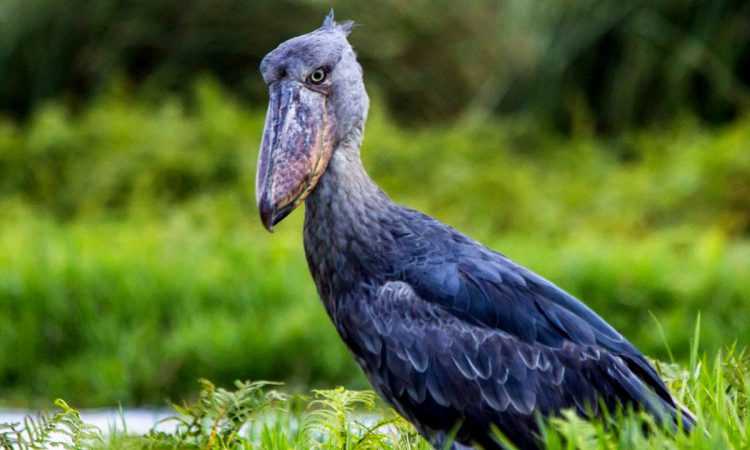
Mabamba Swamp: This is the place to see the shoebill stork. Tours run about half a day from the Nakiwogo docking point in Entebbe. The wetland is a Ramsar site on the northern banks of Lake Victoria with over 300 bird species, including the papyrus gonolek, white-winged warbler, yellow-billed duck, great blue turaco, hadada ibis, cattle egret, and brown parrot.
Queen Elizabeth National Park: Home to over 500 bird species, including crowned cranes, kori bustards, egrets, and Rwenzori turacos, spotted along the park's game tracks and at Kyambura Gorge. A boat cruise on Kazinga Channel adds a range of aquatic birds. Other activities here include chimpanzee trekking, game drives, nature walks, experiential lion tracking, and cultural encounters.
Murchison Falls National Park: Uganda's largest and oldest national park holds over 350 bird species, with Budongo Forest nearby adding further concentration. Expect guinea fowl, grey crowned cranes, eagles, Egyptian geese, lovebirds, and more.
Other birding destinations in Uganda: Mabira Forest, Lake Mburo National Park, Kidepo Valley National Park, Mount Elgon National Park, Lutembe Bay on Lake Victoria, Entebbe Botanical Gardens, Echuya Forest Reserve (over 150 bird species), and the Rwenzori ranges.
Inquire NowTop Birding Destinations in Rwanda
Nyungwe National Park: One of the oldest and largest montane rainforests in Africa, covering over 970 sq. km, with over 330 bird species, about 29 of them endemic to the Albertine Rift. Notable species include the blue-headed sunbird, Rwenzori nightjar, red-collared babbler, purple-breasted sunbird, handsome francolin, Kungwe apalis, and Shelley's crimson-wing.
Volcanoes National Park: Rwanda's most visited safari destination, home to over 170 bird species including waxbills, weaver birds, sunbirds, Rwenzori double-collared sunbird, Rwenzori turaco, dusky turtle dove, scarlet sunbird, red-faced woodland warbler, brown woodland warbler, African long-eared owl, archer's robin-chat, and handsome francolin. Birding here runs year-round, with June to August and January to March as the best seasons.
Akagera National Park: Rwanda's only savannah park, with wetlands, swamps, hills, and woodland supporting over 490 bird species. Look for red-faced barbets, grey-crowned cranes, white-winged warbler, papyrus gonolek, shoebill stork, and northern brown-throated weaver. A boat cruise on Lake Ihema adds species such as the African finfoot. Combine a full day of birding with a game drive or boat cruise.
Other birding destinations in Rwanda: Kigali city, the shores of Lake Kivu, Akanyaru wetlands, and Gishwati-Mukura National Park.
Inquire Now
Bird Species to Look Out For
Shoebill stork: Known for its shoe-shaped bill, this is one of the most sought-after birds in the world. Adults are blue-grey and young birds are brown. Found solitary in specific swamps and marshy areas, including Mabamba Bay Wetland, the Semuliki area, and Murchison Falls National Park.
Great blue turaco: A large land bird that flies only short distances, often preyed on by larger predators. Found mainly in Kibale Forest and Bigodi Wetland Sanctuary.
Shelley's crimson-wing: Rare and distinctive. Females have olive heads and a red mantle, while males show red across the face, back, and crown.
Short-tailed warbler: Also called Neumann's warbler, a small bird with a short tail and a striped back, worth watching closely.
African green broadbill: One of the rarest species globally, also called Grauer's broadbill, found within tropical forest cover.
Other notable species include the black-breasted barbet, bar-tailed trogon, Doherty's bushshrike, green-breasted pitta, and the standard-winged nightjar.
Inquire NowBirding Tips: What to Look Out For
Bird movements: Birds live in areas of dense vegetation and tend to move away or take flight as you approach. Watch too for ground-dwelling species such as the ostrich, the largest and fastest land bird, which spends most of its time on the ground.
Shape and size: Learning the general shape and size of different birds helps with identification, from small species like the sparrow to large raptors. Bill shape and color are useful too. Kingfishers, for example, can be told apart by their black and red bills.
Habitats: Where a bird lives narrows down what it is. A shoebill stork will not be found on dry land but in specific swamps, while a woodpecker sticks to wooded areas. Research where your target species live before booking your trip.
Inquire NowSounds: Experienced birders identify species by call alone. Learning a bird's voice ahead of your trip makes the experience easier and more rewarding.
Plumage: Males and females often differ in color, and some females display brighter colors as breeding season approaches, known as an eclipse of plumage.
Habits and legs: Behavior and leg shape both carry meaning. The black heron, for instance, uses its wings as a shroud to clear obstacles from water while feeding. Strong, long legs generally indicate a terrestrial bird, as seen in eagles.
Birding is usually paired with hiking or a canoe ride through the swamps, mountains, or forests where birds shelter, guided by experts who know the trails and the birds. Outings typically run 1 to 5 hours, starting early morning or in the evening, with cameras and binoculars in hand.
Inquire NowBest Time for Bird Watching in Uganda & Rwanda
Birding can be done year-round, but timing your trip around migration and breeding seasons improves your chances of spotting seasonal species alongside the endemics. Book your birding tour in May, June, July, November, or January to April for the best migration activity.
Birding is best done early morning or at sunset, when birds are most active after waking hungry from the night. Avoid midday to 4pm, when most birds are hidden away or feeding their young in the heat.
Choose months with less rain where possible. Too much rain makes trails muddy and hard to trek, while too much sun can push birds into hiding.
Inquire NowWhat to Bring for a Birding Safari
Pack the following for a comfortable birding trip in Uganda and Rwanda:
- Professional camera for photography
- Backpack for daily essentials
- Rain jacket for sudden rain or cold
- Binoculars for distant birds
- Waterproof hiking boots for steep trails
- Warm clothing for cooler forest and mountain areas
- Field birding guidebook
- Safari clothing: long trousers, hat or cap
- Sunglasses
- Insect repellent
- Waterproof, sturdy shoes
Inquire NowCost of Birding in Uganda & Rwanda
Birding costs vary depending on trip duration, accommodation, travel dates, and destinations visited. As a rough guide, a budget of around covers at least two birding destinations in Uganda, including accommodation, entrance fees, guide fees, transport, and meals.
Inquire NowRecommended Birding Books
Learn more about the bird species of Uganda and Rwanda through these recommended reads:
- The Birds of East Africa by Terry Stevenson and John Fanshawe
- National Geographic Field Guide by Jon L. Dunn
- The Genius of Birds by Jennifer Ackerman
- Birding Without Borders by Noah Strycker
- A Pocket Guide to Pigeon Watching by Rosemary Mosco
- Collins Bird Guide by Dan Zetterström, Killian Mullarney, and Lars Svensson
- Be a Birder by Hamza Yassin
- Backyard Birds by Jonathan P. Latimer and Karen Nolting
- Kingbird Highway by Kenn Kaufman
Uganda holds over 1,060 bird species and Rwanda over 800. Book your birding safari with a registered tour operator for experienced guides and a well-planned route between the two countries' top destinations.
Inquire Now