
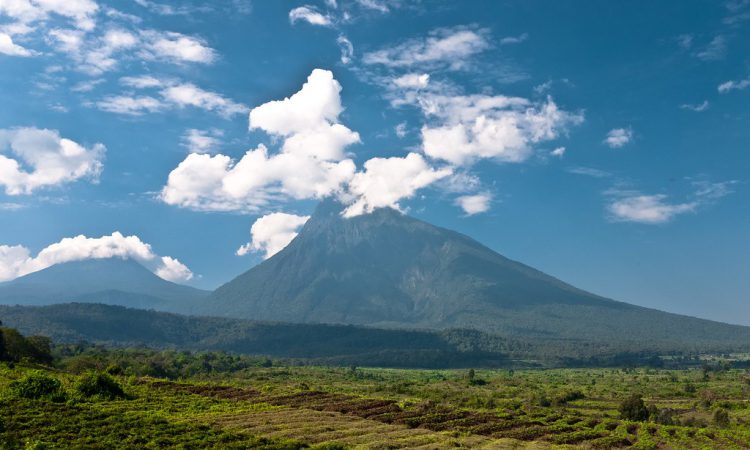
Nyamuragira is one of the active shield volcanoes in the Virunga ranges in eastern Democratic Republic of Congo. The mountain is one of the most active volcanic mountains in Africa. It is also known as Nyamuragira. It is one of the oldest parks in Congo and the second active mountain among the 8 that makeup the Virunga massif. Mountain Nyiragongo is the other active mountain and the rest are all dormant.
The other volcanoes are Mount Gahinga, Mount Sabyinyo, Mount Muhabura, Mount Mikeno and Mount Karisimbi.
HISTORY AND LOCATION OF THE MOUNTAIN.
The mountain derives its name from the Bantu Kinyarwanda verb “Kuragira inka” which means herding cows.
The mountain is about 25 kilometers west of Lake Kivu and 14 kilometers north east of one of the world’s active volcano known as Mountain Nyiragongo.
The mountain has so far erupted at least 40 times since 1885 and the recent eruption was about 12 years ago in November of 2011. Mountain Nyamuragira eruptions have always caused large amounts of Sulphur dioxide which in turn negatively and consequently affect the neighborhood. Small volcanoes are often created after it’s eruption but later on disappear after some time.
Nyamuragira is approximately 3,058 meters high with a caldera that is 2 kilometers wide and its walls at 500 meters high. It also has extensive lava flows at 1500 kilometers squared in the East African rifts. The Mountain also has a volume of 500 cubic km. Much of the mountain’s eruptions do not have lava flows that are destructive to the humans.
Interestingly enough, the mountain is one of the few volcanoes that have kept the lava lakes for years and the formation of the most recent one was in June to August of 2014 with a depth of 500 meters and still continues to grow with hope of forming more lava flows in future.
WHEN TO VISIT THE MOUNTAIN.
To avoid disruptions by rains and muddy trails, dry seasons are always a good option to visit Nyamuragira. One can also easily see clear views of the crater during this season. Drier seasons are normally from the months of June until September or December until February.
WHERE TO STAY?
Tchegera Island tented camp and Kibumba tented camps will give a better stay for one or two nights with favorable weather conditions and great views. A variety of accommodation facilities at the Virunga National Park can also be used for example Bukima tented camp, Mikeno lodge and other peculiar accommodations.
HIKING THE NYAMURAGIRA MOUNTAIN.
The eruptions of the mountain have attracted many hikers all over the world. The hiking experience at Mount Nyamuragira is just extraordinary. It gives hikers an opportunity to even encounter some of the animals like mountain gorillas of Virunga National Park. Hikers also spot park mammals, birds and primates.
First things first, hikers are briefed and guided before the hiking takes place. This is done by the professional tour guides and hikers are given information about the mountain first hand. The Mountain hiking normally starts in the morning when the travelers are done with their breakfast and drive to the hiking offices for tickets and a briefing about the volcano.
Thick vegetation cover, steep slopes and bumpy trails all require one to be at their best health and hikers with luggage are always advised to carry sticks for balance and support. The hiking activity at the mountain takes about 5 to 6 hours and the best hiking trails are led by the armed rangers for safety.
After reaching the summit, one will have great views of the lava lake and surrounding areas including the famous Mountain Rwenzori, Lake Kivu, Virunga National Park and Virunga Ranges.
HIKING PERMITS AND COSTS.
Hikers can get the hiking permits for Mountain Nyamuragira at $300 per head either from Virunga National Park offices or a trusted local tour operator. Hiking permits are the ones that allow you to participate in the hiking activity on this volcano. They can even be bought on the day of trekking for earlier preparations.
WHEN TO HIKE MOUNT. NYAMURAGIRA.
Drier seasons can always be a better option even though hiking can be done all year round. December to February and between June and September remains the best time for hiking simply because the trails are less muddy, not slippery at all and vegetation is short which ease the clear views of the park mammals, insects and primates. Besides this is when the roads are more accessible.
Huge discounts on accommodation are always offered in wet seasons so hikers who are tolerant of the cold can still hike Nyamuragira in the rainy seasons of October to November and March to May. However, during this season the trails are muddy and slippery, vegetation is tall, the summit snowcapped with unclear views and the roads in Virunga National Park are almost impassable.


