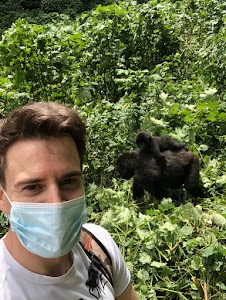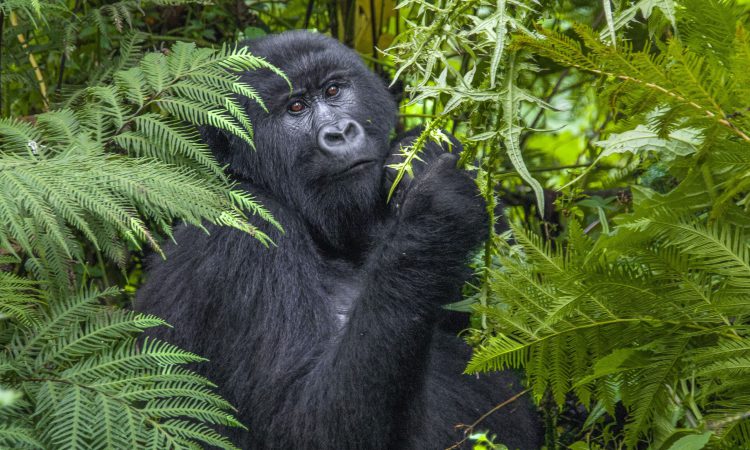
The most popular safari experience in Uganda is undoubtedly gorilla trekking and the country has for long carried pride as one of the few remaining hosts of endangered mountain gorillas in the entire world. There are only three countries globally that shelter the only remaining surviving gorillas(about 1,063) in their natural habitats and these include Rwanda, Uganda and the Democratic Republic of Congo.
All three host the famous Virunga region dominated by thick dense forests and popular volcanoes that act as shelter for the great apes. Among all the three, Uganda is the largest host of mountain gorillas sheltering almost half of a thousand remaining mountain gorillas in the wild. Gorilla trekking in Congo can be done in Virunga National Park while in Rwanda the popular lifetime activity can be done in Volcanoes National Park.
There are only two gorilla trekking destinations in Uganda and these include Bwindi Impenetrable and Mgahinga national parks. A gorilla trekking in Uganda is once a lifetime activity and the whole experience is worth every penny.
GORILLA TREKKING IN MGAHINGA AND BWINDI IMPENETRABLE FOREST NATIONAL PARK.
Mgahinga National Park is the second most popular gorilla trekking destination in Uganda after the vast Bwindi impenetrable forest National Park. Mgahinga is the smallest national park in the country yet one of the most visited tourism destinations in Uganda.
There is only one habituated gorilla family that can be tracked in Mgahinga National Park and is popularly known as “Nyakagezi Group ”. Gorilla trekking in Mgahinga starts with a briefing before visitors can dive into this lifetime experience that also gives trekkers another unique opportunity to see other wildlife species in the park. There are only 9 gorilla individuals in the Nyakagezi family led by their dominant Silverback known as Mark.
Bwindi Impenetrable Forest National Park is the largest host of the remaining mountain gorillas in the wild. There are only approximately a thousand mountain gorillas remaining in the wild and Bwindi shelters almost half of them. This has made this spot a popular gorilla trekking destination that attracts a large number of both local and international visitors from all parts of the world hence largely contributing to the tourism sector of the country.
Bwindi receives a great number of tourists annually and gorilla trekking is the first on their bucket lists. There are over 21 fully habituated gorilla families in Bwindi living in each of the four popular gorilla sectors scattered in different parts of the park and they include Ruhija, Buhoma, Rushaga and Nkuringo.
Buhoma gorilla sector is the most visited and popular gorilla sector and shelters gorilla families like Mubare, Katwe, Habinyanja, and so much more.
Gorilla trekking in both of Uganda’s gorilla trekking destinations can take about 30 minutes to 7 hours especially in Bwindi since gorillas tend to move deeper into the thick forests in search of food.
Each group of trekkers is made of eight members only and each group is allocated to track one particular gorilla family which can only spend one full hour with the endangered mountain gorillas.
HOW BEST IS IT TO TREK GORILLAS DURING SUMMER TIME (JUNE JULY AUGUST AND SEPTEMBER)?
Trekking gorillas during the summertime of months like June, July, August and September is the right timing for this lifetime experience and gives the best remarkable adventure. The summertime is the first and last long dry season in the country and it runs from December to February.
Unlike the unfavorable wet season, during the summer time gorilla trekking is made easy and time-saving as most of the tracking routes are accessible, dry and not muddy at all making hiking easier. The most scenic views are a must to watch due to the reduced vegetation.
WHEN TO BOOK A SUMMER TIME GORILLA TREKKING PERMIT AND OTHER BEST MONTHS FOR GORILLA TREKKING IN UGANDA.
Visitors are advised to book their summertime gorilla trekking permits in advance such as six or one year ahead for early preparations. Other best months for gorilla trekking include December, January and February.