
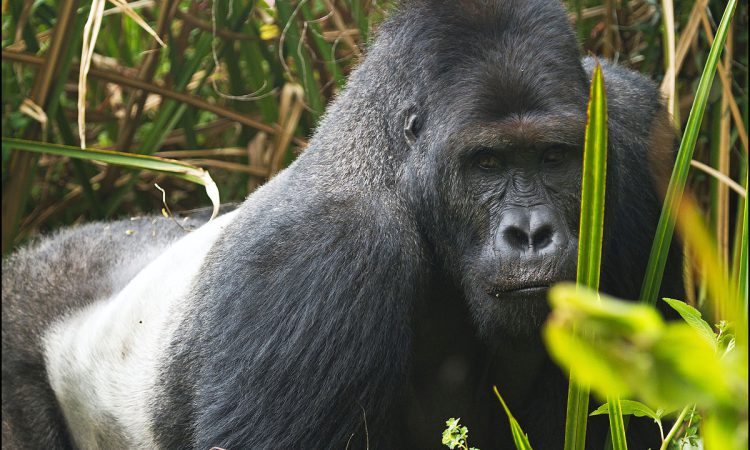
Eastern and Western gorillas.
Eastern lowland gorillas also known as Grauer’s gorillas, are the biggest of the four subspecies distinguished from others by their short muzzle, large hands, and stocky body.
They have a large hominid with a large head, long arms, and a broad chest. The fur is mainly black but adult males have a silvery saddle at their backs.
This kind of gorilla sub-species is only found in the rainforests of the Democratic Republic of Congo.
These eastern gorillas are over 4,000 and are all endangered. They face the threat of habitat destruction and poaching while receiving adequate attention and awareness of conservation and implementing actions.
Eastern gorillas are the largest species on the planet and are capable of feeling complex emotions and learning sign language. These primates weigh about 440 pounds for the females and the males weigh 600 pounds which makes them the largest primates.
Compared to other gorillas, these subspecies have a considerably flatter muzzle, squatter, and larger hands with bald faces and strong muscular bodies.
They are considered to be frugivores which means their diet is almost composed and dominated by fruits, leaves, and seeds.
They can also eat large quantities of bamboo shoots with a few insects like termites and small lizards. These gorillas are highly social animals that stay in groups called troops or bands comprised of about 30 members.
The troops or bands are led by a dominant silverback male who is responsible for protecting his members against any external and internal threat.
Eastern lowland gorillas have a unique communication channel in which they communicate when they are angry like grunting, roaring, hooting, stamping foot on the ground, and beating the chest.
They have a slow reproduction rate whereby females give birth to single infants after the gestation period of 8 months, these infants depend on their mothers for several years and stay within their family group as they grow.
Western lowland gorillas.
The western lowland gorilla is one of the two critically endangered subspecies of the western gorilla that lives in primary forests, montane, and lowland swampland in central Africa that is Angola.
The critically endangered western lowland gorillas have few threats from the wild and other leopards and crocodiles but the main threat continues to be humans who do poaching and lead to habitat loss.
They are distinguished from others by their small size, brown grey coats, and auburn chests.
Male gorillas weigh between 300 to 400 pounds and female gorillas weigh half of that.
They are found in dense forests of central West Africa in countries like Nigeria, Congo, Angola, and Cameroon.
They stay in groups known as bands or troops consisting of one male silverback who is the leader, females, and infants. The male silverback is responsible for maintaining peace and order as well as protecting its members.
Western lowland gorillas are herbivorous and depend on stems, leaves fruits, and small insects.
They give birth to a single infant after a gestation period of 9 months, the infants are found to depend on their mothers for survival until they grow up.
They have a unique mode of communication through hooting, grunting, chest-beating, and stumping feet on the ground. They usually do this to express their anger in case they sense some kind of external or internal threat.
They are endangered and conserved because of many factors like poaching, habitat loss, and attacks of different diseases like Ebola all of which affect their population.
Western lowland gorillas are a merit contribution to the ecosystems and play a big role in seed dispersal and forest regeneration.
Gorilla Behaviors.
A gorilla is a large, powerful and intelligent primate known for its close genetic relationship to humans sharing almost 90% of DNA.
Gorilla behaviors are complex and fascinating which displays their intelligence.
Gorillas live in groups called troops or bands led by a male silverback who is the largest and strongest among others. these troops vary in size and consist of different members like females, juveniles, and infants.
Gorillas have a unique and rare mode of communication through which they express their emotions. These include body language and facial expression by chest beating, grunting, and roaring.
These channels are signs of danger, maintaining social bonds, and establishing dominance.
The male-dominant silverback is responsible for protecting the members of the family group against any threats as well as keeping and maintaining peace and order.
They are herbivorous feeding on stems, leaves, fruits, and shoots. They are found to spend the whole day feeding on these items.
Gorillas engage and participate in different social plays and interactions which help to build a strong bond as well as develop different skills amongst them. They participate by playing, chasing, and mock battles.
During the day, they build new nests to sleep during day rests and night rests. These nests are built using leaves and tree branches daily.
Gorillas have been found to confront each other on matters concerning family group inheritance.
They use tools like sticks or tree branches to help them in foraging as part of their daily plays.
Gorillas’ behaviours are marked by complex and social dynamics to build strong family bonds and adaptability to their forested habitats. When you get to understand their behaviours, helps you to easily interact with them in their natural habitats.
Gorilla lifestyle.
Gorillas are active during the day as they feed, rest and socially interact with other members.
Gorillas stay in nests which are built every single evening.
Gorilla threats are poaching, habitat loss due to deforestation and attacks of diseases and pandemics like Ebola.
Gorillas are found staying in groups comprised of several members like females, juveniles and infants all headed by a silverback whose role is to protect its members against any threat.
Where do gorillas stay?
Mountain gorillas are divided into different subspecies and each of these have different habitats.
Eastern gorillas stay in montane forests in the volcanic mountains found in East Africa. Such destinations are the Virunga mountains bordering Rwanda, Uganda, and Congo and the Bwindi impenetrable national park in Uganda.
Eastern lowland gorillas stay in the lowland montane forests of eastern Congo.
Western lowland gorillas stay in swamps, dense forests, and lowland rainforests in central and west Africa. Such destinations include Congo, Cameroon, Nigeria, and Angola.
Cross river gorillas also known as western gorillas can be found in countries like Nigeria, Cameroon, and the cross-river region.


