
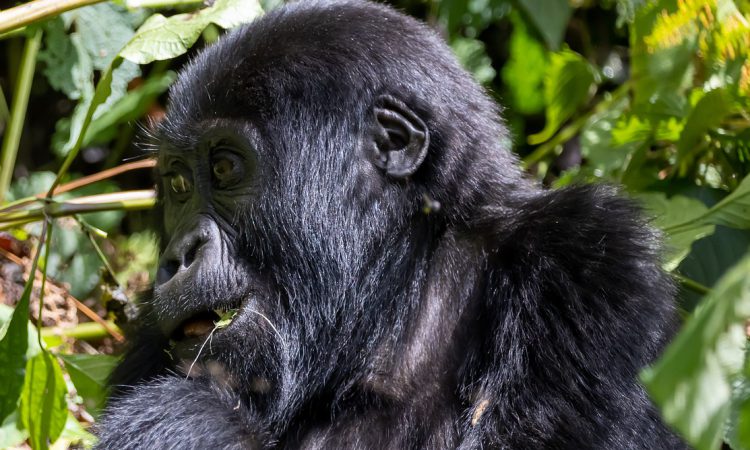
Gorilla trekking safaris in either Bwindi Impenetrable or Mgahinga Gorilla National Parks are possible throughout the year, including the month of November. The chances and quantity of rainfall increase and peak in November compared to the drier months. Both Bwindi and Mgahinga receive around 157-162 millimeters of rain in November. The weather is relative humidity in both parks is also relatively higher, at around 82%, which is considered very humid but cool.
The relatively heavier rains in November affect gorilla trekking adventures since this causes the forest trails to become mud-covered and slippery. Such trails are relatively challenging to traverse hence requiring extra caution and physical fitness. Despite these challenges, November offers unique opportunities for those daring physically demanding adventures in the jungles of Bwindi and Mgahinga. Gorilla trekking safaris in November require that you carry waterproof clothing, a raincoat or poncho, and rain boots to be successful.
Location of gorilla trekking safaris in Uganda
Bwindi Impenetrable National Park in Kanungu district, southwestern Uganda covers a total land area of 331 square kilometers. Bwindi is situated close to the border with the Democratic Republic of Congo. Bwindi Impenetrable National Park is about 501.3 kilometers southwest of Kampala, and about 164.4 kilometers north of Kigali, the capital city of Rwanda. With an altitude ranging from 1,160 to 2,607 meters above sea level, Bwindi is covered with dense and ancient rainforests. Bwindi is home to over 459 mountain gorillas with over 50 gorilla families and of these 24 are habituated.
Mgahinga Gorilla National Park, in Kisoro, southwestern Uganda is situated close to the borders of Rwanda and the Democratic Republic of the Congo. Mgahinga Gorilla National Park covers 33.7 square kilometers and is part of the larger Virunga Massif. This is a chain of Volcanic mountains located in the border region of Uganda, Rwanda, and the Democratic Republic of the Congo. Mgahinga is the home of several iconic peaks Mount Muhabura, Mount Gahinga, and Mount Sabinyo. Mgahinga sits at an altitude of about 2,227-4,127 meters above sea level. Mgahinga Gorilla National Park is approximately 496.7 kilometers southwest of Kampala and 135.3 kilometers north of Kigali. It has only 1 habituated gorilla family.
Vegetation at Bwindi and Mgahinga National Parks in November
Since November is a wet season, Bwindi and Mgahinga are covered by denser vegetation cover compared to the dry seasons. This provides cover and more food sources for the residents, including the mountain gorilla, chimpanzee, L’Hoest’s monkey, golden monkey, elephant, buffalo, and others. During this month, both parks have mixed ecosystems ranging from montane and lowland rainforests to bamboo forests and grasslands. The tree species comprise Newtonia, pine, mahogany, and star apple among many others. Such vegetation is a source of fruits, leaves, buds, and stems for the mountain gorillas to feed.
The dense vegetation during November makes the gorilla trekking safari more thrilling amidst the heavy undergrowth while hiking along the trails. This enhances the mystery of whether you will encounter the gorillas because they are mostly out of sight for people on gorilla trekking safaris. However, because trekkers are accompanied by experienced trackers, you will have the confidence to encounter the gorilla family.
Temperature conditions at Bwindi and Mgahinga National Parks in November
During the month of November, Bwindi Impenetrable National Park and Mgahinga Gorilla National Park experience relatively lower temperature conditions, with average highs at around 23oC (73oF), and lows of around 11oC (52oF). These temperatures vary depending on the altitude and specific location.
The relatively low temperatures in November affect gorilla behavior at both Bwindi and Mgahinga, by creating chilly conditions. Since mountain gorillas are adapted to these climatic conditions, they usually seek shelter in dense vegetation or congregate together for warmth. This may also reduce their foraging or movement, hence relatively difficult to locate if you are on gorilla trekking safaris.
The cool temperatures in the month of November can be quite comfortable for gorilla trekking safaris. This ensures the overall pleasantness of the experience, by allowing visitors to fully immerse themselves in the stunning biodiversity of the parks without being significantly affected by extreme heat and cold.
How gorilla trekking safaris are done in Bwindi and Mgahinga Parks
Gorilla trekking safaris in both Bwindi and Mgahinga are expected to start by 8 am, so you must be at the park headquarters at around 7: 30 am. You will gather at the designated briefing site, where knowledgeable park guides will brief you about the proper code of conduct for the gorilla trek including the necessary cautions and rules and regulations.
Afterward, the trekkers will be divided into groups of 8 individuals, each of these groups will be accompanied by a ranger guide and a well-trained armed guard to follow specific trails in the jungles. Along the trails, the group will seek an indicated habituated gorilla family. Meanwhile, they can spot a variety of beautiful insects and plant species.
The duration of the hike may vary from at least 2 hours to even a full day of trekking. This however depends on the location of the gorilla family in question, as well as your fitness level. Once the gorilla family is encountered, you are allowed to spend at most an hour in their presence. Overexposure could cause stress and disturbance. After the adventure, you will be awarded a certificate indicating your successful gorilla trekking.


