
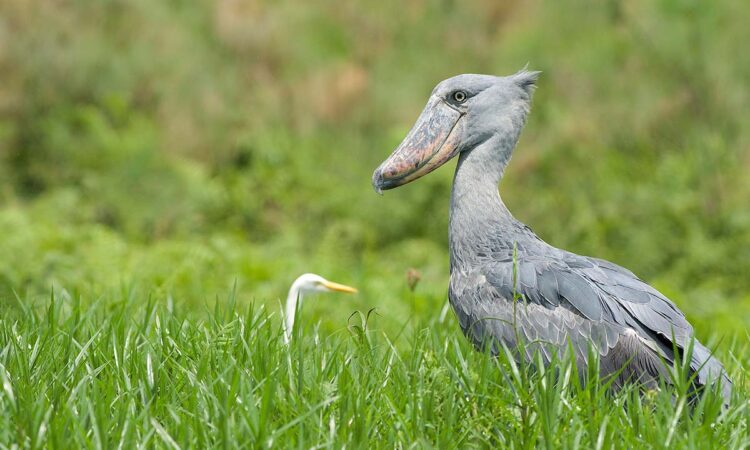
Mabamba swamp in the central part of Uganda is situated right on the northern shores of Lake Victoria. Mabamba wetland is home to the elusive shoebill stork. Mabamba wetland spans approximately 24 square kilometers. It is an Important Bird Area, also housing the threatened papyrus yellow warbler and the endangered blue swallow. Mabamba wetland was designated a Ramsar site in 2006.
Fauna and Flora in Mabamba wetland
There are about 200,000 birds in Mabamba wetland either residents or migratory. The number of bird species calling Mabamba home totals up to around 300. The species include the papyrus gonolek, long-crested eagle, yellow-throated greenbul, long-toed lapwing, African marsh harrier, black-headed gonolek, northern brown-throated weaver, fan-tailed widowbird, slender-billed weaver, yellow-backed weaver, fork-tailed drongo, gull-billed tern, grassland pipit, striped kingfisher, pied kingfisher, yellow-billed duck, African jacana, little egret, goliath heron, white wing black tern and little bee-eater.
Other fauna species found in the Mabamba swamp include singidia tilapia, Nile perch, mudfish, frogs, butterflies, snakes, and sitatunga. The vegetation composition is mainly papyrus, silver grass, reed, fern, water lilies, and sedges.
Mabamba Wetland is a permanent wetland that plays a key role in sedimentation and it is a siltation buffer where water is discharged into Lake Victoria. The Mabamba wetland ecosystem also plays a significant role. These include ecosystem and socioeconomic services. For example, the Mabamba wetland is a water resource for the surrounding communities. Mabamba wetland is a protein source, offering fish. The water can also be used for transport. The wetland is also a source of building materials like clay. Other benefits include grazing, cultivation, medicinal plants, and ecotourism.
Weather experienced in Mabamba wetland.
Mabamba wetland experiences a tropical climate, like most places in Uganda. There are 2 distinct seasons, the dry season and the wet season. The former occurs twice each year, from June to August, with June to July being the driest. There is also a dry season that occurs from late December to February. The wet season is also bimodal, running from March to May, and also from October to November. The mean annual rainfall received in Mabamba wetland is around 1320 millimeters and average atmospheric temperatures range between 11oC and 33oC.
What to see in and around Mabamba Wetland
Mabamba swamp can be explored by visitors since it has the following attractions,
Nansubuga Cultural Hill
Visitors on a tour of the Mabamba wetland can also see this significant cultural site. This belongs to an important clan of the Baganda Kingdom, the Mamba Kakoboza clan. While offering exciting views of the Mabamba wetland, the Nansubuga cultural hill offers views of the 600-year-old tombs, sacred forests, and rocks with board games.
Mabamba caves
These geological wonders are so beautiful and offer opportunities for visitors to see places that offered shelter for the earlier people. Currently, they are utilized as shelter for a number of fisher folk.
Local people and their cultures
Adjacent to the Mabamba wetland is the Baganda. These are exciting people who will offer visitors interesting perspectives of their rich history and customs. Visitors will have a good time interacting with them and observing their unique way of life. There are great opportunities to see the locals engage in fishing and peasant farming in and around the Mabamba wetland.
Shoebill
Mabamba swamp is a prime spot to see this very rare and unique species of bird. Spotting the shoebill is mainly done on a canoe and it is a guided tour. You are allowed to take as many photos as you can shoot. While watching the shoebill, there are also hundreds of bird species that you can encounter. These include the blue swallow, hamerkop, crested crane, and papyrus yellow warbler.
What to do in the Mabamba swamp
There are numerous activities you can do while on a tour of Mabamba Swamp. These include the following,
Shoebill viewing
Mabamba wetland is one of the best places where visitors can go for a birdwatching excursion. The shoebill is the most popular bird that attracts hundreds of visitors each year to this place. Come with your camera and a pair of binoculars to locate this rare bird in its natural habitat. While on a canoe locating the shoebill, other birds will be seen as well. Do not miss out on the chance to see the blue swallow, yellow-billed duck, long-toed lapwing African openbill, etc.
Fishing tour
You can also join a group of fisher folk engaged in fishing in the Mabamba wetlands to catch fish. There are a variety of fish species that you can catch while there. These include tilapia, Nile perch, and mudfish, etc. This is also a good opportunity to take pictures with your catch for future memories.
Village walk
Visitors can also explore the pristine areas around Mabamba wetland. Meet new people, learn some words in Luganda, a common language in the place, and taste the local cuisine. Take time to listen and appreciate the stories people tell you about their culture and way of life. You will also explore the different gardens, caves, and various landscapes.


