
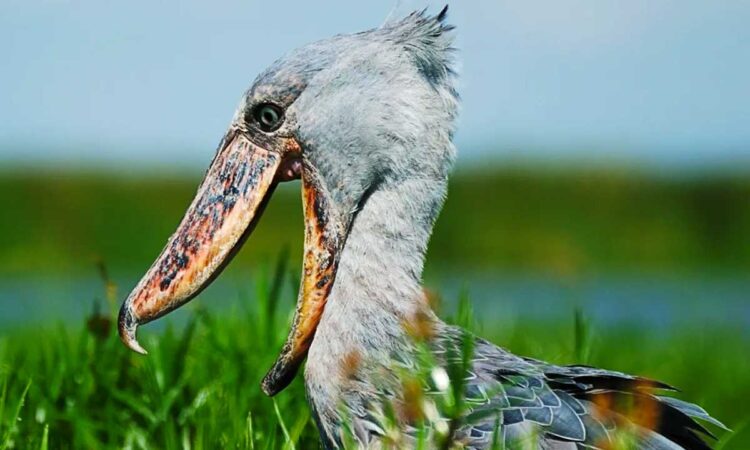
Come and visit Mabamba wetland with us and have a fascinating shoebill-watching experience. Mabamba wetland is an Important Bird Area as well as a Ramsar site that covers an approximate land area of about 24.2 square kilometers in the central part of Uganda. Mabamba wetland is very close to Kampala city at only 55 kilometers on road. The ecosystem of Mabamba wetland is dominated by marsh, that stretches through a long narrow bay with papyrus plants at the edges near Lake Victoria. Other plant species here include ferns and water lilies.
In these habitats you will watch shoebills on any day of the year, thus making Mabamba wetland the best destination to site this vulnerable bird species. The shoebill is adapted to large freshwater wetlands like Mabamba wetland with floating vegetation, which offers the shoebill an abundance of food including lungfish, catfish, snakes, tilapia, and frogs among others. While watching it you will notice that it is highly patient while waiting for its prey to show up in the waters of the wetland. This is a good time to take pictures of it from a distance without interrupting its hunting routine.
You will watch a shoebill and notice that an adult stands at a stature of between 110-140 centimeters on average and has a large shoe-shaped bill colored grey-blue. The body is covered with light bluish-grey feathers with a pair of darker grey wings. In terms of weight, adult males are around 5.6 kilograms while females weigh on average around 4.9 kilograms. The shoebill’s feet are large and have middle toes, that could reach between 16.8 to 18.5 centimeters long. They have a relatively short but thicker neck compared to several long-legged birds found in Uganda.
With broad wings, they are well adapted to soaring while their necks are drawn back. They are however relatively slower during flights with only 150 flaps per minute and rarely do long flights. Though normally silent they give out different sounds when communicating depending on the situation. For example, they do bill-clattering while on their nests. You can also hear hoarse croaks when they are getting aggressive with other big birds or enemies. They also whine in loud sounds, while can also be heard making lowing sounds, like cows.
Other activities in Mabamba Wetland
While on a shoebill watching tour in the Mabamba wetland, you might as well enjoy various activities around this pristine destination. For example, you might go for a village walk around the wetland to interact with the local people who live there. This is a perfect opportunity to learn about people’s ways of life including the languages they speak especially Luganda. You will also learn about their involvement in the conservation of Mabamba wetland. Another activity is butterfly watching, which is a golden opportunity for the visitors to look for species such as Acrae sp., and Bicyclus sp., etc.
Sport fishing is another activity that a visitor can do in the Mabamba wetland. This can be done with the fisher folk who capture fish such as lungfish, tilapia, mudfish, Nile perch, and others. Also, Mabamba wetland is home to over 260 species of birds, including other vulnerable ones like the blue swallow. You can also participate in a guided birding tour to see species like the grey crowned crane, yellow warbler, pigmy goose, lesser jacana, spur-winged goose, and Goliath heron. You can also engage in sightseeing and get views of the Nansubuga cultural hill, smallholder farms, and the Mabamba caves.
Reaching Mabamba wetland
Mabamba wetland can be accessed on both road and water transport. You can be picked up by our driver guide from either Kampala or Entebbe. From Kampala, you will take only 1-hour drive via the Entebbe Express highway. An alternative route is passing via Mpigi and Kasanje You will then get on a boat cruise on Lake Victoria to finally reach Mabamba Wetland. With Standard Safaris, your journey to and from Mabamba will be taken care of to reduce inconveniences. We have the best car hire services and driver guides to take you to and from your destination.
The best time to go for shoebill watching at Mabamba Wetland
Shoebill watching at Mabamba Wetland can be done throughout the year since such an ecosystem provides food for the birds consistently. However, the wet season is the best time to go to Mabamba wetland since this is the time the birds are breeding. The dry season is also a good period to go to Mabamba wetland for shoebill watching since the vegetation is not as dense as during the wet season. Therefore, you can see the shoebill from a longer distance. Also, shoebill watching during the dry season is uninterrupted due to a low chance of experiencing rain during the tour. The wet season normally occurs from March to May and also from October to November, while the dry season occurs from June to August and December to February.
What to travel with to Mabamba wetland for shoebill watching
Your packing list should include among others, the following highly essential things.
- A pair of binoculars
- Camera or smartphone
- Daypack
- Refillable water bottle
- Suncream
- Sunglasses
- Wide-brimmed hat
- Raincoat or poncho
- Waterproof shoes
- Lightweight clothes of long-sleeved shirt and pair of trousers
- Birding checklist


