
Overview of Volcanoes National Park
Volcanoes National Park is Rwanda’s oldest national park after it was established in 1925. It stretches for about 160 square kilometers of land mass. It is located in the northwestern region of Rwanda. Volcanoes National Park borders with the Democratic Republic of Congo’s Virunga National Park. The park is home to mountains Karisimbi, Bisoke, Gahinga, Sabyinyo, and Mahavura. These are five of the eight volcanoes of the Virunga mountain ranges that form the Virunga massif. Volcanoes National Park is part of the Virunga conservation area the only remaining natural habitat of the mountain gorillas. The mountain gorillas are considered endangered species because of this factor. As their name suggests mountain gorillas harbor the steep slopes of mountains thus the Virunga massif is their formidable habitat.
Volcanoes National Park has been at the stoplight of history after it hosted Dian Fossey a renowned primatologist and conservationist. After a civil war broke out in the Democratic Republic of Congo, the Virunga National Park also part of the conservation area harboring mountain gorillas became a hostile place to work. This forced Dr. Dian Fossey to shift her sights to Rwanda’s Volcanoes National Park on the 24th of September 1967. In the same year, she established her base in the park and named it Karisoke Research Center after the mountains Karisimbi and Bisoke that neighboured the center. She focused on improving and conserving the mountain gorillas and fighting poaching. This attracted a lot of attention leading to funding from international groups. On December 26th, 1985, Dian Fossey was killed and buried close to her research center. Visitors from across the world visit the center each year to pay their last respects to Dr. Dian Fossey.
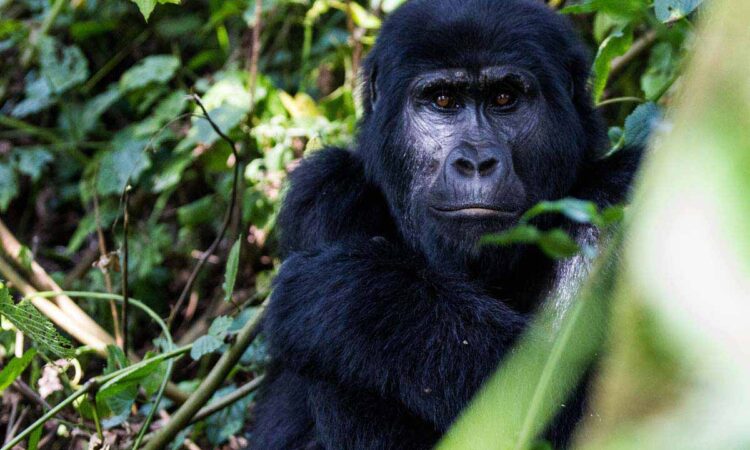
Volcanoes National Park is one of the best gorilla trekking destinations in the world. It houses over 380 individual gorillas that stay in groups known as families. Each family is headed by a silverback. There are approximately 15 mountain gorilla families in Volcanoes National Park.
Noheli gorilla family
The Noheli gorilla family is part of the 15 gorilla families in Volcanoes National Park. The story of the formation of this family is interestingly unique. This story begins with silverback Noheli who was living solitary. He was found by three females from Isimbi and Susa families who had fled their respective families on 7th November 2021. And just like that Noheli gorilla family was found with 5 members after one female had fled with an infant. The other two females after they had joined conceived and gave birth to two babies. As Noheli the silverback was enjoying his lucky start with a family, he was attacked by Matsiko another solitary silverback who took away three females as Noheli fled. Matsiko left the Igisha group in August 2019 to live alone however saw an easy target of Noheli and took it. The Noheli gorilla family has now 4 individuals including a silverback and three adult females.
Volcanoes National Park as mentioned does not house only the Noheli gorilla family but also other gorilla families including some of the following.
Igisha gorilla family
The Igisha group boasts of being the biggest mountain gorilla family in the entire Volcanoes National Park a title that was once held by the Susa gorilla family. The Igisha group is named after its dominant silverback Igisha who after being a subordinate silverback in the large Susa gorilla family decided to start his. He left his mother’s family Susa with over 23 gorilla individuals who had trust in his leadership to begin his family on the 30th of November 2014. Over the years the Igisha gorilla family has grown to 36 members ranking it the largest gorilla family in the park.
Karisimbi gorilla family
Formerly known as the Susa B gorilla family, the Karisimbi gorilla family was formed after the splitting of the Susa gorilla group in 2009. The Silverback Nyagakangaga the then subordinate of the dominant silverback of the Susa group, broke off the family with 13 members to start his. It was referred to as Susa B since it was part of the large Susa A group. However, with the settling of this family along the steep slopes of Mount Karisimbi, the Susa B group was then named the Karisimbi gorilla family during the Kwita Izina naming ceremony.


