
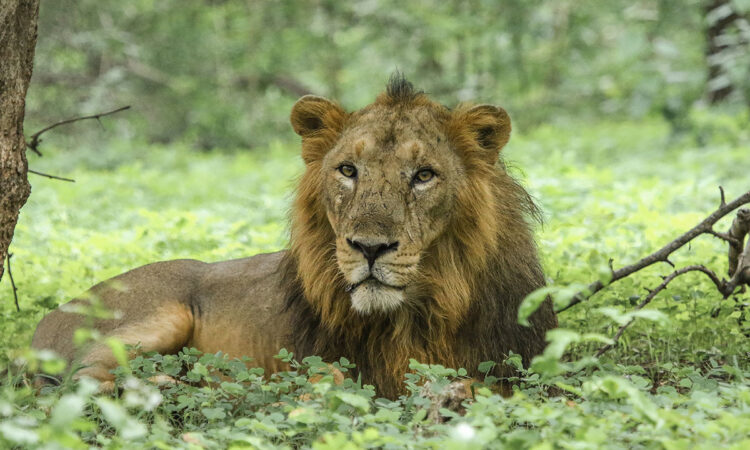
In the wild, you can find African lions in the savannah national parks of Uganda. Lions are apex predators that survive on a diet that constitutes mainly herbivores like hartebeest, Uganda kobs, impalas, zebras, giraffes, oribi, and African buffaloes, etc. They occasionally enjoy eating other carnivores/omnivores like crocodiles, cheetahs warthogs, etc.
African lions in Uganda can be seen on a delightful game drive. This involves moving on an open-roof safari car driven by a knowledgeable guide. You are driven along the game tracks to where they frequent. You are allowed to take photos of them if you finally see them. For a more immersive experience, you can opt for lion tracking in Queen Elizabeth National Park.
Lions are part of the African Big Five, others being buffaloes, elephants, rhinos, and leopards. The key destinations in Uganda where you can spot the lions on a safari include,
Queen Elizabeth National Park
Between 70 to 100 lions reside in Queen Elizabeth National Park. Queen Elizabeth National Park is situated in Kasese district, western Uganda. Queen Elizabeth National Park was established in 1952 and now occupies 1,978 km2. Queen Elizabeth National Park is the most popular in Uganda with visitors who love seeing the unique tree-climbing lions.
Habitats in Queen Elizabeth National Park are diverse and include bushland, grassland swamps, thickets, open water forests, etc. The water bodies include Lake George, and Lake Edward, both of which are connected by Kazinga Channel. Flora and fauna found in Queen Elizabeth National Park are comprised of 97 mammal species, 610 bird species, and 950 plant species.
Queen Elizabeth National Park experiences a tropical type of climate. The destination experiences warm conditions throughout the year with temperatures reaching as high as 29oC and lows of around 18oC. There are 2 rainy seasons each year, with the first experienced from March to April and the second from September to November.
The total annual rainfall received in Queen Elizabeth National Park is 1250mm. The mean annual temperatures fall between 22 to 25oC. The dry season in Queen Elizabeth National Park runs between June to August, with June and July being the driest. December to February is also a dry period, however there are some showers expected.
Murchison Falls National Park
Murchison Falls National Park has the highest population of lions in Uganda, with around 220 individuals. Murchison Falls National Park was established in 1952 after being gazetted as a game reserve in 1926. Murchison Falls National Park is in northwestern Uganda and is the largest, covering around 3,840 km2 in Buliisa, Nwoya, Masindi, and Kiryandongo districts.
Murchison Falls National Park in combination with associated reserves has 144 mammal species, 556 bird species, 51 reptile species, 51 amphibian species, and 755 plant species. These are found in a variety of habitats, including wooded savannah, grassland savannah, bush, open water, tropical forest wetland etc.
Murchison Falls National Park also experiences a tropical type of climate. With 2 rain seasons, the first runs from mid-March to mid-June and the second from August to November. 2 dry seasons are also experienced in Murchison Falls National Park. December to February is dry and hot while June and July are dry but with chances of showers expected.
Annual rainfall received in Murchison Falls National Park falls between 1100mm to 1500mm with the peak falling in October. Murchison Falls National Park experiences warm temperatures throughout the year. Temperatures range between 22 to 31oC and can fall to as low as 18oC during the night.
Kidepo Valley National Park
Kidepo Valley National Park has around 23 individual lions. Kidepo Valley National Park is found in the Kaabong district in the northeastern corner of Uganda and covers about 1,442 km2 of land. Kidepo Valley National Park is the third largest in Uganda, gazetted in 1962 after its establishment as Kidepo Valley Game Reserve in 1958.
Habitats in Kidepo Valley National Park are largely composed of dry savannah vegetation and woodland, dry montane forest, deciduous bushland and thicket, etc. Fauna and flora in Kidepo Valley National Park comprise 86 mammal species, 462 bird species, and 692 plant species, etc. There are two valley systems, Narus and Kidepo is divide Kidepo Valley National Park into two.
Kidepo Valley National Park weather patterns are characterized by semi-arid climatic conditions with frequent droughts. Unlike most parts of Uganda, Kidepo Valley National Park has a single wet season. This runs from April to early August, with the rains generally light. The annual rainfall amount recorded is around 890mm, and30oC the average annual temperatures.
The dry season in Kidepo Valley National Park is experienced between September and March. There are some chances of rainfall in March, September, October and November. From December to February there is almost no rainfall received, with Kidepo Valley National Park experiencing drier and hotter weather patterns. Temperatures can peak at around 40oC.
When to see lions in Uganda?
All the Ugandan destinations where lions reside in their natural homes are open to visitors all year round. You are therefore welcome to explore their homes and see these big cats on a safari you will never forget. However, for enhanced visibility in the savannah grasslands of the destinations, we recommend that you visit there in the dry seasons.
Dry seasons offer better visibility due to sparse vegetation that would otherwise cover the lions in their home range. This is caused by low precipitation and relatively warmer weather, which are unfavorable for the growth of most plant species. Also, the water spots are reduced thus forcing the lions to move closer to the few water sources available. Accessing them becomes quite easy.
While the dry season offers wonderful experiences to see lions in Uganda, a caveat to consider is that this is the peak season. Accommodation and transportation are in high demand and visitors are many in the destinations. Choose to visit the destinations in the wet season instead, to enjoy peaceful experiences, with accommodation and transport offered at discounted rates.
However, wet seasons cause heavy rains in Uganda’s savannah national parks. This makes the tracks muddy, hence quite challenging to drive through. The lush vegetation cover and plenty of water points make finding the lions a little harder. However, this raises the suspense levels of locating the lions thus making the safari much more fun.


