
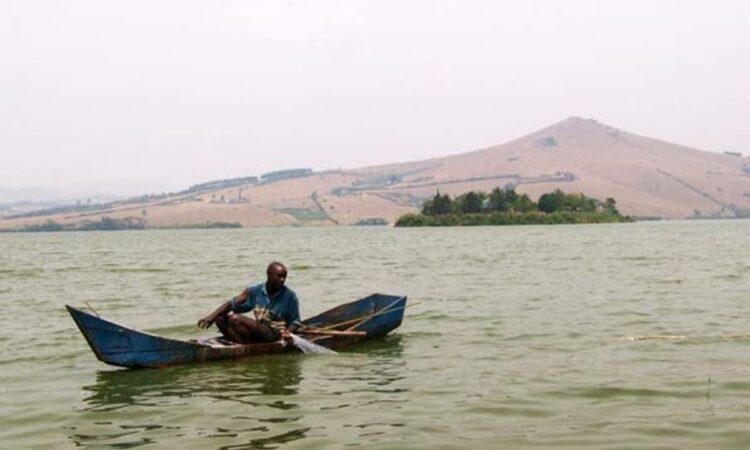
Deep in the heart of Ntungamo district, there lives a hidden gem popular to the locals for its beauty and cultural significance that has now spread to the world, this is Lake Nyabihoko. Although it is not as big as most of the other major lakes in the country, Lake Nyabihoko has shot up the charts to become a popular tourist attraction for both the locals and international visitors. Lake Nyabihoko’s rise to fame is mostly attributed to the mythical story of its formation, which often leaves everyone who listens to it in wonder and amazement. This lake has also left a huge blueprint of development in the region where it is located, because it attracts visitors who bring revenue to the region. Lake Nyabihoko may often not be talked about as much, but one thing is for sure: it is a gem worth checking out. The history of Lake Nyabihoko is believed to have led to its formation as well. This is not the usual formation history that aligns with geography and scientific findings, but rather a mythical arrangement that the locals strongly believe is true. This history of the formation of Lake Nyabihoko may conflict with the empirical studies of the scientists and geographers. The area around Lake Nyabihoko is popular for cattle rearing. A relatively large population of the people in this place is Banyankole of the Bahima cluster, who mainly rear cattle.
Formation and history of Lake Nyabihoko
The story of the formation of Lake Nyabihoko dates back some decades to a farm of a local farmer called Mutuumo. Mutuumo was a popular and respected farmer in this area who was resourceful in cattle rearing and even went further to trading cattle products like hides and ghee. Mutuumo had a strong relationship with the Bachwezi, whom he worshipped a praised. Bachwezi were believed to be gods at a time when their dynasty and rule in the areas of Mpororo in the Ankole Kingdom had ended when they disappeared. Mutuumo would often interact with the Bachwezi through worship, and in turn, the Bachwezi gifted Mutuumo a white cow called Njeru. However, this gift came with precise instructions from the Bachwezi that he could never slaughter this cow for eat. This beautiful cow, Njeru, was later to become the source of Mutuumo’s wealth as it produced many calves that formed the foundation of his farm. Njeru also had a constant supply of milk, which helped Mutuumo to multiply his wealth. Mutuumo had many friends from around his area, but also as far as Rwanda.
One day, he decided to go on a long journey to Rwanda to visit a friend and obtain a young bull to add to his herd. This was a long journey, and Mutuumo knew he had to spend some days there since the only mode of transport then was on foot. On this account, Mutuumo gave precise orders to his wife that if at all he’s away and Njeru, his beloved cow, dies, they must never eat it but rather bury it whole. After this strong emphasis, Mutuumo left for Rwanda. A few days after his departure, Njeru becomes sick and is treated but the servants, but nothing much changes. A day passes, and the unthinkable happens: Njeru dies. To the servants, this was a day to feast, but to the Mutuumo’s wife, this was a tragedy. She ordered that Njeru should be buried, but the servants talked her out of it and cowardly gave in to their wish, and Njeru was slaughtered and feasted. After this feast, it began to rain slowly and increased later. Early morning, as Mutuumo’s wife was on her usual duties of churning milk for ghee, she heard the walls of her house falling into water. She didn’t move, thinking it was nothing. Before she could know what was happening, she drowned, and that marked the end of Mutuumo’s farm and wealth.
As Mutuumo returned from Rwanda with his bull, the tragic news of what had befallen this land met him at a distance. With misbelief, he arrived at his former home and saw a large water body big enough to form a lake. He could not imagine this misfortune, and after wiping, he decided to go to his best friend Mwamba in Kakyeera, Kooki, or Rakai district. Days passed, and Mutuumo said nothing about the calamity he had faced. However, as any friend of Mwamba’s knew, something was not right. He talked to Mutuumo and agreed to go back as a witness to what was left of Mutuumo’s farm. At a glimpse of this lake, Mutuumo had decided to jump in but was stopped by Mwamba. Back to Kakyeera, they went, and Mwamba called for a huge feast, and after they had enjoyed enough. They came back to the lake and both, holding hands, left the lake and drowned.
How to get to Lake Nyabihoko?
Lake Nyabihoko is located in Ntungamo district in southwestern Uganda, approximately 372 kilometers from the capital Kampala. The recent developments in the transport system in the country have helped to ease the accessibility to the lake. By road, Lake Nyabihoko can be accessed using the Mbarara-Ntungamo highway, taking about 6-7 hours from Kampala. There is also an alternative of taking a flight from Entebbe International Airport or Kajjansi Airstrip to Nyakisharara Airfield, also known as Mbarara Airfield.


