
A guide to visiting Queen Elizabeth National Park is a detailed presentation of what the park offers, starting from its history of establishment and attractions to activities and others. This guide to visiting Queen Elizabeth National Park works best for the first applicants to visit the park and with little knowledge about it. From the beginning of time, during the park’s establishment, Queen Elizabeth National Park has stood out to be the best-protected area in the country. This guide seeks to answer even the most frequently asked questions about Queen Elizabeth National Park. However, visitors can get in touch with a tour company like Standard Safaris to find out about Queen Elizabeth National Park and how they can explore this great marvel.
Brief history
Queen Elizabeth National Park has been on prior existence for many years, even before its formal establishment as a national park in 1952. As far as the colonial era, Queen Elizabeth National Park has been a gem for the country, Uganda, but also the continent. The park plays a key and significant role in pushing Uganda on the world map to compete with some of the best tourist destinations in the world. The history of the park dates back to 1912, when shortly after the epidemic of sleeping sickness attacked the park area, and many people were evicted, thus giving room for the wildlife in the area to multiply. Fast forward to 1952, the colonial government elevated the game reserve to a national park called Kazinga. It rotated across Lake Edward and Lake George. The tales of the beauty of the park reached the queen of England, Queen Elizabeth II, who decided to visit the park in 1954. This led to the changing of the park name from Kazinga National Park to Queen Elizabeth National Park to honor the visit of the queen.
Highlights
Through the years, Queen Elizabeth National Park has been named the most famous national park in the country. This is attributed to the several tourist attractions that put it at the pedestal of most of the other protected areas in the country. Stretching along the walls of the western arm of the Rift Valley, Queen Elizabeth National Park has a total land mass area of about 1,978 square kilometers. This vast area of the park covers the districts of Rukungiri, Kamwenge, Kasese, and Rubirizi. The park’s massive landscape is a mixture of savannah grassland and woodland plains with scattered valleys. Queen Elizabeth National Park hosts a wide range of flora and fauna, with natural features like lakes and vegetation also taking refuge in the park.
What makes Queen Elizabeth National Park a popular tourist destination?
The park’s measure of popularity is measured by the number of visitors it registers every year, and below is why these visitors flock to the park every year.
Wildlife
The variety of wildlife species is the major tourist attraction in Queen Elizabeth National Park. On average, the park has over 95 mammal species that roam its vast plains and can be spotted by visitors while in the park. These wildlife species range from the famous four of the Big Five species, i.e., lions, leopards, elephants, and buffaloes, to others like hyenas, warthogs, antelopes, waterbucks, reedbucks, topis, and primates like chimpanzees, olive baboons, vervet monkeys, and colobus monkeys.
Tree-climbing lions
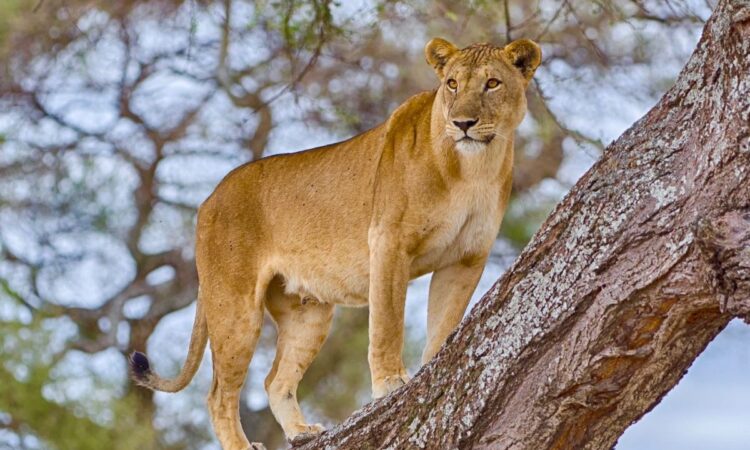
The western side of Queen Elizabeth National Park, which stretches inside Rukungiri district, called the Ishasha region, is home to a large number of tree-climbing lions. This is a treasure of the park and one of its main exports to the world. It is a rare occurrence among the lions to climb trees, but the lions of Ishasha have mastered the art of climbing with practice over many generations. Cubs have been seen learning from the older lions and practicing until they master the climbing. Queen Elizabeth National Park prides as the only park in the country with these lions, and also in the region shares this occurrence with lions of Lake Manyatta National Park in Tanzania.
Birdlife
Queen Elizabeth National Park takes the lion’s share of hosting the most bird species in the country, with over 600 birds. The birdlife in the park is increasing incredibly due to a variety of factors, like food and habitat that favor these birds. The park’s vast landscape of scattered ecological systems takes central stage for the birdlife. The bird species in the park are of two types: endemic residents and seasonal migratory birds. Some of the birds in the park include the African fin foot, African fish eagle, African skimmer, pink-backed pelican, black-headed gonolek, red-chested sunbird, papyrus gonolek, shoebill stock, long-chested eagle, Egyptian vulture, great blue turaco, grey-crown crane, white-tailed lark, and the helmeted Guinea fowl, among others.
Crater lakes
The park’s attractions surpass the fauna to also the crater lakes that dominate the areas around and inside the park. Over 40 crater lakes are scattered across this entire region, giving visitors an amazing Crater Lake exploration experience. The common one is Lake Katwe, which is located in the park and is popular for rock salt mining.
What are some of the tourist activities in Queen Elizabeth National Park?
With several attractions offered by Queen Elizabeth National Park, a variety of activities are put in place to explore these attractions, as unveiled below.
Game drives
Game viewing or drives are the park’s major export, given its variety of wildlife species that roam its landscape. Game drives help to spot various animals like lions, elephants, and buffaloes, and elephants and also explore the plains of the park safely in the comfort of a 4×4 safari vehicle.
Boat cruise
Kazinga Channel is the perfect spot for boat cruise adventures in Queen Elizabeth National Park. This boat cruise opens the aquatic life of the park to visitors as they encounter animals like Nile crocodiles and hippos, favorites of the water, and also elephants, antelopes, buffaloes, and warthogs that roam the shoreline. The Kazinga Channel, where this boat cruise takes place, is a waterway that connects Lake Edward to Lake George.
Birding
Birding extends throughout the ecological systems of Queen Elizabeth National Park by bringing visitors to some of the beautiful sites to spot these birds. A professional and experienced birding guide with incredible knowledge about almost all the 600 birds of the park graces the visitors with much insight into the birdlife of the park. Designated birding trails are well selected and followed through the birding process to spot these birds in their natural habitats.
Chimpanzee trekking
Chimpanzee trekking refers to the encounter of chimpanzees in their natural environments and spending an hour with them, observing them play, feed, and sleep. Queen Elizabeth National Park is widely known by many as a savannah wilderness, but all this is true and more, as it also has a tropical forest vegetation beneath its savannah grassland plains. The Valley of Apes, Kyambura Gorge, is located inside the park and hosts over 100 chimpanzee primates. Visitors, after a briefing session by the park rangers, head into the forest to encounter these primates on foot. This experience is quite an adventure to explore the primate side of Queen Elizabeth National Park.
How can Queen Elizabeth National Park be accessed?
The park is accessed using only two means of transport, air and road. The cheapest and commonly used means is the road. Many routes lead straight to Queen Elizabeth National Park from the capital and also from other destinations. Air transport is also available as domestic chartered flights begin from Entebbe International Airport or Kajjansi Airport, or any other destination in the country, to the different airstrips in and around the park. This improved transportation system to Queen Elizabeth National Park has made the park more accessible to visitors.
In conclusion, there is more to discover about Queen Elizabeth National Park, and getting in touch with us at Standard Safaris, we make sure you dig deep into adventure by crafting these safari experiences of the entire park.


