
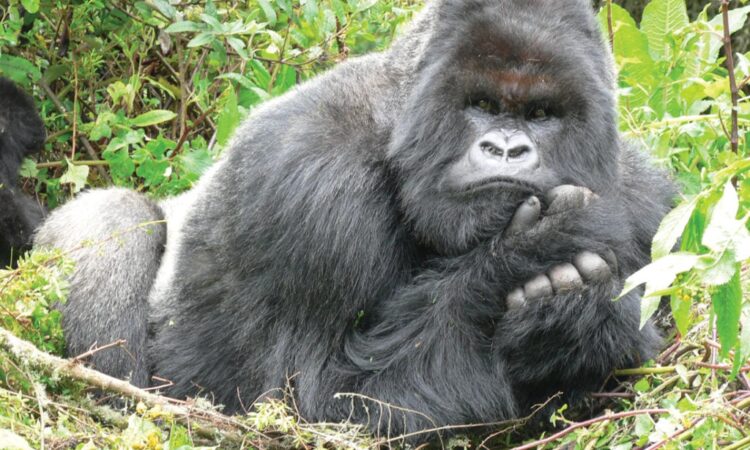
Since the year 2015, Twibuke has been the dominant silverback of the Ntambara Gorilla Group in Volcanoes National Park. The late silverback gorilla Ntambara is where the name of this group comes got. The Ntambara Gorilla Group has 14 members that mostly roam on the slopes of Mount. Bisoke. Interestingly, this is the same area where the Shinda Gorilla Group, their original family, used to forage.
It was in 2008 when the Ntambara Gorilla Group formed from the Shinda Gorilla Group. This happened after the death of Shinda, the dominant silverback. During the split, the silverback, Ugenda, went with the majority (19) of the members, while Ntambara remained with only 9. This group has since been through a lot of exciting drama. Before Twibuke even became the dominant silverback, the Ntambara group faced high-stakes threats from 2 lone silverbacks.
After the death of Ntambara, Ugutsinda succeeded him. Even without expressing clear signs of leading the Ntambara group, Twibuke became the head after the death of Ugutsinda. Twibuke was still around 17 years old at the time. Initially, his behavior patterns were quite similar to his father’s, Ntambara. But he became calmer and more assertive as his dominance status increased.
Twibuke stabilized the family to the point of maintaining strong bonds, even with a neighboring gorilla group, Umubano. This is an unusual behavior among mountain gorillas. It is difficult to encounter distinct families without a close tie in their recent bloodline, having healthy interactions among themselves. These 2 gorilla groups have not lived together before, thus making this behavior exciting to witness. Their adult females get along well, and their respective infants play together whenever they meet, etc.
The now 27-year-old Twibuke has, for the last decade, shown the capability of protecting and guiding the Ntambara Gorilla Group until recently. Twibuke’s leadership seems to be under genuine threat from a low-ranking member in the group. His younger brother, silverback Inkumbuza, is challenging his authority. At the moment, Inkumbuza is 2 decades old and has been helping Twibuke to keep the group safe and much stronger.
What has elevated Twibuke to become a serious competitor is his powerful physique. This has made him much more appealing to the adult female gorillas and the young ones. They apparently believe that this will offer them protection from external threats. Umuganda is the third silverback and younger than the mentioned 2. He sometimes entertains the younger members of the family to enhance cohesion.
Most times, Twibuke shows his dominance and leadership skills within the group. For example, there was an incident that happened involving a group headed by Segasira that interacted with the Ntambara group. After some fights, screams, and aggressive displays, Twibuke decided to move away as a strategy to protect his family. However, when Inkumbuza insisted on facing the threatening gorillas instead, Twibuke forced him away by biting him.
When to track gorillas?
You may not track the Ntambara Gorilla Group, but by chance, you might encounter Twibuke while tracking a habituated gorilla group. Volcanoes National Park is open every day except for a few hours on Umuganda Day. So apart from this day, you can travel to Volcanoes National Park for gorilla tracking tours. Among the available gorilla families offered for gorilla tracking tours are Umubano, Kwitonda, Urwego, Muhoza, Sabyinyo, Susa, Noheli, and Karisimbi.
Procedure of gorilla tracking
Only habituated gorilla families are available for tracking in Volcanoes National Park. Moreover, tracking any of them is done only once a day. Each visitor should have a gorilla permit to be eligible for tracking a habituated gorilla family. You will have to arrive at the park headquarters earlier than 8:00 a.m. to present your gorilla permit. Attend a brief meeting where you will be offered knowledge about what to do and not do while tracking gorillas.
Follow the seasoned tracker into the forest to search for the gorilla group you were assigned to track. Once the gorilla group is found, stay near them at a distance of at least 7 meters for an hour. Watch them behave naturally in their home. Take photos once allowed. You will then return to the starting point of the tour, where debriefing will be done. This is the end of the thrilling gorilla trek in Volcanoes National Park.
Traveling to track gorillas
Use either road or air to travel to Volcanoes National Park in the northwest of Rwanda. Visitors from Kigali City cover a distance of about 103.8 kilometers to the Volcanoes National Park headquarters. Driving from Kigali to Volcanoes National Park takes a duration of only 2-3 hours. Enjoying breathtaking views of the hills on the way is guaranteed. With seasoned guides and smooth-running cars, Standard Safaris shall drive you to the Volcanoes safely and comfortably.
Meanwhile, travel much faster from Kigali to Volcanoes National Park; we recommend air transport. Akagera Aviation offers helicopters for aerial transfers to Volcanoes National Park. These are chartered flights that take around half an hour from Kigali International Airport to Musanze Airport. After arriving at Musanze, you will arrive at the Volcanoes National Park headquarters by road transport. This drive is quite short, taking around 10 minutes.


