
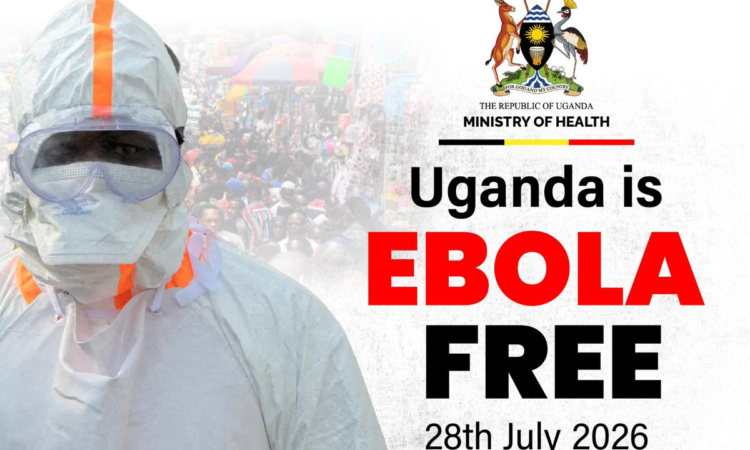
It is now official, Uganda is free of Ebola, a deadly hemorrhagic disease caused by the Bundibugyo virus. The outbreak was declared on May 15, 2026 after it was imported from northeastern Democratic Republic of Congo. According to the Ministry of Health the latest outbreak of the disease ended on Tuesday July 27, 2026. The last Ugandan citizen was discharged on June 16, 2026. Meanwhile, according to the World Health Organization, a 42-day waiting period after this is required to consider the outbreak over.
Dr. Chris Baryomunsi, the Minister of Health announced that this mandatory monitoring successfully ended. Throughout these 42 days, the ministry maintained intensive surveillance in the whole of Uganda and no new Ebola infections were detected. Therefore, it is safe to say that the outbreak has ended and Uganda is free of Ebola. The Ebola virus infected just 20 people within the country, and only 2 deaths were confirmed. It is important to know that Uganda has suffered a number of Ebola outbreaks since its first in 2000.
Though this came with heavy challenges, a lot of expertise has been gained over the past 2 and a half decades. That is why recent infections have been brought under control swiftly yet with insignificant spread among the populace. The Bundibugyo strain, is quite different from the Zaire and Sudan viruses etc. Currently, the Ebola virus has got vaccines and treatments approved globally, while that of the Bundibugyo strain is still under development.
How Ebola Virus is Transmitted?
The known natural hosts of the Ebola virus are the fruit bats that belong in the Pteropdidae family. Humans usually get infected after contact with the bodily fluids, blood, organs or secretions etc. of the infected fruit bats. However, even chimpanzees, monkeys, gorillas, porcupines and forest antelopes are also known to spread Ebola. People usually contract Ebola from them when found already ill or dead inside the forest. Infected people can now directly spread Ebola virus through the broken skin or mucous membranes of other people.
Therefore, the blood or body fluids of the sick person or one who has died of Ebola is highly infectious. Also, Ebola spreads through contact with any objects or surfaces contaminated with infected body fluids like blood, vomit or feces. During burial ceremonies where direct contact with a corpse can also promote the transmission of Ebola. The good news is that no infected person can transmit Ebola disease unless they develop symptoms. Nevertheless, they will remain infectious so long as their blood contains the virus that causes Ebola disease.
Symptoms of Ebola?
When an infection by the Ebola virus occurs, an incubation period for the onset of symptoms is 2-21 days. Symptoms are rather sudden and manifest in a variety of ways. A person is normally fatigued, with high fever, headache, sore throat, muscle pain and malaise etc. What follows include vomiting, diarrhea, abdominal pain rash and some symptoms of impaired kidney and liver functions. Majority of these symptoms are shared with other infectious diseases such as malaria, typhoid fever, meningitis, and Shigellosis etc.
Surprisingly, for patients with Ebola virus bleeding is less common at the early stages, but later in the disease. Some of the patients will experience internal and external bleeding. These can be seen in vomit, feces, from the nose, gums and vagina. There are occasions where bleeding occurs at the site of the skin where needles have punctured. Also these symptoms can also occur in a variety of diseases. So, to diagnose Ebola infection, methods to use are quite diverse. They include virus isolation by cell culture, antigen-capture detection tests, antibody-capture enzyme-linked immunosorbent assay and reverse transcriptase polymerase chain reaction assay.
How to Prevent Ebola Outbreaks?
Since treatment for the Bundibugyo strain is still in development, control of Ebola outbreak heavily relies on a few practical strategies. One is the provision of intensive supportive care for the infected. Another is to prevent or control infection as much as possible. It is also important to do surveillance tracing of contacts. For people, who have died due to Ebola related symptoms, their burials are safe and dignified. Finally, citizens or any person must be mobilized to actively participate in the fight against Ebola.
Activities to do in Uganda?
Since Uganda is free of Ebola disease, tour activities are better experienced under these normal circumstances with confidence. The country still offers all the activities travelers have loved to participate in before, during and after the outbreak. Below are some of the activities you are provided to do when you explore Uganda,
Game Drive
This offers views of Uganda’s diverse range of mammals, birds, reptiles, amphibians and others. Game drives are enjoyed in a safari car, especially the ones with open roofs. The big five and other large mammals like antelopes, warthogs, giraffes, hyenas, and baboons etc. can be observed clearly. In the savannah national parks, through the pop-up roof, get picturesque woodlands and grasslands views. For game drives visit Queen Elizabeth, Murchison Falls, and Lake Mburo National Parks etc.
Gorilla Trek
A very thorough activity offered in Bwindi and Mgahinga National Parks in the southwest of Uganda. The goal is to search for a habituated family of mountain gorillas to spend one hour watching them. Satisfaction is got from seeing how they behave in their natural environment. Just ensure to maintain a distance of at least 7 meters away from them since they a vulnerable to human diseases.
Chimpanzee Trek
A full hour is also offered to watch these dynamic apes in their natural homes after you track them. Kibale National Park in the southwest of Uganda is arguable the best destination for this adventure. But, Uganda offers a diverse range of experiences to track chimpanzees in other destinations. Travelers can enjoy this in Kyambura Gorge, Budongo Forest, Bugoma Forest and other destinations.
Golden Monkey Trek
In Mgahinga National Park, visitors track golden monkeys and see them for one hour, uninterrupted. These monkeys live in the same forest with the gorillas, therefore you can see both primates at the same time. Though Uganda is free of Ebola now, do not move less than 7 meters close to them. This is to avoid harming the golden monkeys or yourself because you might disrupt their way of life.
Others
There is still birdwatching, boat cruise, nature/forest walk and more for visitors to do in Uganda. For adventure lovers, you can climb mountains like Rwenzori, Elgon or Sabyinyo among others. You might as well choose to enjoy hardcore activities like bungee jumping, white water rafting, abseiling, and kayaking on the Nile River. Cultural experiences are also key activities to do among the Batwa, Banyakore, Karamojong, Baganda, Batooro, Bakiiga and others. Enjoy interacting with the people safely since Uganda is free of Ebola.


