
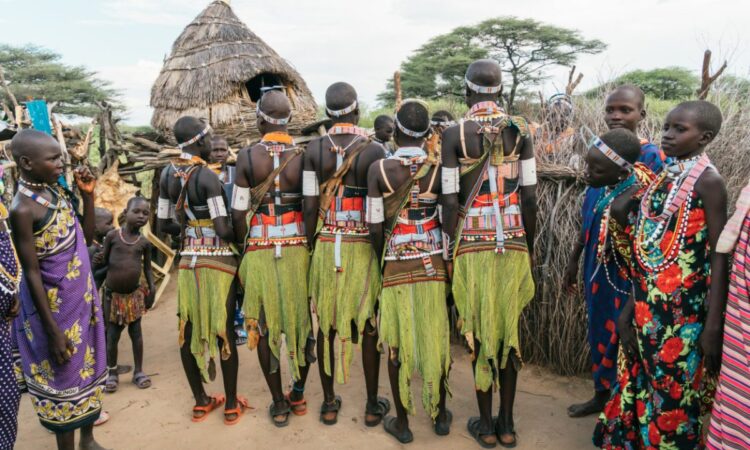
With an estimated population of 12.4 million people, South Sudan stands out as one of the least populated countries in the East African region. Given that the country has not carried out a proper national population census, it’s still challenging to tell the exact number of people who find a home in the newest country. The last census was carried out in 2008, before the country gained its independence, when the area that later turned out to be South Sudan had approximately 8.26 million citizens.
Over the years, after the country gained its independence, the population of the people living in the country has since increased as a result of various factors. These include internal conflicts, migration, childbirth, and the return of communities that were previously displaced as a result of war. In spite of these hardships, the country has continued to experience population increase ever since it gained independence.
The youth, children, and young adults dominate the population of the country, an outstanding factor that reveals rapid population increase. A bigger number of people here range between 18 and 20 years of age. Meaning the country has a massive labor force, which has paved the way for growing demand for medical facilities, education, and job creation as the young people grow to responsible citizens
Ethnic diversity
There are about 60 indigenous ethnic communities that find a home in South Sudan. Making it one of the culturally rich countries in the region. Each group comes with its own customs, languages, and traditions, as well as social organizations that have survived centuries.
The two largest ethnic groups may include;
Dinka
The Dinka tribe is also locally known as Jieng. It prides itself as the biggest ethnic group in South Sudan, and contributes to over 35–36% of the population in the country. Traditionally, this community has always survived as cattle keepers, and for many years has influenced the country’s political and military arena.
Nuer
The Nuer are without doubt the second biggest ethnic community in the country, consisting of over 15 to 16% of the population. The Nuer are renowned for their deep culture and their strong ties to cattle, tradition, and family. They are mostly found in the Greater Upper Nile region.
Other major ethnic groups in South Sudan include the Shilluk, Bari, Azande, Toposa, to mention but a few. Various smaller groups are normally found in different parts of South Sudan. This abundance gives South Sudan a wide range of cultural traditions, from diverse languages to deep traditional ceremonies and lifestyles. However, competition over resource ownership, political differences, and historical tensions have sometimes contributed to continuous conflicts between some ethnic groups.
Being rich culturally means the country is also home to many local languages, and a big number of them belong to the Nilo-Saharan language family. Juba Arabic is widely spoken in busy towns and is used as a shared language between different communities from different historical backgrounds. English remains an official language, but is mainly used in schools, government, and international communication.
Population challenges
For many years, the population of South Sudan has been encountering various hardships. There are over 2 million residents who are internally displaced in the country as of today, making it one of the world’s countries with the highest rates of internal displacement and refugee pressure. Even though the country’s population is one of the smallest on the continent, there are over 2.3 million South Sudanese taking refuge in neighboring countries, especially Kenya, Uganda, Ethiopia, and Sudan. The persistent conflict that began in 2013, mixed with economic insecurities, along with natural catastrophes like floods and droughts, and inadequate food. This has forced South Sudan to become one of Africa’s largest displacement countries.
Urbanization and Juba
Ever since South Sudan gained its independence in 2011, Juba, the capital city, which was once a small town, has quickly developed in the face of persistent hardships. Juba’s population brings together people from different areas of South Sudan, as well as other groups of people from the neighboring countries, especially those who have come for work, trade, and business activities. Many people have moved to the city in search of better employment opportunities, safer environments, and access to better services like healthcare and schools.
This rapid population growth has led to overutilization of the available infrastructure, with accommodation, roads, and medical services struggling to cater to the increased demand. Other significant towns in the country may include Wau, Malakal, and Bor. These have also encountered difficulties like other parts of South Sudan.
Years of continuous conflict have forced many families to vacate their homes and shift to safer environments, even though some locals return when the situation is a bit calmer. The movements have changed the social and economic atmosphere in the country, especially in urban areas.


