
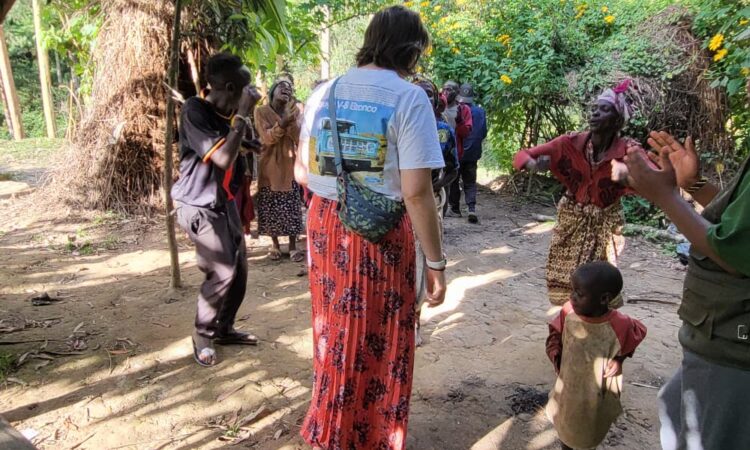
The Batwa community tours in Bwindi National Park offers some of the very best authentic experiences in Uganda. The Batwa people are the original dwellers of Bwindi Forest, until they were evicted in 1992. Although their extraordinary cultural heritage was affected by this eviction, they did not lose them entirely. As a visitor to Bwindi Impenetrable National Park, experience and appreciate their cultures in a guided tour. A local guide takes you in a village outside Bwindi Forest, with several residents composed of the Batwa.
What to do in the Batwa Community?
While in one of the Batwa community tours in Bwindi National Park, you will witness their cultures, preserved for centuries. They demonstrate this through food-preparation, language spoken, dressing and home organization etc. There are skilled men who still know how to hunt efficiently with traditional weapons like bows and arrows. These and more skills will be on display. The elders will ensure that you feel comfortable as they tell you their folktales. Meanwhile, they can show you some of the herbs they harvest to treat various ailments. There is also entertainment in the form of traditional music, dancing and playing their own musical instruments.
What is the cost of Batwa Community Tour?
In a group of 5 visitors, you will need a total of $15 to do a Batwa community tour. This price will cover the guiding throughout the tour. This will also support their livelihoods as well as any community initiative. Remember, this is not an activity organized by Uganda Wildlife Authority, so the price can change without prior review or announcement. That is why you should contact us for information before you plan for the tour. We have maintained a good working relation with the Batwa Community, thus are notified promptly in case of any changes.
How to get to Bwindi?
Any plans to get to Bwindi National Park should have only road or air transport in mind. The park is 501 kilometers away from Kampala on the Kampala-Masaka-Mbarara-Kabale route. Driving takes 10-11 hours, which seems like a long journey honestly. But, you get to pause and enjoy scenic views and enroute lunch. If you are still concerned about travel time, domestic flights are available from Entebbe to any of Kihihi or Kisoro airstrip. From the Entebbe airport, AeroLink, the operators ensure that you fly for 1 hour and 15 minutes to either airstrip. A less than 2-hour ground transportation completes your transfer to Bwindi.
When to go for Batwa Tour?
You are free to go for any Batwa community tours in Bwindi National Park on any day of the year. The experience might differ quite a bit depending on the weather conditions though. For instance, in the dry season, rains are not so frequent, so your experience is unlikely to be disrupted. Access roads to the communities are also dry and navigable because they are dry. Daily weather is also characterized by cool and dry weather to ensure that you feel comfortable as you interact with the Batwa. Dry season visits are done in the months of June to August and December to February.
Brief Information about Bwindi National Park
The 321 square kilometer Bwindi became a national park in 1991, and a UNESCO World Heritage site in 1994. Situated in southwest Uganda Bwindi Impenetrable National Park is a renowned place, especially for its 459 mountain gorillas. These make up a half of the total population of mountain gorillas in the wild. Among them, there are 23 gorilla families habituated already. With most of them available for daily gorilla treks, this is among the best places to experience gorilla trekking tours. Also, Bwindi is the best place to experience gorilla habituation, done only in the Rushaga Sector.
A part from Rushaga sector, Bwindi has 3 more gorilla sectors, namely Ruhija, Nkuringo and Buhoma. Chimpanzees are the other species of apes that live inside Bwindi. Their numbers are currently 426, with chimpanzee treks soon to be introduced. Other Bwindi primates include blue monkeys, black and white colobus monkeys, L’hoest’s monkeys, vervet monkeys, red-tailed monkeys, and pottos etc. With 357 bird species sharing the habitats with the rest of the biodiversity, birding tours are offered here. To encounter most of the forest biodiversity, you can do nature walks on trails such as Muzabajiro, Ivy, Rushura and Munyanga.


