
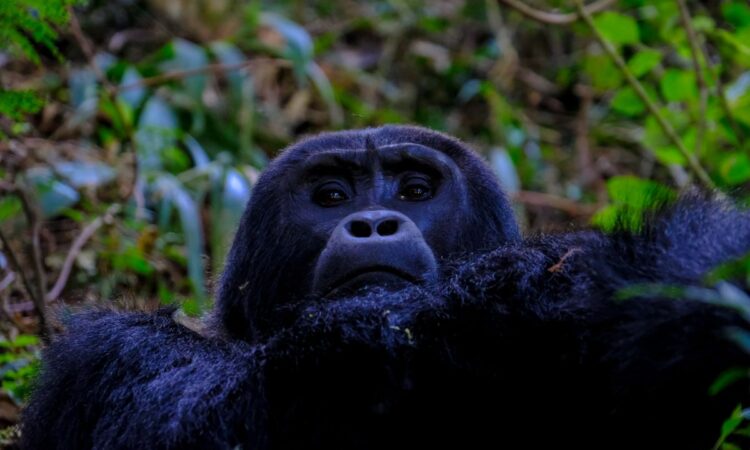
Why can’t mountain gorillas be kept in zoos? Mountain gorillas are a subspecies of eastern gorillas only adapted to mountainous regions, which zoos might not provide at all. They prefer roaming in habitats that have elevations that range from 2,000 to 4,000 meters above sea level. Their habitat comprises dense forest, rainforest, mixed forest, sub-alpine vegetation, and bamboo forest etc. Also, mountain gorillas have 98% of their DNA similar to humans. This implies that any contagious disease in a human has a significant chance of infecting the gorilla, in zoos.
Where in the Wild Can you see Mountain Gorillas?
In the wild, mountain gorillas are known to live in central-east Africa. Finding them is limited to Uganda, Rwanda and the Democratic Republic of Congo. Uganda houses mountain gorillas in 2 destinations that are close to each other. Bwindi Impenetrable National Park and Mgahinga Gorilla National Park. The national parks are in southwest Uganda. Rwanda hosts its gorilla population inside Volcanoes National Park. Mountain gorillas in the Democratic Republic of Congo are housed inside Virunga National Park.
How to see Mountain Gorillas?
The most known way of seeing gorillas is during gorilla trekking tour in the gorilla destination. All the four national parks offer this activity. During the gorilla trek you are guided to a group of habituated gorillas in the forest. A ranger guide who is very excellent when it comes to tracking mountain gorillas helps you with some armed rangers. When you finally meet the gorillas they make sure you get an hour observing and appreciating their lives. When the time is up, you return to where the activity started to be debriefed.
But, there is another activity not similar to the gorilla trek that you can participate in to see these primates. This is gorilla habituation experience, which is only done in Bwindi Impenetrable National Park. What brings the difference is you spend 4 hours with the gorillas instead the usual 1 hour. Also, you track and observe a gorilla group which is still under habituation, in fact they are semi-habituated. In addition to this, you do the activity in a team comprised of habituators, primatologists and ranger guides.
What is the Cost of seeing Gorillas?
The cost of gorilla tours is not uniform across the 3 countries. In both Bwindi and Mgahinga, gorilla trekking to foreign nonresidents is $800 per person. A much reduced fee of $700 is expected from foreign residents per person. Each visitor from the Rest of Africa can pay $500 per person while East African Community need only 300,000 Ugandan shillings. Rwanda gorilla trekking permits are available to each visitor at $1,500 for foreign nonresidents. Their citizens and visitors from within the East African Community pay only $200. Foreign residents in Rwanda and Africa need only $500 pp.
Congo has the relatively cheapest gorilla trekking permits, with foreign visitors able to trek for only $400 pp. East African Community citizens can visit Congo’s Virunga National Park for a gorilla trek with only $200 pp. Congo citizens pay only $20 per person to access the park and trek the gorillas. In the low season, however, gorilla trekking for foreigners is offered at $200 per person. This also happens in Uganda where foreign nonresidents pay $600 and foreign residents are asked to pay $500 per person.
It costs $1600 per person for foreign nonresidents to do gorilla habituation experiences in Uganda. Both foreign residents and visitors from the Rest of Africa need only $1,000 per person. Every Ugandan and visitors from all the other East African Community countries can pay only 750,000 Uganda shillings. But you will pay different rates for gorilla habituation starting on January 1st, 2027. This is when each foreign nonresident and foreign resident will pay $1,800 and $1,600 pp. Rest of Africa and East African Community citizens pay the original fees mentioned above.
What is the best time to see Mountain Gorillas?
Mountain gorillas can be seen on any day you choose, but we as Standard Safaris say you do in the dry season. The dry season always makes trekking much easier than when it is in the wet season. You enter the forest with drier gorilla trails that ensure you can walk steady, without slipping to get injuries. Even the gorillas are visible in the forest because the foliage do not grow as dense as they do in the wet season. Twice a year, dry seasons occur in the gorilla destinations, with the main one between June to mid-September. December to February offer a second dry season. Make contact with us through our website for more information about this.
What is the Conservation Status of Mountain Gorillas?
According to the IUCN Red list of endangered species, mountain gorillas have been endangered since 2018. Before that, they were critically endangered, with conservation efforts leading to an increase in number. From 680 individuals in 2008 to their current population of 1,063 in all the 3 countries. In Bwindi National Park, 459 mountain gorillas are known to reside inside the forest, contiguous with Sarambwe Nature Reserve. The rest, 604 individuals reside in the Virunga Conservation Area. This is where you find Mgahinga, Virunga and Volcanoes national parks.


