
A diverse range of tribes practice unique culture in South Sudan. You can witness them in their villages. They include the following.
Dinka cattle camps
The Dinkas have all been part of life’s rich pageant after the civil unrests that occurred in South Sudan, but their cultural virtues still prevail and form a big part of their way of living. The bygone age has seen one of the tallest individuals in the world. Just as it’s said that the things we own end up owning us, the cattle that Dinkas own are a lifeline of this unique tribe.
Trekking long distances from their permanent places to the pristine environment near the calm Nile River to prove their besotted loyalty to their cattle. The cattle camps established away from home after trailing through exciting landscapes that involves the Dinka feet getting covered with dust is side by side with over 500 cows in a herd is a fascinating saga that would make one feel the need to be lost in the same direction with the Dinkas.
The pride and joy of Dinkas lies beneath the health of their glorious curvaceous horned better half – cattle. As the golden sunrays brim out to brighten the world, Dinka men and boys stand in eagerness and unmatched readiness to embark on a hike to take their animals on grazing until the same golden rays of light fall at dawn only to release darkness of the night. While the day is for feeding, nights are family times because the Dinkas alongside with their animals have the night to themselves and always keep the blazing frames of fire with the smoke to keep mosquitoes and other insects away from all the family members.
By the end of the four months that the Dinkas venture into grazing their prestigious cattle herds away from home, the bonding and connectedness gives them more reasons to live alongside their animals and is not rated to anything else to them.
Mundari tribe
While the Dinkas equate their lives to that of their cattle, the Mundari do not see any difference between man and cow. This explains a reason as to why they don’t feed on cattle meat. The tropical pastures make it easier for most African countries to graze their cattle but the relationship between some tribes with their herds is beyond acceptable, between a farmer and their crops and animals. The relationship between dogs and humans has existed even before prehistoric eras but the relationship this tribe has with its cattle surpasses the human-pet relationship and they don’t have to worry about keeping them indoors in their sitting rooms because they are nomads and therefore prefer embarking on long treks to look after their cattle that are part of their rich history.
Mundari is the smallest ethnic group in South Sudan with a population of 70,000 -100,000 people. Staying 75Km north of Juba which happens to be within low and dry areas since it’s in the Nile valley, this tribe has to move in their East where the White Nile is situated in search for the greenery and water that can quench the thirst of their livestock. Similar to other nomadic tribes, the Mundari are ever ready to either die or kill for their animals and they are always in possession of weapons not to fight anyone but to protect their cattle.
Mundari tribe and their traditions.
One of the famous norms common to all African cultures is the transition from childhood to adulthood especially for men and each culture has a unique and interesting transition process endemic to their culture. The Mundari youth waiting for transition collectively have three months away from the community with a village elder to perform and go through initiation rituals before rendered men.
While in this isolation coccus they live side by side with nature to the extent that they don’t even have any clothes on as they might be a barrier to the wonders of environment around them. The climax of this initiation period is a cow sacrifice that confirms passage to adulthood for these individuals.
Besides cattle keeping, the Mundari are also known for fishing where they predominantly use spears and nets while catching fish. Being agro-pastoralists, Mundari grow crops ranging from simsim, groundnuts, maize and sorghum.
Mundari are one of the generous people in South Sudan and generally have no interest in engaging into wars however they are always equipped with weapons to safeguard their cattle from rustlers and other possible threats.
The cattle culture is endemic to most indigenous tribes of South Sudan, Mundari also have a deep connection with their cattle where every life occurrence has a connection to their herds, ranging from giving birth, marriage, transition from childhood to adulthood among other events that occur in their communities.
Mundari Cattle camps.
Mundari Cattle camps offer unbeatable connection between these individuals and their herds. While the men lead cows out for grazing at sun rise, women are obliged to clean and prepare food for the family. Dusk offers joy and happiness to individuals in the camp as they venture into dancing to music that is played with horn floats off their cattle.
The nights of Mundari people are as similar as the days as sleep is not part of them at night since they are obliged to keep watching over and protecting their lovely herds from the rustlers and wild animals like hyenas, wolves and jackals that also pose threats to their cattle in the dark hours of the day.
Sacrifices that leave facial artistic marks are also endemic to different individual tribes in South Africa. But, among the Mundari these are identified by the two sets of three parallel line. Each is on either side of their foreheads. There is no connection in the middle.
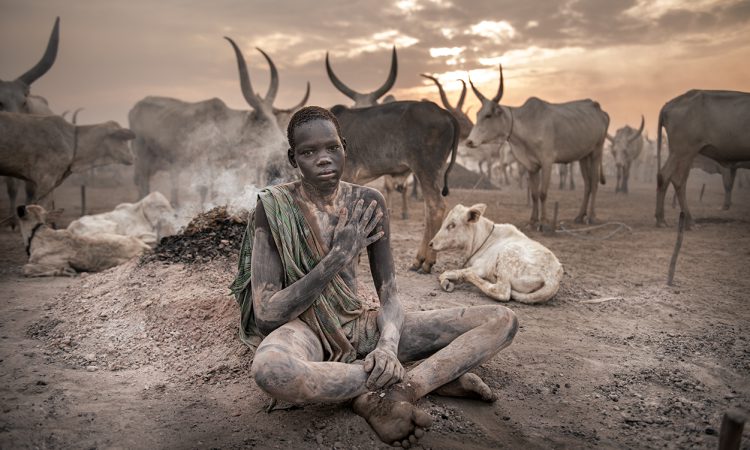
They treasure their herds to the extent that nothing from the animals goes to waste. That is why they reuse the cow dung by burning it into ash and smearing it all over their bodies. It acts as sunscreen from the blazing heat during grazing and keeping insects away from them. Tinted hair definitely looks gorgeous on the skin of a dark and bright Mundari. Their hair is washed with cow urine to change it from black coiled knots to orange.
Uniqueness of the Mundari people.
- The most valued assets that the Mundari own are the cows. They owe their lives to these herds. It reaches an extent that they neither sacrifice them for meat nor allow anything from them go to waste. This is because they entirely feed on milk, collect urine and cow dung and use it in their daily lives.
- A golden shower is endemic to the Mundari people. Any individual interested in obtaining blonde hair receives a cow-urine wash. This is always due after a fortnight. While they utilize urine into a golden wash, cow dung is burnt into ash and used as sunscreen and protection against insects for both the people and their cattle.
- Cow blowing is a practice of blowing into the vagina of a cow after giving birth to increase milk production.
- The bond between a child and mother is a process that develops over time. This is due to the connectedness that the two share. However, the Mundari mothers have only 3 months to bond with their kids. After they are taken away by their older siblings or cousins who grow them until age of 4-5. Usually mothers are permitted to just take food for their kids.
- The civil wars in this country have made guns as accessible as possible. This is responsible for equipping all the Mundari with guns. They do not use these for any warfare but for the protection of their cattle and homesteads against rustlers.
- The long magnificent curved horns of their cows are added with more beauty as they mix cow dung and urine. This mixture is smeared all over these horns to give a distinct dazzling and polished color.
Why visit the Mundari tribe?
- Technology is sweeping away most of the traditional traits of cultures. Therefore, an itinerary to Mundari will grant tourists an opportunity to interact up close with them. It is one of the tribes that have still preserved their ways of life..
- Cattle is sacred in this tribe to the extent as it serves as a currency. Settling job obligations, for marriage and others is done with cattle. Nothing from the cattle is taken as waste.
- Watching a herd of about 850 cows moving side by side and sleeping with humans is so fascinating. They have massive long horns, which makes one of the prestigious type.
- The Mundari are not as sky-piercing in terms of height as the Dinkas. But, they are relatively tall and quite muscular which all contribute to the wondrous wrestling that they speak highly of. The dark melanin of these individuals keeps the wounds they acquire in due course a secret. But, the waves sent to the surrounding can be equated to mild earthquake sounds. This is worth watching as these warriors fight to be remembered by a lion’s heart.
- There are various cultural practices that are ventured on the Mundari. Also, they are endemic to only them like scarring their faces and tinting their hair using cow urine. This is smeared all over their bodies as a sunscreen.
South Sudan as the youngest country in the world is still undergoing expansive reforms. It also still recovering and building the country as an aftermath of civil wars that the country has been battling. However, there is relative peace in all parts of the country. Therefore, tourists can embark on visiting the country to sight some of the hair-rising cultural practices. These characterize various tribes in South Sudan and cannot be found anywhere around the globe. Contact us for culture tours in South Sudan and beyond to enjoy Africa.


