
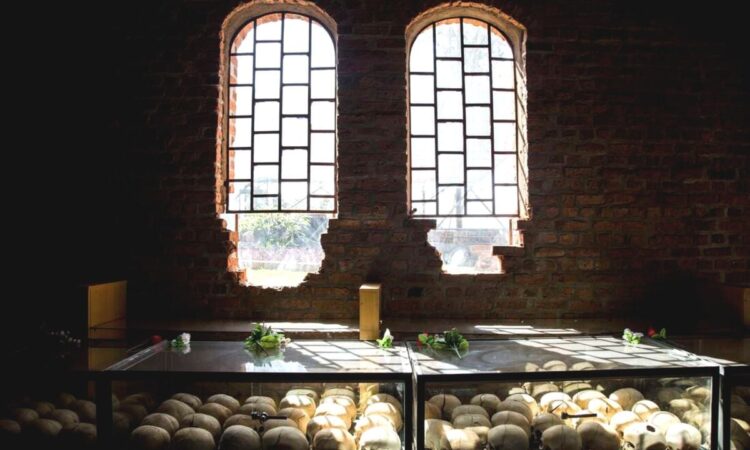
Embarking on a day tour to the Ntarama and Nyamata genocide memorial sites will provide visitors with an insight into how the 1994 Rwanda genocide transpired. These memorial sites are tangible evidence of how brutal the Rwanda genocide of 1994 was. This long period of 100 days was a period of absolute terror, bloodshed, and massacres. What started as a thought of discrimination along cultural lines, developed into a massive, countrywide genocide against the Tutsis. This genocide led to the death of over a million Tutsis and a few Hutu sympathizers. This tour of the Ntarama and Nyamata genocide memorial sites gives visitors a chance to interact with the survivors who tell their side of the dark story.
History of Ntarama and Nyamata
Ntarama and Nyamata genocide memorial sites have a lot in common, not just in being memorial sites but also in other factors. To understand the history of these two genocide memorial sites, we need to separate them.
Ntarama genocide memorial site
This site was a former catholic church that was a cherished holy place for the believers. This was way before the dark year of 1994 when the Rwanda genocide began. The Ntarama Catholic Church was a sacred place for most of the catholic believers in its area of work. However, the most unfortunate thing befell this holy church on 15th April 1994 when it turned from being a holy place of God to a place of refuge. This was at the peak of the genocide of 1994 in Rwanda. Over 5,000 Tutsis ran and sought refuge in this church. This was in the thought that the Hutu militias would respect God’s sacred places and not reign terror in this place. To their disappointment, the Hutu militia in support of the Interahamwe made small holes in the closed church and threw in hand grenades. Henceforth, the church opened fire on the defenseless Tutsis and finished off their terror with machetes to those who still had life. Survivors who fled this scene were hunted down and killed in the neighboring communities. Today, this church holds the remains of the victims and also a massive grave outside where many people were buried by the clean-up forces sent by the then-general government to get rid of the evidence.
Nyamata genocide site
The history of Nyamata dates back to the start of the Rwanda 1994 genocide against the Tutsis. Nyamata was a former village Catholic Church in Nyamata village, peaceful and holy churches were taken. However, all that changed during the 1994 Rwanda genocide when it was attacked by the Hutu militias. These militias had followed the Tutsis who had hidden in the church, escaping being killed. The militias and the Hutu Interhamwe reigned on the Tutsis who had locked themselves inside the church, broke open the doors of the church with hand grenades, and shot the Tutsis at close range, killing most of them. The Interahamwe then entered with machetes affirming the kills. An average of 10,000 people were killed in the church, and their clothes and remains are visible with blood stains until today. The Nyamata genocide site was recognized as a UNESCO cultural site in 2023.
What is the significance of Ntarama and Nyamata to the 1994 genocide?
Ntarama and Nyamata are significant to the 1994 Rwanda genocide against the Tutsis in various ways, from being places of murder, misinformation, and crime scenes to UNESCO and memorial sites. This is because both of these places house the remains of over 20,000 people on their premises, without mentioning over 100,000 buried outside. Nyamata and Ntarama are former churches that attracted fleeing Tutsis in thousands and ten thousand thinking they would be safe. Before in the African setting, churches were considered holy places that are respected by everyone and no atrocity can occur in them. This was later understood during the 1994 genocide, which was just misinformation. Years that followed after the genocide of 1994, Ntarama and Nyamata were turned into a memorial site and in 2023 made World Heritage Sites by UNESCO.
Where are the Ntarama and Nyamata genocide memorial sites located?
The Ntarama genocide memorial site is located in the Cyugaro village in Bugesera district. This is south of the capital city, Kigali. The genocide memorial site is located just an hour from Kigali city. The Nyamata genocide memorial site is also not far from the former site. Nyamata is located in the Nyamata village of Bugesera district on the highway to the border with Burundi.
What to see on a visit to Ntarama and Nyamata?
Ntarama and Nyamata genocide memorial sites offer an epic historical tale of the dark past of Rwanda unfolded in real time. Here is what you can expect to see on a visit to Ntarama and Nyamata genocide memorial sites.
Remains of the victims
Over 15,000 remain of the victims of the massacres that took place at the Ntarama and Nyamata genocide sites. These victims were mostly the Tutsi people who had sought refuge in these former churches. The Hutu militias opened the doors of these churches with extreme force using hand grenades and massacred in cold blood these people. On a visit to these genocide sites, one can spot the remains of the victims like bones and skulls. Shocking as it may sound, these remains are visible as a reminder of how dangerous and dark the 1994 genocide was.
Mass graves
Visitors to Ntarama and Nyamata can also encounter the mass graves that hold the remains of over 50,000 people between them. These mass graves were dug by the genocide government to bury the victims in a bid to eliminate the evidence of what their Hutu militias had done. Most of the victims were brought from the neighborhood of the churches and buried there.
Blood-stained clothes of the victims
The Nyamata and Ntarama genocide memorial sites also bear the blood-stained clothes of the victims. These clothes were left there as a notable representation of what happened in these areas. There are also bullet holes visible on the church walls and the damaged doors from the bombings of hand grenades thrown by the Hutu militias. Visitors can gain an insight into how dark and sad these times were.
Identity cards of victims
There are the identity cards of the victims at the Nyamata and Ntarama genocide sites, as that is how the Hutu militias identified the victims after they had massacred them. Visitors can also spot the identity cards of the victims still present at the sites.
How much does it cost to visit Ntarama and Nyamata?
Ntarama and Nyamata genocide sites can be visited at a fee of USD 15 per person. This money collected helps to maintain the activities at the genocide sites and also a percentage is put away to help improve the economy of the communities around these genocide sites.


