
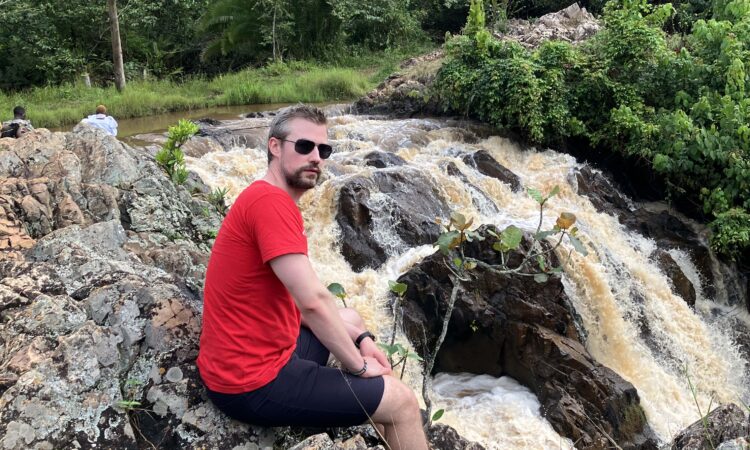
Sezibwa Falls located in the Buikwe district along the Kampala – Jinja highway, is a great hiking place for nature lovers. The falls are located just 40 kilometers from the capital city Kampala. The Sezibwa Falls are under the management of Buganda Tourism Board. They are formed when water moving at high speed squeezes through a narrow rock vent. This increases speed before dropping over 17 meters of rock walls and plunging into a small pool. City life can tend to be very tricky, very busy, and tiresome, therefore a hike to the Sezibwa Falls is a great way to relax off the busy life of the city. The falls draw their water from the wetlands and streams of Lake Victoria flowing through to Lake Kyoga.
The Sezibwa Falls are a natural habitat for flora and fauna including bird species and some primates. The falls are also a cultural site for Buganda Kingdom as the river is considered spiritual. Sezibwa Falls have a rocky terrain characterized by short forests and bamboo that overlook the falls. Sezibwa Falls are important to the Buganda kingdom as its banks are used as spiritual places for praying to their traditional gods.
Sezibwa means “something endless” a name that came about culturally after a mythical tale. This mythical tale is believed to have led to the formation of the river Sezibwa. The cultural legend tale has it that a woman who had family problems with her husband went to her parents for refugee. She was taken back to her family escorted by her mother but on her way got tired and rested in the bush. However, she went into labor shortly after and gave birth to twins Bwanda and Sezibwa who came as water.
These rivers then flowed parallel in different directions with Bwanda flowing to the east and Sezibwa to the east. River Sezibwa however is the most cherished among the two rivers because of spiritual intervention. This intervention came about when the River Sezibwa faced a lot of hurdles on its way but the spiritual god Nalongo Kkubo came to its rescue. People across the Buganda kingdom come to the riverside on Sezibwa Falls to pray to the spirit that helped the river for blessings.
Hike to Sezibwa Falls
Hiking to the top of Sezibwa Falls is one of the major activities to engage in while at the falls. This hike begins with a briefing from the guides of the falls that take the visitors through what to expect. This hike involves navigating through the slippery rocks and muddy trails to the top of the falls. Visitors enjoy scenic views of the water flowing upstream while giving life to the surrounding vegetation like the forests and bamboo before plunging down the rock faces.
There are designated bridge trails that overlook the falls and offer the best picture area. As the hike continues to the top, visitors will witness the cultural prayer places for the local people. The hikers can also encounter different bird species such as Emerald Cuckoo, fan-tailed widowbird, osprey, great blue turaco, green crombec, green Hylia and woodland kingfisher to mention but a few.
Other activities to do at Sezibwa Falls
Hiking to Sezibwa Falls is just a drop in an ocean of activities at the falls. There are many other activities designed to suit nature lovers and holidaymakers. These include the following.
Bird watching
Bird watching is arguably another main attraction at Sezibwa Falls. The falls host over 50 species and can easily be spotted with the help of an experienced birding guide. There are common species that can be easily almost spotted upon reaching the falls. These birds include long-tailed cormorants, African finfoot, Emerald Cuckoo, fan-tailed widowbird, osprey, great blue turaco, green crombec, green Hylia, Grey-backed Carmaroptera, Grey-headed Negrofinch, grey-headed sparrow, hadada ibis, little greenbul, lizard buzzard, olive-bellied sunbird, red-bellied paradise-flycatcher, Red-chested sunbird, red-eyed dove, red-faced crombec, red-headed malimbe, ross’ turaco, shining blue kingfisher, tambourine dove, toro olive greenbul, velvet mantled drongo, Vieillot’s black weaver, western nicator, white-headed saw-wing, white-browed scrub robin, white-spotted flufftail, white-throated bee-eater, yellow fronted canary, yellow wagtail, yellow-fronted canary, yellow-white-eye, black and white manikin, speckled mousebird, striped kingfisher, superb sunbird, and woodland kingfisher to mention but a few.
Swimming
Swimming is an exciting activity at the Sezibwa Falls for the holiday-makers. The river floor is rock cement with ocean-like soil. It is also shallow and with no animals like crocodiles thus favoring swimming. Swimmers can also go as far as the falls area and enjoy the view as they take pictures for memories.
What is the ideal time for a hike at Sezibwa Falls?
The rock terrain of the entire area of the falls is slippery and proves very hard to navigate. It is on this account that it is best to hike in the dry season. This is because the dry season is characterized by dry weather with little or no rain, unlike the wet season. The clear weather during the dry season offers the best views of the falls and makes photography at the falls the best. The dry season runs from June to September and December to February.
What to pack?
The following is a list of essential items that are ideal for the best hiking experience at Sezibwa Falls.
- Hiking boots
- Rain jacket
- First aid box
- Drinking water
- A camera
- Insect repellent
- Accessories like sunscreen, hat, etc.


