
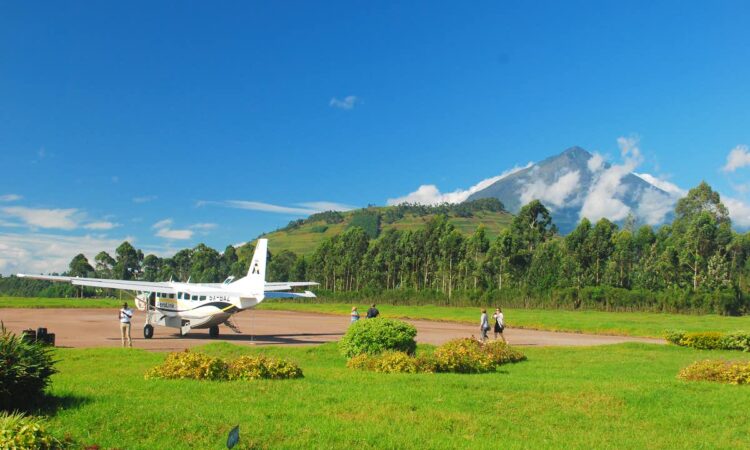
There are 2 airstrips near Bwindi Impenetrable National Park, Kihihi and Kisoro. These are landing areas for domestic flights from Entebbe International Airport and other destinations within Uganda. After landing at either airstrip, road transportation is used to reach Bwindi Impenetrable National Park. The airstrips are elaborated as below.
Kihihi Airstrip
This is situated in the northern part of Bwindi Impenetrable National Park, just 45 km away from Buhoma. Domestic flights from operators AeroLink Uganda are offered from Entebbe International Airport to Kihihi Airstrip daily. This flight starts at 07:00 a.m. and arrival at the airstrip is at 08:15 a.m. Another schedule starts at 10:30 a.m. and arrival is at about 11:45 a.m.
A third flight scheduled from Entebbe International Airport to Kihihi Airstrip starts at 01:00 p.m. to 03:45 p.m. Then the fourth schedule starts at 01:00 p.m. to 02:10 p.m. Return flights, i.e. from Kihihi Airstrip to Entebbe start at 08:35 a.m. and arrive at 11:25 a.m. The second return flight schedule start from 12:05 p.m. and arrival in Entebbe Airport at 02:25 p.m.
The third return flight is scheduled from 03:50 p.m. to 05:15 p.m. Another return scheduled flight starts at 02:30 p.m. to 04:15 p.m. Some of these flights will operate in the months of March, April, May and November, while others will not.
Kisoro Airstrip
This airstrip is situated in the south of Bwindi Impenetrable National Park, just 40 km away. AeroLink Uganda offers direct flights from Entebbe International Airport to Kisoro Airstrip daily. The first schedule from Entebbe starts at 07:00 a.m. and arrival in Kisoro is at 08:15 a.m. Second flight schedule starts at 10:30 a.m. to 11:45 a.m.
Return flights are also similar to those for Kihihi Airstrip. With the first flight from Kisoro at 08:35 am due to arrive at Entebbe at 11:25 a.m. Second schedule starts at 12:05 p.m. and arrival is by 02:25 p.m. All second schedules to and from Kisoro Airstrip are offered daily apart from the months of March, May, April and November.
Air Fares for Kihihi and Kisoro Airstrips
Air fares for a one-way ticket to or from Kihihi/Kisoro Airstrip costs $308.15 for an adult and $215.70 for a child. These are exclusive of taxes, which amount to $80 on each category. For return flight fares, it costs $510.20 for an adult and $357.14 for a child. Both offer $90 for tax. However, there is a surcharge of $70 included for one-way and return flights of Kisoro Airstrip.
Best time to fly to either Kihihi or Kisoro Airstrip?
Flying to either Kihihi or Kisoro Airstrip is done all year round. But dry seasons are recommended because of safer and comfortable atmospheric conditions. This season is experienced in the months of January, February, June, July, August, September and December. March, April, May and November receive relatively heavy rains and cloudy conditions thus less safe for flights.
Some terms and conditions to consider before flying to Bwindi?
At Entebbe International Airport, you must arrive an hour before your flight to check in. At the airstrips, checking in time is half an hour before your flight. It is important to know that you will not be allowed to fly after that time. Checking in online is also an option to avoid inconveniences at the Airport terminal.
The flight operator is not responsible for any direct or indirect costs arising from delays to their services. Also, the operator reserves the right to land in an alternative airstrip in case it is unsafe to do so at the original destination. The operator will also not be liable to cover your costs as a result of this change of plans.
In case you have any underlying health conditions, physical disability, old age or any other, you must inform the operator in advance. This is important for the flight crew to offer assistance in case of emergencies. Smoking is not permitted in the plane to avoid inconveniencing other passengers and also as a precautionary measure.
The maximum weight for luggage is 15 kg in soft bag. In case there is room for luggage heavier than the mentioned, the excess weight will be charged at the current freight charges. This costs $5 for each kilogram. You are not allowed to travel with dangerous luggage including ammunitions and firearms.
What to see in Bwindi when you fly?
Mountain Gorillas
These are great apes and Bwindi Impenetrable is famous for sheltering almost a half of the total global population. The best way of seeing these critically endangered great apes is by doing a gorilla trek. This adventure involves a guided trek into the dense forest to locate a habituated gorilla family. When you encounter what you are looking for, spend an hour in their presence.
Batwa Pygmies
A cultural encounter with the Batwa people is a great time to connect deeper with the forest’s former dwellers. They survive just adjacent to the forest and can be visited for various purposes. Entertainment through traditional songs, dancing and playing music instruments. Witness them demonstrate their hunting and food gathering skills and preparing their local dishes etc.
Birds
With 357 species of forest birds, Bwindi is one of the top birdwatching hotspots in Uganda. The destination has over 20 Albertine endemic bird species comprising of both resident and migratory birds. During birdwatching you could sight the Shelley’s crimson-wing, African green broadbill, strange weaver, MacKinnon’s shrike and mountain masked apalis etc.
Why fly to Bwindi instead of driving?
Bwindi Impenetrable National Park is around 498 km from Kampala thus takes a travel time of 10-11 hours to reach by road. This is relatively too much time spent on the road that would otherwise be used to enjoy other activities. Meanwhile, flying to either airstrip from Entebbe Airport takes an average of 1 and a half hours, thus reducing travel time.
Besides reduced travel time, flying instead of driving to Bwindi is a golden opportunity to enjoy aerial views of diverse landscapes. From Entebbe all the way to southwestern Uganda, there are remarkable physical features comprising lakes, forests, hills, valleys, swamps, mountains and rivers etc. This is a unique way of viewing Uganda’s natural wonders.


