
Most of the most fascinating attractions in Kibale National Park are found inside the 759 square kilometer forested destination. Unique biodiversity is among the must-see aspects of Kibale Forest. Among them are rare fauna and flora that find shelter in a variety of habitats. These encompass tropical rainforest, savannah vegetation and swamp among others. In total, 71 mammal species, 370 bird species and 350 tree species thrive in Kibale National Park. Some of the species are described below,
Chimpanzees
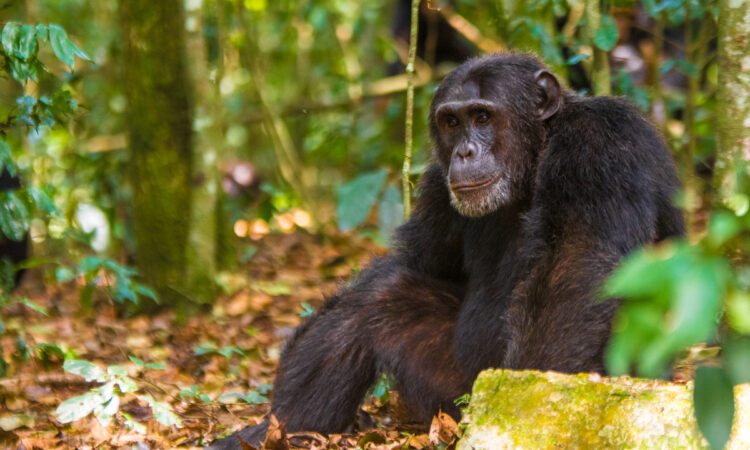
A must-see endangered ape species that has partly contributed to the park’s status as the Primate Capital of the World. These are endangered mammals with long arms and fingers for knuckle walking. However, sometimes they walk upright quite like humans. Chimpanzees are omnivores that spend their time both on the forest floor and high up in the trees. In terms of statistics, Kibale National Park houses the largest population of chimpanzees in Uganda, 1,500 chimps. As social mammals, they live in communities, and a habituated one can be tracked by visitors daily.
Golden Cats
This is a cat species with chestnut or reddish-brown fur on its body. Some have their fur colored greyish-brown, while others’ are dark spotted. The African golden cat is extremely rare, with encounters mostly by mere luck or on camera traps. Its presence is only recorded in African rainforests, with Kibale National Park being among the few to shelter them. Their population globally is still unclear, but their conservation status is considered vulnerable. Golden cat tracking to see them is a recently introduced activity, and can only be done in Kibale National Park.
Olive Baboons
These omnivorous monkeys can be found in troops across multiple areas of Kibale National Park. They get their name from the green-grey coat which you can witness from a distance. However, when you look closely, their coats have many colors ranging from yellow-brown to black. Baboons love feasting on fruits, roots, tree barks, seeds, birds and rodents etc. Like chimpanzees, they can spend time both on the forest floor and high up in trees. Something fascinating about olive baboons is how alpha males display dominance through physical power in a troop.
Vervet Monkeys
These are old-world monkeys that you can see even before you enter Kibale National Park. The face of a vervet monkey is black in color while most of their body is covered in grizzled-grey fur. Like the aforementioned primates, vervets are social mammals. However, both males and females show dominance hierarchies in different ways. For males, the most dominant has to be much older, with the best fighting abilities beside possessing more allies. Meanwhile, the females just have to put up with one of higher maternal social status.
Black and White Colobus Monkeys
These distinguish themselves from other monkey species with the absence of thumbs on the hands. Black and white colobus monkeys have fur colored black, and long white mantles. Their face has a beard around it, while the tails are quite bushy. These monkeys feed on leaves, fruits, flowers, which implies they are strictly herbivores. They live in groups, with a dominant male and no dominance among females. A behavior unique to them is the greeting ritual, every time they reunite with a familiar individual.
Forest Elephants
The African forest elephant is among the best attractions in Kibale National Park. This is quite different from their savannah counterpart thanks to its smaller size. Also, their tusks are distinct, as they are straighter and point downwards. Yet, the savannah elephant’s tusk is curved outwards. The ears of the forest elephant appear oval in shape, while the savannah’s appear triangular. They are herbivores, and love consuming leaves, tree barks, seeds and grasses. Unfortunately, forest elephants are critically endangered species.
Beautiful Flora
One of the most unique attractions in Kibale National Park is its diverse flora. This is a moist evergreen, semi-deciduous tropical forest with a variety of herbs, trees, shrubs and lower plants etc. They range from epiphytes, figs and many others. A walk inside and outside the forest offers views of lianas, ferns, charcoal trees, Guinea plum and others. massive hardwood includes mahogany and numerous fig tree species. Also, Kibale National Park’s swamps and riverine forests are home to papyrus plants and palm trees.


