
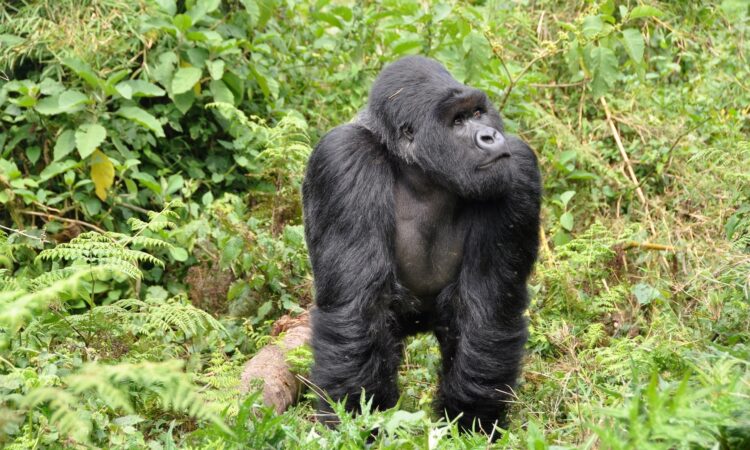
Defense mechanisms are crucial in the survival of mountain gorillas in their natural habitats. Mountain gorillas have evolved survival tactics over long periods of time to allow them to fend off potential threats in the wild. Without these defense mechanisms, they would not have survived for all this time. Otherwise, they would be far more vulnerable to environmental pressures, humans, and their own predators.
These are some of the defense mechanisms mountain gorillas use to fend off threats,
A mountain gorilla has a powerful build that serves as a natural deterrent to their predators or threats. They will also stand upright on their hind legs to appear taller and more imposing, hence using their size to be more intimidating to a threat or predator. Most silverbacks tend to charge at a threat as a survival tactic to scare away a predator or any other threat.
A mountain gorilla will also stand up and expose its big, sharp canine teeth as a defense mechanism to intimidate a threat. A predator might perceive them as being powerful enough to inflict a deadly bite once it happens.
A mountain gorilla family will most certainly stay so close to the dominant silverback at all times. This is because the silverback is always looked up to for the protection of the entire gorilla family.
Most mountain gorillas prefer to belong to a family, which ensures that their chances of survival are higher. This is because defending against threats is much better as a group rather than individually.
A mountain gorilla has evolved to make vocalizations in the form of screams and grunts. This is a way to signal to a potential threat of its presence. These sounds can also be made to signal to other members of the group of potential danger.
Chest beating is another non-contact tactic mountain gorillas use to fend off predators or any other perceived threat. They can do this by thumping their chests with capped or open hands to produce rhythmic sounds.
Mountain gorillas have their bodies covered by thick fur as a survival mechanism. Besides insulating them during cold weather, this is used to avoid deadly scratches or bites during intense fights with other threats.
Mountain gorillas also have large home ranges to ensure that they can travel long distances daily to look for food. In this way, they can avoid clashing with other competitors for the same resources, including food and shelter.
Female mountain gorillas usually avoid mating until they find a male whom they deem strong and healthy. This is a survival strategy that ensures the production of viable offspring to live much longer than expected.
Mountain gorillas have also evolved to live in Afromontane ecosystems. This ensures that they are in a better position to see their threats clearly as they approach.
Where to see mountain gorillas?
Worldwide, mountain gorillas in the wild exist in only 2 populations and within the Albertine Rift region. One population is found in Uganda’s Bwindi Impenetrable National Park. The other population is in 3 national parks that form the Virunga Conservation Area. These are the Democratic Republic of Congo’s Virunga National Park, Rwanda’s Volcanoes National Park, and Uganda’s Mgahinga Gorilla National Park.
Seeing mountain gorillas is generally done during a gorilla trekking trip. Gorilla trekking basically involves locating a habituated gorilla family in the forest. If the habituated gorilla family is encountered, staying in their presence is done for 1 hour. This is a chance to witness some of their unique behavior, including some defense mechanisms they employ to survive. Photography and taking videos are allowed.
To witness their unique ways of behaving for an extended period of time, a gorilla habituation experience is offered. This experience takes a duration of 4 hours and is done only in Uganda’s Bwindi Impenetrable National Park. Gorilla habituation experience is done on a semi-habituated gorilla family found in the Rushaga sector. What makes this experience unique is that you get to participate in the familiarization of gorillas before they are trekked by visitors.
The best time to see gorillas
Dry seasons offer perfect conditions to see mountain gorillas compared to the wet seasons. This is a period generally experienced from June to August and also from December to February. This is because the gorilla trails in the forest are muddier during the wet season than during the dry season. However, the rainy seasons are also a good time to see gorillas. Rainy seasons occur from September to November (short rains) and from March to May (long rains).


