
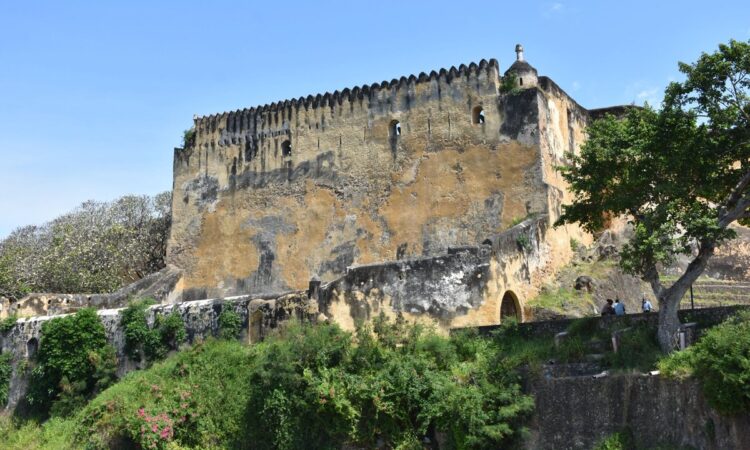
Fort Jesus Museum is situated in Mombasa, a vibrant coastal city in Kenya. This spot is not just a tourist attraction, but a historical landmark that represents centuries of military and cultural significance along the coast. Fort Jesus museum is well-positioned along Nkrumah Road, right on the edge of Mombasa Island. The masterpiece is a UNESCO World Heritage Site, which was constructed by the Portuguese in 1593 to preserve and showcase the region’s complex past. Considering that Fort Jesus was designed to protect Portuguese interests along the East African coast, the spot has witnessed and seen several battles, shifts in power and chaos.
Getting to Fort Jesus Museum.
It is with no doubt that the exciting journey to Fort Jesus commences in Mombasa’s Old Town, a historic district widely known for its narrow streets, the aroma of spices from local vendors, Swahili architecture and vibes. Fort Jesus is about 3 kilometers from the center of Mombasa, which makes it accessible. After reaching the fort’s eye-catching coral stone structure, standing 18 meters long and surrounded by a moat, you. The ocean breeze and fresh airs from the nearby Indian Ocean adds a refreshing vibe as guests enter through the main gate.
Fort Jesus is open for tourists daily, from early morning at around 8:00 AM to 6:00 PM late evening, offering flexibility for visitors. Depending on one’s choice, guests can explore independently or go in for a guided tour. The spot’s design, credited to Italian architect Giovanni Battista Cairati, bears a resemblance to a human figure lying on its back, with the head facing the sea. A complete tour lasts for about 1 to 2 hours, depending on the guest’s pace. Guests can begin at the battlements, where they can climb up and look through narrow windows that were once used for defence. The viewing point offers panoramic views of Mombasa’s old rooftops, Nyali Beach and the harbor.
Inside Fort Jesus.
The museum itself is housed within the fort’s interior and contains a collection of artefacts that illuminate Mombasa’s history. Among the stunning stuff to look at are items recovered from the Santo António de Tanná, a prominent Portuguese frigate that sank in 1697 during battle with the Omani, including barnacle-encrusted jars. Other displays may include pottery from Manda and Gede, and Chinese porcelain, reflecting the region’s role in the slave trade and Indian Ocean trade. The presentation is brief, with minimal labeling, preserving the real atmosphere. Visitors can also dive into the fort’s darker past in the torture chambers, where slaves were always held before their transportation. Cannons are exhibited along the walls, including Portuguese models with a 200-meter range and British models extending to 300 meters. The Omani House, which is located in the San Felipe bastion, features Quran inscriptions on its doorposts, a remnant of the Arab occupation following their victory in 1698 after a three-year battle.
What to look at?
Several spots within Fort Jesus stand out. The Mazrui Hall exhibits Omani architectural elements, including faded spirals and wooden lintels, alongside graffiti etched by Portuguese sailors sailing ships and dhows. The Swahili Cultural Centre, which was established in 1993, provides training for interested local youth in traditional crafts, where visitors may observe weaving or carving if activities are going on. Outside the Fort is a Portuguese water cistern and a 76-foot once an Arab well, though too salty for drinking, which offers insight into history. The route of the Arches and its painted walls and dim lighting create such an exciting experience.
For guests visiting the Fort between Thursday and Sunday, the Fort Jesus Sound and Light Show at around 8:00 PM is an additional experience. This 60-minute event is accompanied by guards in traditional robes with torches, guiding guests through a multimedia kind of briefing of the Fort’s history, like the Portuguese conflicts, Omani conquests, and the British use as a jail. The show ends with fireworks, and an optional Swahili BBQ dinner of chicken, skewers, and fries is available in the courtyard to fuel guests up.


