
The mountain gorilla is a critically endangered primate species that goes through a fascinating lifecycle from birth to death. With their current population at 1,065 individuals globally, these are considered some of the most important species in the animal kingdom. These are flagship and umbrella species in their respective forested habitats. Their lifecycle is observed in 4 stages as described below,
Infant mountain gorilla
This stage of a mountain gorilla’s lifecycle is usually from 0 to 3 years of age. These can be born at any time of the year. During birth, a mountain gorilla weighs between 1.4 to 1.8 kg. The fragile baby relies on the mother for everything, and they stay close for up to 6 months. The adult females help in weaning them to ensure reproductive success, as well as their survival.
The infant mountain gorilla will start crawling at 9 weeks, stand at week 20, and walk at 8 months. They become agile enough to get on their mother’s back at 6-7 months. Infant gorillas will also be carried by juveniles as they grow older. Infant mountain gorillas do not recognize their father, regardless of his status as the dominant silverback. The infants will always spend the night in the mother’s nest until the birth of another infant.
Juvenile mountain gorilla
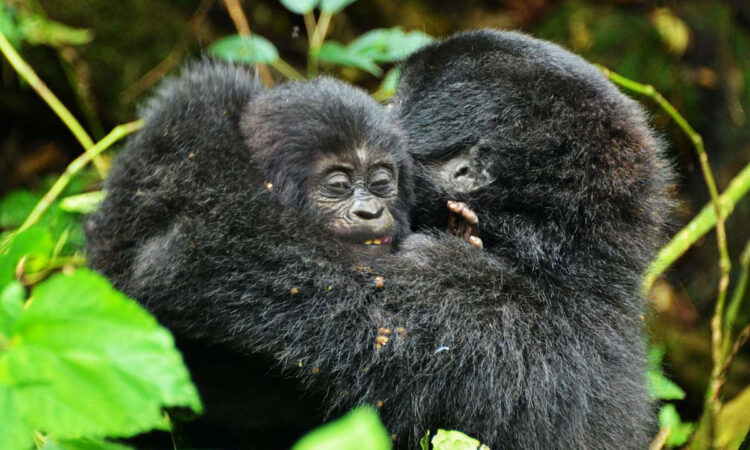
This stage starts at the age of 3 to around 6, and there might be no clear distinction between the males and females. This is a period where the mountain gorilla is more adventurous and socializes more with their family members. They can play and wrestle with their siblings and older members, including the father. They also love to somersault and are more arboreal than their older family members.
Sub-adult mountain gorilla
This stage starts at the age of 6 to around 10 years. The mountain gorilla is now quite independent and socializing more with other family members. Female young adults often reach sexual maturity in this stage, while males are still growing. From the age of 8, young female adults may migrate away or choose to stay in the family. The females that choose to stay often bond for life with the dominant silverback.
The males at this stage have started growing taller and are at the adolescent stage. This is when some male adult characteristics start to manifest. The males can now be called blackbacks. These males can play the role of sentries in the gorilla family. At this stage, they have fully learnt how to build their own nest, where they will spend a night.
Adult mountain gorilla
This stage is achieved from the age of 10 onwards. This is the stage when a female mountain gorilla can have their first offspring. Males at this stage are blackbacks or even silverbacks if they grow much older (from 12 years plus). The latter have a distinct greyish hair across their back. The dominant ones protect the family at all costs from threats like predators and humans. They also play a crucial role in guiding the entire family.
Mother mountain gorillas play a crucial role in the survival and integration of baby gorillas in the family. Blackbacks may migrate from their family or challenge the dominant silverback to take over the family. They tend to leave the family at age 11, and this is a gradual process. The blackback has fewer chances of surviving in the family compared to the mature female gorillas. Adult females typically produce one baby per 4 years after a gestation period of 8.5 months.
On average, the adult males may reach a height of 171 cm and weigh around 180 kg. Meanwhile, females can reach a height of 150 cm and an average weight of around 90 kg. Some male adults, especially new dominant ones, can engage in infanticide against other silverbacks’ offspring. Mountain gorillas generally live up to over 40 years in their natural homes.
There are only 2 small populations of mountain gorillas that exist on earth. One population is in Uganda’s Bwindi Impenetrable National Park, adjacent to Sarambwe National Reserve in the Democratic Republic of Congo. Another population lives in the Virunga Conservation Area, spanning Uganda, Rwanda, and the Democratic Republic of Congo. They comprise Volcanoes National Park, Mgahinga Gorilla National Park, and Virunga National Park.


