
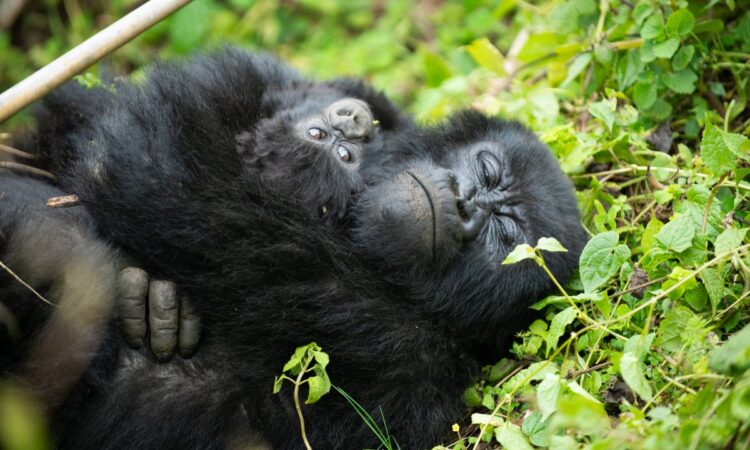
Gorilla sleeping behaviors and habits are similar to those of humans due to the closeness of their DNA percentage to up to 98.8%. The gorillas have a daily routine of being very active during the day and resting at night. Gorillas are quite picky in their sleeping behaviors and habits, such as in selecting an area to camp for the night. As dusk compresses the skyline, these gorilla primates spring into action to prepare for the night.
They construct a nest using sticks and plant leaves to cozy and comfort. Depending on different factors like location, weather, and also security of the area, gorillas construct their sleeping nests high up in the trees or on the ground. In the gorilla primate world, it’s every gorilla for itself as each primate is entitled to construct its own nest for the night. Upon getting up at dawn, the gorillas dismantle the sleeping nests and abandon them, thereafter going about the daily chores of the day.
The sleeping habits of gorillas are unique, as every gorilla constructs a sleeping nest for the night. However, this is with exceptions to the infants who share a nest with their mothers for protection, coziness, and warm sleep. Juvenile who are old enough to construct their own sleeping nest are left to sleep alone on their nest, the same as the silverback. Gorillas sleep in a coordinated formation of rounding up in the same area for protection and warmth, as the nights in their habitats can be extremely cold, especially in the colder wet seasons.
The silverback usually takes the central stage of the sleeping formation to monitor and protect the gorilla family in case they come under predator attack. Juveniles prepare sleeping nests high up in the trees while the silverback stays on the ground. Gorillas sleep on their backs and also on their sides throughout the night with their legs folded. During the middle hours of the day, gorillas can also construct temporary nests for short naps after a belly full of feeding.
Where to encounter gorillas in the world?
The process of encountering gorillas is called gorilla trekking, and this process provides visitors with an amazing opportunity to spend an hour with the gorillas on their daily routines. Gorilla trekking is one of the rare tourist activities in the world and is limited only to Africa. Not many countries offer these types of activities due to the rarity of these primates. Below are some of the few areas in the world where gorillas can be encountered.
Bwindi Impenetrable National Park
Bwindi Impenetrable National Park is an enchanted gorilla destination situated in the Pearl of Africa, Uganda. The misty forest of Bwindi tells a sweet story of adventure told through the lens of alluring encounters with the endangered mountain gorillas. About 459 of the 1,063 mountain gorillas left in the world today are found in Bwindi Impenetrable National Park. This is close to half of the whole mountain gorilla population.
Gorillas, like most primates, live in groups known as gorilla families. Bwindi alone has over 50 families of gorillas, and 26 of these are habituated, meaning they can be trekked by visitors. The trekking experience of gorillas in Bwindi Impenetrable National Park is done among the different sectors, such as Buhoma, Nkuringo, Ruhija, and Rushaga. These gorilla sectors have done much to improve the trekking experience of these primates, as the different gorilla families are distributed across these sectors.
Mgahinga Gorilla National Park
Tucked away in the rolling hills of the Kigezi and Virunga ranges, Mgahinga Gorilla National Park is among the few places that host mountain gorillas. Though it is one of the smallest protected areas in Uganda, with just 33.7 square kilometers, it makes up in the gorilla trekking experience. Mgahinga Gorilla National Park has over 100 mountain gorilla primates living in its stretched-out wilderness. The Nyakagezi gorilla family is the only active and habituated gorilla family in the park. Visitors fly into the country and straight to Mgahinga Gorilla National Park for an excellent time with the mountain gorillas.
Volcanoes National Park
Volcanoes National Park is Rwanda’s most treasured possession, located in the northern region of the country. This park has made a name for itself for being one of the best gorilla destinations in the world. It harbors about 300 mountain gorillas that roam the highlands of the Virunga ranges under the dense montane canopies. With about 12 gorilla families, and out of these, 10 families are habituated, visitors can enjoy a seamless gorilla experience.
Kahuzi-Biega National Park
The rare to find lowland gorillas are hosted in Kahuzi-Biega National Park, located in the southeastern region of the Democratic Republic of Congo. In the whole of East Africa, the lowland gorillas can be trekked in Kahuzi-Biega National Park. Similar but slightly different from their cousins, the mountain gorillas, the lowland gorillas are smaller in size with less fur and are very agile. True to their name, the lowland gorillas dwell in the lowland areas, especially on the bases of mountains.
Virunga National Park
This park is the epitome of gorilla adventure, as all the gorilla habitats commence from here. Virunga National Park is situated in the heart of the Democratic Republic of Congo. Spanning over 6,000 square kilometers, Virunga National Park is an uncharted gorilla destination with over 200 mountain gorillas. The gorilla trekking in this park is quite affordable compared to other gorilla destinations, making it a gem for visitors on a budget.


