
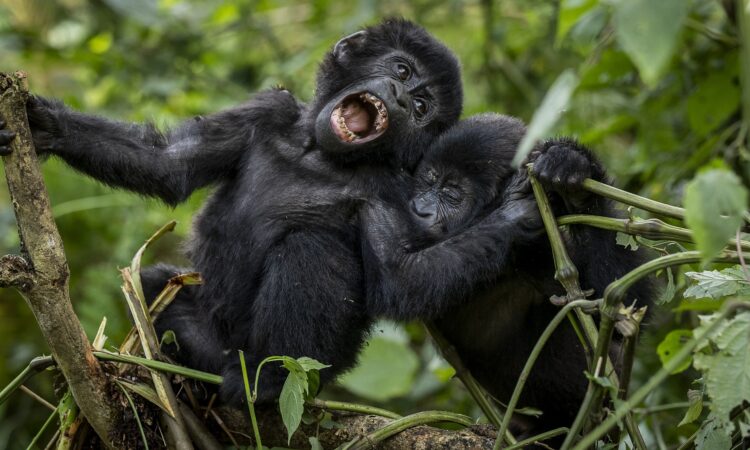
Uganda gorilla trekking safaris are possible during the month of February, where tourists have a clear chance to go on unforgettable adventures in either Bwindi Impenetrable National Park or Mgahinga Gorilla National Park both located in southern Uganda. Though February falls within the dry season, there is a possibility of some rain in these mountainous destinations. But, this amount of rainfall is much lower compared to the wetter months of the year like May, October and November.
In February, Bwindi national park typically receives a total average rainfall ranging from 50-100mm. Similarly, Mgahinga national park also receives 50 – 100mm of rain during the month of February. With such low amounts of rainfall, the forest trails are less muddy and slippery thus providing the perfect navigation conditions for gorilla trekking safaris. Also, drier weather prompts gorillas to descend to lower altitudes looking for food, thus increasing their accessibility to visitors.
Where to trek gorillas in the month of February?
Bwindi impenetrable National Park.
This park is situated in southwestern Uganda, close to the border of Democratic Republic of Congo. Bwindi covers a total land area of 331 square kilometers, located between geographical coordinates of approximately Latitude 1.0521° S, and Longitude 29.6201° E. Bwindi is about 452 kilometers southwest of Kampala, the capital city of Uganda and about 220 kilometers north of Kigali, the capital city of Rwanda. Standing at elevation ranging from 1,160-2,607 meters above sea level, the park is covered with dense, ancient rainforests and houses at least 400 mountain gorillas, with 24 habituated gorilla families.
Mgahinga Gorilla National Park.
This is great destination where you can trek gorillas in February. It is also situated in southwestern Uganda. Unlike Bwindi, Mgahinga national park is not only close to the border of the Democratic Republic of the Congo, but also the border of Rwanda. Mgahinga national park is part of the Virunga Mountains conservation area and covers a total land area of at least 33.7 square kilometers. Mgahinga sits on elevation ranging from 2,227-4,127 meters above sea level.
From Kampala, Mgahinga national is about 470 kilometers in the southwest, and only 227 kilometers from Kigali. Combined together with Bwindi national park they have almost half of the total mountain gorilla population in existence.
Vegetation at Bwindi and Mgahinga National Parks in February.
Bwindi in February is covered by lavish and diverse vegetation. This creates a lively green scenery for its inhabitant species, including the mountain gorillas. During this time of the year, the park has mixed ecosystems ranging from montane and lowland rainforests to bamboo forests and open grasslands. Such vegetation provides food and shelter for the mountain gorillas, which in turn makes the gorilla trekking safari fun-filled and mysterious.
Equally, Mgahinga has the lush and varied vegetation landscapes through the month of February. This is characterized by montane forests, bamboo thickets, and open grasslands, just like in Bwindi Impenetrable National Park.
Likewise, the rich vegetation is a food source and cover for the mountain gorillas similar to Bwindi. While this vegetation cover is good for the mountain gorillas, it is not for the trekkers, since it may cover the mountain gorillas away from the eyes of the trekkers.
Temperature conditions in Bwindi and Mgahinga National Parks during the month of February.
During the month of February, Bwindi Impenetrable National Park experiences moderate temperature conditions that range between 7oC and 20oC thus making it an ideal period for gorilla trekking safaris. This ensures that a tourist experiences comfortable conditions during their safari as they navigate the dense forests in search for the endangered mountain gorillas. Also, these temperature patterns will have an effect on the daily activities of the mountain gorillas. This is because cooler temperatures at higher altitudes will force them to descend towards the lower altitudes where the temperatures are relatively warmer. This is an advantage to the trekkers who will now have higher chances of encountering them.
Similarly, Mgahinga Gorilla National Park maintains moderate and consistent temperatures throughout the year and particularly in February, these typically range from 15oC to 25oC. Such a temperate climate provides suitable conditions for both travelers and the park’s various wildlife species, including the mountain gorillas to encounter each other.
How gorilla trekking safaris are done in Bwindi and Mgahinga National Parks?
Gorilla trekking safaris in Bwindi strictly start at 8:00 am. Trekkers must gather at the designated briefing site, where UWA ranger guides brief them, advising them about the proper code of conduct during the gorilla trekking adventure including numerous cautions to be taken. After this session, visitors are then divided into groups of 8 individuals, each of which is accompanied by a ranger guide and armed guards to follow a specific forest trail. Along the trails, the group will seek for a specific habituated gorilla family. Meanwhile they can spot a variety of bird, insects and plant species. The gorilla trekking adventure may take at least an hour or even a full day, depending on the location of the gorilla family.
The same applies to gorilla trekking safaris in Mgahinga Gorilla National Park. Morning briefing sessions are conducted at the park headquarters at 8:00am, before gorilla trekking adventure begins. Since Mgahinga national park covers a relatively small area, and with only 1 gorilla family compared to the 24 families in Bwindi, trekkers enjoy more intimate and quiet experiences.


