
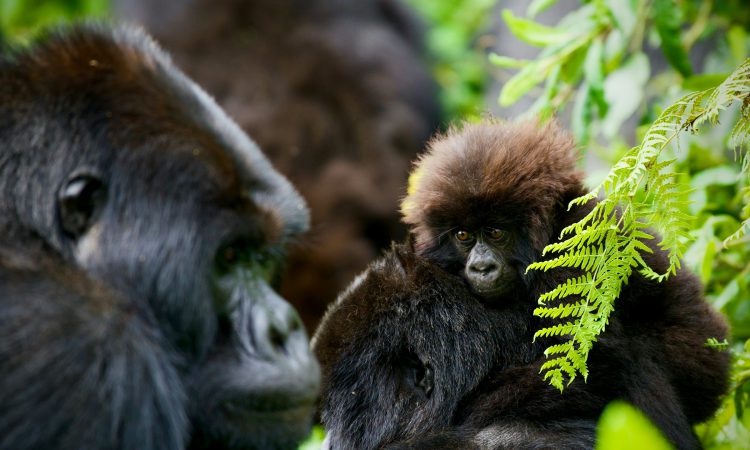
Uganda gorilla trekking safaris are possible throughout the year therefore, the month of June is no exception. While Uganda experiences a dry season in June, there are chances of rainfall particularly in the gorilla trekking destinations of Bwindi Impenetrable National Park and Mgahinga Gorilla National Park since they are situated in mountainous regions. However, these rains are relatively lighter compared to the wetter months of the year thus making gorilla trekking safaris more favorable for trekkers.
The average total rainfall in Bwindi Impenetrable National Park is approximately 49 millimeters in the month of June, one of the lowest amounts in the year. On the other hand, the average total rainfall in Mgahinga Gorilla National Park in the month of June is around 38 millimeters.
With such reduced amounts of rainfall compared to the previous months, the gorilla trails in both national parks are less muddy and slippery thus providing you the ideal conditions for smooth gorilla trekking safaris. Drier weather also prompts gorillas to descend to lower altitudes seeking their favorite meals thus increasing their accessibility to trekkers. There are also clearer skies to enhance your visibility while hiking in the jungles.
Though the humidity levels vary in both Bwindi and Mgahinga, it is lower in the dry season compared to the wetter months. However, both of them being in rainforest regions the humidity levels can still be relatively high and in June they experience an average of around 77% which could be described as humid but cool.
Temperature conditions at Bwindi and Mgahinga National Parks in June
Bwindi Impenetrable National Park receives consistent temperatures throughout the year due to its closeness to the equator. This ranges from highs of around 23oC (73oF) to a significant drop of 11oC (52oF) during the night. In June, Bwindi usually experiences temperatures ranging from 25oC (78oF) in the afternoon to 19oC (67oF) in the morning and gets cooler at higher altitudes. This ensures that trekkers experience comfortable conditions during their adventure as they navigate the dense jungle in search of mountain gorillas. These temperature patterns also influence the behavior of mountain gorillas since cooler temperatures at higher altitudes will prompt them to descend to lower altitudes where the temperatures are much warmer. This is an advantage to the trekkers who will now have higher chances of encountering them.
Equally, in June Mgahinga Gorilla National Park experiences moderate temperatures, typically ranging from 19oC (67oF)-25oC (78oF). These conditions are pleasantly warm and humid but cool hence presenting comfortable conditions for both travelers on gorilla trekking safaris and the park’s various wildlife species including the mountain gorillas.
Accessing gorilla trekking safaris
Bwindi Impenetrable National Park in Kanungu district southwestern Uganda covers a total land area of 331 square kilometers. Bwindi is found near the border with the Democratic Republic of the Congo and is one of the best places to see gorillas in Africa. In Bwindi, there are at least 459 mountain gorillas with over 50 gorilla families with over 24 habituated gorilla families.
On the road, Bwindi is about 501.3 kilometers southwest of Kampala the capital city of Uganda. From Kigali, the capital city of Rwanda Bwindi is about 164.4 kilometers north. Bwindi is located at an altitude of 1,160-2,607 meters above sea level.
Alternatively, Mgahinga Gorilla National Park in the Kisoro district in southwestern Uganda. It covers a relatively smaller total land surface of about 33.7 square kilometers bordered by Rwanda and the Democratic Republic of the Congo.
Mgahinga Gorilla National Park forms part of the greater Virunga Mountains conservation area that constitutes Volcanoes National Park and Virunga National Park besides Mgahinga. On the road, Mgahinga is about 496.7 kilometers southwest of Kampala and it is only 135.3 kilometers from Kigali. Combined with Bwindi they have almost half of the remaining 1063 mountain gorillas on Earth.
Vegetation at Bwindi and Mgahinga National Parks in June
During the month of June, the dry season influences the vegetation within Bwindi Impenetrable National Park. Due to the diverse altitudes at Bwindi, it consists of dense tropical jungles characterized by various vegetation types. Bwindi is largely composed of a montane forest characterized by tall trees, dense undergrowth, and a plush canopy.
During the dry season of June, the trees a composed of relatively thick leaves which often shed due to low chances of rainfall. Some parts of Bwindi are composed of bamboo forests, especially at higher altitudes. This is essential for providing food and habitat for various wildlife species, including the mountain gorillas.
Therefore, in June the bamboo may still be green and dense but due to rising temperatures, they may start to dry out. There are also grasslands and clearings in the dry season which provide important habitats for elephants and various antelope species. These clearings make the park relatively visible to these species and travelers on gorilla trekking safaris. Therefore, you could locate the mountain gorillas with less difficulty compared to the wetter seasons.
Mgahinga Gorilla National Park in June also experiences its dry season that influences the vegetation composition much like in Bwindi. During this time, Mgahinga is dominated by montane forest and the vegetation varies with altitude. Bamboo forests at higher altitudes and grasslands in the lower altitude regions. The montane forest is characterized by tall trees and dense undergrowth.
The grasslands and clearings become more prominent in the dry season and are very important for wildlife species such as buffaloes, leopards, and bush pigs among others. Just like in Bwindi, this rich vegetation is a food source and cover for the mountain gorillas.
Besides the endangered mountain gorillas, Bwindi is also known for its rich biodiversity, with at least 160 tree species and over 100 species of ferns that comprise some of the undergrowth. Bwindi has around 120 mammal species, including elephant, otter, jackal, civet, buffalo, golden cat, bush pig, forest hog, black-fronted duiker, and yellow-backed duiker. Mgahinga is also known for its rare golden monkeys.
How gorilla trekking safaris are done in Bwindi and Mgahinga
Gorilla trekking safaris in Bwindi usually begin early in the morning, with the travelers gathering at a designated briefing point. Here you will receive key information from an experienced park guide regarding the mountain gorilla behavior and the proper code of conduct while trekking. After the briefing, you along with other trekkers will be divided into small groups of 8 individuals and each group will be accompanied by an experienced guide and armed guards to trek a specific gorilla family. The gorilla trekking adventure varies in duration and difficulty but is also reliant on the location of the particular gorilla group, ranging from an hour to a full day.
Mgahinga gorilla trekking safaris also follow similar procedures, with an early morning briefing session conducted at the park headquarters before the trek begins. But due to the relatively smaller park size and only 1 habituated mountain gorilla family, the traveler on gorilla trekking safaris can have a more intimate and secluded experience. Once the gorilla family is encountered, you are allowed to spend only an hour with them before you return to the park headquarters.
Due to the low rainfall chances and higher temperatures, ensure to pack lightweight clothing for your gorilla trekking safaris. However, bring with you some warmer coatings for the cooler evenings. Moreover, you should consider bringing a raincoat, or poncho for the unexpected rainfall.


