
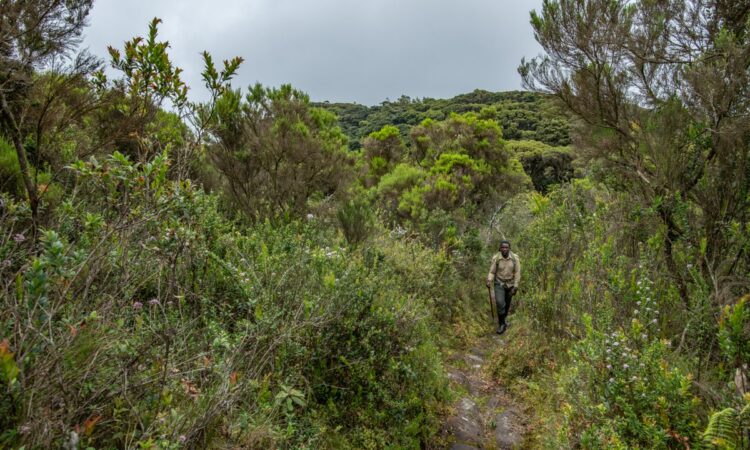
The Igishigishi trail is among the best known throughout the Nyungwe Forest, in the southwestern part of Rwanda. This trail starts from the Uwinka Reception of Nyungwe National Park. The Igishigishigi trail directly connects to the canopy walk, thus very thrilling to explore. The overall length here is around 2.4 km, which takes at least 1.5 hours to traverse. The Igishigishigi trail is exciting if you love a nature walk, birding tour, and primate tours, etc.
What primate species can you see along the Igishigishigi trail?
In Nyungwe National Park, 13 primate species are known to live there. A tour along the Igishigishigi trail is an opportunity to see some of them, if not all of them. Some of these primate species include the common chimpanzee, L’hoest’s monkey, red-tailed monkey, blue monkey, olive baboon, black and white colobus monkey, owl-faced monkey, grey-cheeked mangabey, Dent’s mona monkey, vervet monkey, and bushbaby species, among others.
What bird species can you see along the Igishigishigi trail?
Generally, Nyungwe National Park houses at least 345 bird species, with at least 26 Albertine endemics among them. With your pair of binoculars, you will sight plenty of interesting and colorful birds while walking along the Igishigishigi trail. Your eyeballs will observe the Rwenzori batis, dusky crimson-wing, handsome francolin, red-collared mountain babbler, strange weaver, regal sunbird, red-throated apalis, Kungwe apalis, and the famous Rwenzori turaco, etc.
What mammal species can you see along the Igishigishigi trail?
The chances of encountering a mammal along the Igishigishigi trail are quite high because Nyungwe National Park contains 85 species. Primates are among the mammal species. However, non-primate mammals include bushpig, serval, genet, otter, mongoose, porcupine, Boehm’s squirrel, Ruwenzori sun squirrel, fire-footed rope squirrel, and duikers, etc. Ensure that this is a guided tour to ensure that you are safe enough to even take photos of the mammals.
What plant species can you see along the Igishishigishi trail?
Along the Igishigishigi trail, you are almost certain to see any of the 1,100 plant species recorded in Nyungwe National Park. Nyungwe Forest is a montane rainforest with distinct species of trees, lianas, herbs, and other undergrowth. Some of the plant species to spot while walking along the Igishigishigi trail include the following: mountain thistle, tassel berry, false fig, fringe tree, water berry, and crabwood, etc.
Other trails found in Nyungwe Forest?
Nyungwe Forest is praised for its many unique trails, including Igishigishigi. Trails in the forest include Muzimu, Bigugu, Rukuzi, Kamiranzovu, Uwinka, Karamba, Isumo, Umugote, Ngabwe, Umuyove, and Irebero. Following these trails leads you to some of the most picturesque wonders you will ever see in the world. Examples of what to observe on Nyungwe Forest trails include waterfalls, swamps, tree canopy, and the source of the Nile River, etc.
How can I reach the Igishigishigi trail in Nyungwe Forest?
From Kigali city, you can reach Nyungwe National Park by either road or air transport. The distance you will cover to reach the Igishigishigi trail at the Uwinka Visitors Center is around 214.4 km by road. This is a 4-5-hour scenic road journey to your destination. With Standard Safaris, you will travel comfortably in a 4X4 safari Land Cruiser. If you want other options, you can select from sedan cars, saloon cars, minibuses, buses, drones, and SUVs, etc.
If air transport is your best choice to travel to Nyungwe Forest, you will be offered a helicopter flight. This is from Kigali International Airport to One & Only Nyungwe House. This is a luxury travel experience that also offers aerial views throughout the flight. Travel time is 35-45 minutes. Getting a ticket for a chartered flight could be done with Standard Safaris as well. This is important because it cuts your expenditures on travel and other inconveniences.
What is the best time to explore the Igishigishigi trail?
The best time will always be the dry months of the year. This is because these months offer perfect conditions to hike on a less muddy and less slippery trail. This is a result of a reduction in rainfall amounts that fall in Nyungwe Forest. The dry months occur mostly in the dry season. This season occurs from June to August. The rainy season is experienced from September to May. You can also explore along the Igishigishigi trail in the wet months for a more thrilling tour.
Choosing to hike along the Igishigishigi trail during the wet season is done for plenty of reasons. It is important to note that there are plenty of bird species that breed during the wet season, so birders will have a great experience. Then, there is the advantage of seeing a denser vegetation cover in the forest caused by heavy rains. Also, some lodges offer the best discounts to clients when they wish to stay at Nyungwe Forest during the low season, which occurs in the wet season.


