
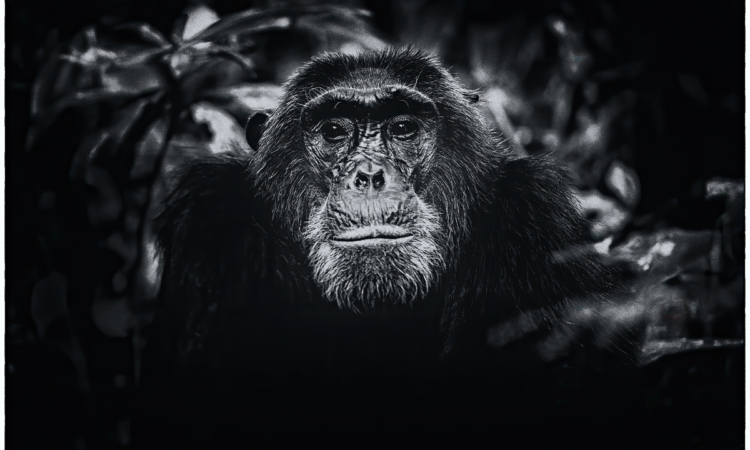
A violent civil war has erupted in Uganda’s lush 795 square kilometers Kibale National Park. The rare occurrence took place among the Ngogo chimpanzee community, which has the largest population on earth, with over 200 individuals. Ngogo chimpanzees lived harmoniously in the Ngogo Sector situated in the central part of Kibale National Park. They shared this pristine territory and the resources within it with an extraordinary level of unity, almost divine. Moreover, they shared mating partners and formed fluid alliances among subgroups hence a surprising Kibale National Park chimpanzees in a violent civil war.
According to the studies carried out among the Ngogo chimpanzees, there were some signs that rifts might occur by 2015. Before then, these chimpanzees had impressively maintained a relatively stable structure, where individuals maintained social bonds while moving between clusters. Now, in June 2015, the researchers observed that one of the subgroups, called the Western chimpanzee subgroup approached the Central subgroup. What followed was a quite unusual change in social interaction, where the Western decided to run away from the Central subgroup. Consequently, the Central subgroup desperately pursued them, which again, was quite unusual, because it had never been witnessed regarding that context.
This implied that the social bonds between the subgroups were gradually breaking down, hence amplifying hostilities and territorial separation. This indicated that Kibale National Park chimpanzees in a violent civil war was quite imminent. During the following years, the divide between the Western and Central subgroups became more noticeable. By 2017, the two factions where now holding and actively patrolling borders of separate territories. As this happened, territorial defense escalated, accompanied by increasing aggression, eventually leading to violence.
The period between 2018 to 2024 saw some adults from the Western group kill several males and infants from Central. The hostilities increased when more males from Central disappeared mysteriously implying that they were killed by those from the Western group. Research is still ongoing to determine the root cause of the split of a once thriving chimpanzees. However, there have been so many factors speculated to be the cause of this disunity, which occurs approximately once in 500 years. These include rivalry for food and reproductive opportunities, massive size of the community, diseases and dramatic changes in alpha males etc. In Gombe National Park, Tanzania, Dr. Jane Goodall recorded a similar scenario.
Despite the rarity of this behavior, we must learn the consequences of complex dynamics among primate groups or troops. The Kibale National Park chimpanzees in a violent civil war underscores breakdowns of relationships under certain pressures, leading to deadly consequences. This asserts that also chimpanzee communities, like humans’ experience conflict that might go beyond their control. Therefore, knowledge about this event expands on our thinking regarding the significance of social bonds in sustaining group cohesion. Ultimately, we need to nurture strong relationships to prevent conflict like this.
Kibale National Park, the best place to meet chimpanzees
Kibale National Park is mostly a moist ever-green deciduous forest situated in southwestern Uganda, east of the Rwenzori Mountains. Over one thousand four hundred chimpanzees live in this place, thriving in various habitats inside. This is one important factor that qualifies Kibale National Park as the best place to meet chimpanzees. Plus, there are 5 chimpanzee communities including the Ngogo groups that have been habituated or semi-habituated. Besides the Ngogo communities, there is the Kanyanchu community, Kanyawara community and the Sebitoli community. The Kanyanchu group can be seen on chimpanzee trekking tours.
With these factors, visitors will have a high chance of meeting the Kibale National Park chimpanzees in a violent civil war. Since Kibale National Park is a large complex ecosystem, chimpanzees are not the only wildlife species that call this place home. The destination houses 13 primate species, also including chimpanzees, which is why it is called the primate capital of the world. Primate species like red-tailed monkeys, L’hoest’s monkeys, black and white colobus, grey-cheeked mangabeys, vervets, pottos and baboons also thrive in Kibale. This makes primate viewing an important activity done in Kibale National Park.
Chimpanzee Trekking in Kibale National Park
Even if you missed witnessing the violent civil war, you can still see them differently. Chimpanzee trekking tours are available for visitors interested in encountering such amazing apes in the wild. Before you are allowed to track the habituated chimpanzee community you are required to have a chimpanzee trekking permit. Each permit costs $250 for a foreign non-resident, $200 for a foreign resident. Only UGX180,000 is for an East African Community citizen. During low season chimpanzee trekking permits cost $200 for each foreign non-resident and $150 for foreign residents.
Chimpanzee Habituation Experience in Kibale National Park
What makes chimpanzee habituation experiences enticing is that they are done for an extended period compared to trekking tours. During the latter, viewing chimpanzees is limited to 1 hour only, while habituation experiences are done for 4 hours straight. All this time offers a more intimate encounter with chimpanzees in the wild. If you are lucky enough witnessing Kibale National Park chimpanzees in a violent civil war will be extremely worthwhile.
Currently to participate in a gorilla habituation experience, you must purchase a permit that costs $300 for each foreign non-resident. Each foreign resident will purchase one at $250 and each of the East African Community citizens does for UGX250,000. Starting in January 2027, the Uganda Wildlife Authority will implement new rates for chimpanzee habituation experiences in Kibale. Foreign non-residents will have to pay $400 for each permit, while foreign residents will have to pay $300 per person. Each visitor from the rest of Africa pays $250 per permit and the East African Community citizen pays UGX250,000.


