
The presence of mountain gorillas in Bwindi Impenetrable National Park often overlooks other primates like monkeys in the park. Think of primate heaven, where there are a variety of primate species, this is Bwindi Impenetrable National Park. As we explore the different monkey species in the park, let us first know more about Bwindi Impenetrable National Park. On the world stage, Bwindi Impenetrable National Park came in the 1930s when it was divided between two blocks of the northern and southern forest reserves. The northern block was named Kayonza Crown Forest Reserve, and the south Kasatora Crown Forest Reserve. In the years that followed in 1942, these reserves were combined with an average size of 207 square kilometers and named the Impenetrable Central Crown Forest. In 1966, about two years after the reserve was combined with the other two reserves, mountain gorillas were sighted and named an animal sanctuary. Later, in 1991, the animal sanctuary gained national park status and was named Bwindi Impenetrable National Park. The tree species in the park date as far back as 25,000 years.
You cannot talk about Bwindi Impenetrable National Park without mentioning the Virunga conservation area. This is because the conservation area encircles the park. This Virunga conservation is the last natural habitat of mountain gorillas. It also encircles Virunga National Park of the Democratic Republic of Congo, Rwanda’s Volcanoes National Park, and Mgahinga Gorilla National Park in Uganda. Bwindi Impenetrable National Park is the best gorilla destination in the world. However, Bwindi Impenetrable National Park does not stop at harboring mountain gorillas alone.
Monkey species in Bwindi
Bwindi Impenetrable National Park harbors an average of approximately 11 primate species. However, in this article, we are to focus on monkey species in Bwindi Impenetrable National Park. Monkey species in Bwindi Impenetrable National Park are of various types, including the following.
Black and white colobus monkeys
The black and white colobus monkeys in Bwindi Impenetrable National Park are some of the common monkey species that can be encountered. These monkeys live in groups known as troops, and each troop can have between 5-10 individual monkeys. Each troop is headed by a dominant male colobus monkey who is in charge of searching for food and protecting the troop. The black and white colobus monkeys get their name from their distinctive appearance of white fur on their face, from their shoulders to their lower backs, and the rest of the body is black. The black and white colobus monkeys are very territorial and often fight to protect and maintain their territories. There are over 400 black and white colobus monkeys in Bwindi Impenetrable National Park.
Blue monkeys
There is an estimate of about 3,000 blue monkeys in the country, with their habitat including Bwindi, Kibale, Echuya Forest, Mabira Forest, etc. Blue monkeys in Bwindi are located in the rainforest on the foothills of the highlands. They live in groups mainly dominated by females, as males always leave the group after mating. Each group is usually led by a matriarch. The blue monkeys’ diet is mainly made up of fruits and leaves. Males can weigh about 6 kilograms, and females 3.5 kilograms.
Red-tailed monkeys
The red-tailed monkeys of Bwindi live in rainforests on the lower lands of the park. They mainly feed on leaves, nuts, and fruits. They have a brownish body, white nose and cheeks, and a reddish-brown tail. The red-tailed monkeys are clever as they store food like nuts in their elastic cheeks. They are sometimes seen socializing with blue monkeys, which makes them social and peaceful primates.
L’Hoest’s monkeys
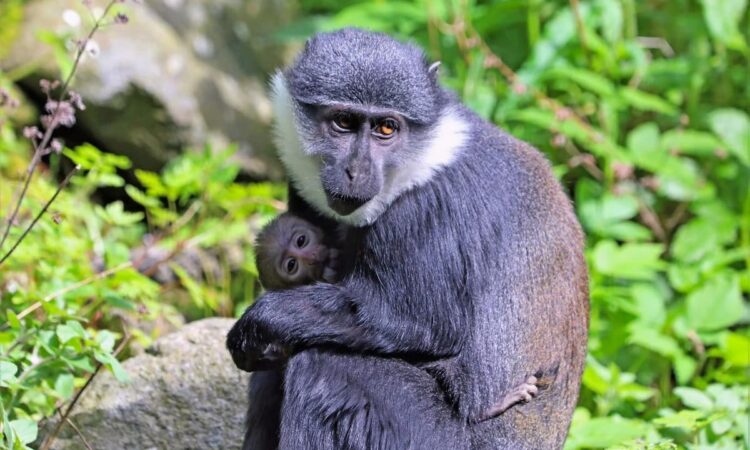
The L’Hoest monkey in Bwindi Impenetrable National Park lives in the sub-montane forests in the lowland areas of the park. They are also social, living in groups of over 10 to 17, and sometimes they can even grow to 40 members. The L’Hoest’s monkeys have white fur on the cheeks and below their eyes with a dark brown back, and the rest of the body is black. However, they have a pale tail at the start and black at the hook-shaped tip. The diet of these monkeys is made up of many things, like fruits, flowers, mushrooms, etc.
De Brazza monkeys
These monkeys are native to Bwindi Impenetrable National Park. They are the largest of the guenon family. The De Brazza monkey bodies are well-speckled in gray, white noses that stretch to the bread and reddish crown above their eyes. They have a stripe of white on their thighs and rumps. They are omnivores feeding on fruits, seeds, arthropods, reptiles, and birds.
Vervet monkeys
Vervet monkeys are some of the most common species of primates in Bwindi Impenetrable National Park. Just like the other primates, vervet monkeys are social beings living in groups of 10-50 monkeys. Uganda has over four types of vervet monkeys, and these include the black-faced vervet, Naivasha vervet, Jebel Mara tantalus, and Stuhlmann’s green monkey. Bwindi harbors the black-faced vervet monkey.
Bwindi Impenetrable National Park does not stop at hosting monkeys but also other primates. These primates include the following mountain gorillas, chimpanzees, and other nocturnal primates like Potto, Demidoff’s Galago, and Spectacled Galago.


