
The new price for guided walks in Bwindi National Park from Rushaga to Nyabaremura is now $80 per person. This by the way is for only the foreign nonresidents, which is up from $60 per person. Meanwhile, $50 per person is for both Foreign residents and visitors from the Rest of Africa. Notice that this has been maintained, along with that of Ugandans and other visitors from the East African Community. They however will pay only 50,000 shillings per person.
The new price for guided walks in Bwindi National Park from Buhoma to Nkuringo is $100 per person. Like the previous one, this is for the foreign nonresidents. Again, similar to the previous price, foreign residents and visitors from other parts of Africa will still pay $50 per person. Also, citizens from within the East African Community must pay 50,000 shillings per person. Effective 1st January 2027, the new price will start. This is expected to boost wildlife conservation, enhance park infrastructure and visitor experience among others.
When to do guided walks?
Any day is good for guided walks in Bwindi National Park. However, the smoothest guided walks in Bwindi National Park are experienced from June to August. This time, Bwindi Forest is in the dry season, a time characterized by reduced rainfall patterns. Even from December to February, similar conditions are experienced. With little to no rainfall, the nature trails are quite dry and easier to walk on without slipping. This season offers nonstop guided walks because your adventure cannot be stopped due to rainfall. But, it is important to visit Bwindi with a warm sweater and light rain jacket because it can rain even in the dry season.
How to Reach There?
The only possible modes of transportation to use on your way to Bwindi National Park are road and air. Driving a car to Bwindi Forest offers scenic views wherever you start from. Now, when the journey begins in Kampala, it covers 477 kilometers in 9-10 hours through Masaka, Mbarara, Ntungamo and Kabale. There are visitors who prefer a short travel duration, thus would rather opt for air transport. A domestic flight scheduled from Entebbe International Airport to Kihihi or Kisoro Airstrip takes 1 hour 15 minutes. There is less than 2 hours to spend on the road when you move from either airstrip to a respective Bwindi sector.
About Bwindi National Park
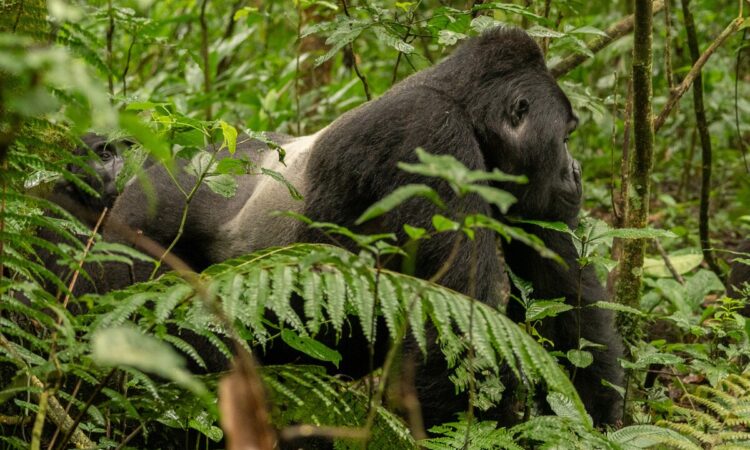
Bwindi in southwestern Uganda gained national park status in 1991. The park had its first gorilla family (Mubare) habituated for tourism in 1993. In 1994, Bwindi became a UNESCO World Heritage Site. Right now, Bwindi occupies 331 square kilometers, with 459 mountain gorillas recorded so far. For the record this number makes up almost a half of the total numbers of mountain gorillas left in the world. Its location in the Albertine Rift region implies that it has accumulated plenty of unique biodiversity over millenia.
Mammal species and bird species recorded in this pristine ecosystem are 120 and 357 respectively. In addition, the vegetation is home to 51 reptile species, 310 butterfly species, 200 trees, and 88 moth species. The mammal species category has quite a number of primate species. These include L’hoest’s monkeys, chimpanzees, mountain gorillas, olive baboons, and blue monkeys etc. At Bwindi, enjoy guided walks on nature trails that lead to picturesque waterfalls and various rift valley viewpoints.
In the communities adjacent to Bwindi Impenetrable National Park, some indigenous people live there. They are mainly comprised of Batwa pygmies and Bakiiga. The former dwelt in the forest until they were evacuated in the early 1990s. As hunter-gatherers, their entire lives relied on resources offered inside the forest. To date, many of them still construct their homes in trees. Demonstrations about their hunting techniques can be witnessed if you visit them. Some of their cultures and traditions are communicated in music and dance that they provide for entertainment to visitors.
What else to do in Bwindi?
Bwindi offers much more than guided walks. Since it has a healthy population of mountain gorillas, gorilla trekking can be done here every day. This place offers the best gorilla treks because a remarkable number of 22 gorilla families have been habituated. Most are offered for trekking tours. When you locate the gorillas, watching them is done in an hour. A more extended time with the gorillas is offered on a gorilla habituation experience. For 4 hours, you can spend time close to semi-habituated gorillas in the wild.
Birdwatching is readily available for the ornithologists worldwide. This is because Bwindi has a lot of birds, including 23 Albertine endemic species. While at Bwindi, move with your binoculars to spot the Shelley’s crimson wing, short tailed warbler, and Rwenzori turaco. More birds not to miss are montane nightjar, African fin foot, hadada ibis and Kivu ground thrush among others. As mentioned earlier, you can also do a community walk among the Batwa and Bakiiga just outside the forest.


