
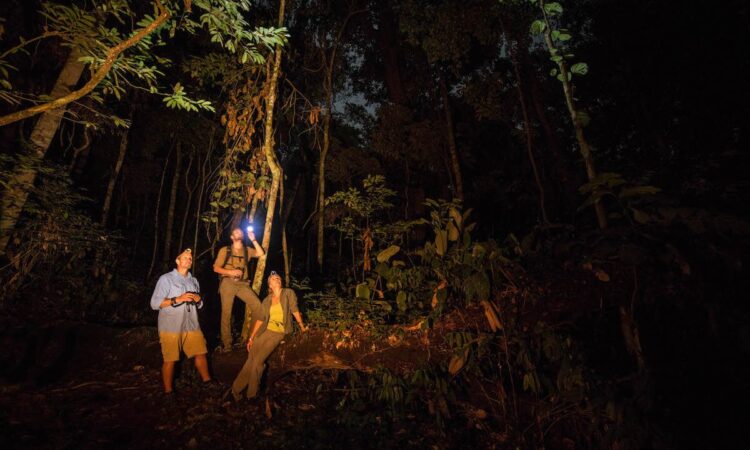
A charming night nature walk adventure is among the latest activities visitors can also fully enjoy in the lush Nyungwe Forest. A night nature walk is a generous opportunity for a visitor to get a unique perspective of Nyungwe Forest’s wide range of wildlife species. The visitor on a night nature walk in Nyungwe Forest is led by an informative ranger guide to observe and learn about the numerous nocturnal wildlife species.
What to see during a night nature walk in Nyungwe Forest?
Visitors on a night nature walk in Nyungwe Forest have an opportunity to spot a variety of wild animals. Tree hyraxes, flying squirrels, and bushbabies are some of the many wild animals you expect to encounter on a night nature walk in Nyungwe Forest. Nocturnal bird species to spot in Nyungwe Forest include the western barn owl, African grass owl, Fraser’s eagle owl, African wood owl, red-chested owlet, Albertine owlet, and Verreaux’s eagle owl, etc.
Animals are not the only wildlife to see in Nyungwe Forest. There are over 1,063 species of plants and some can be seen clearly during the night nature walk. You will have a great time soaking in the ambient winds hitting your face and the tree leaves around you. Nyungwe Forest is also endowed with 38 reptile species including various species of snakes. Therefore, you have a high chance of encountering some while walking along the nature trails.
Time taken in a night nature walk in Nyungwe Forest?
Night nature walks in Nyungwe Forest generally start at 5:30 PM every day. The night nature walk in Nyungwe Forest takes around 3 hours. Your driver guide from Standard Safaris will ensure that you arrive at the starting point before the time. This is very important because you need the briefing, conducted by the ranger. Physical fitness is important if you are planning to go for a night nature walk in Nyungwe Forest.
When to go for a night nature walk in Nyungwe Forest?
Nyungwe Forest can be accessed for a night nature walk throughout the year. But a night nature walk is best experienced during the dry season. The dry season offers cool and wet weather in Nyungwe Forest. However, the dry seasons are marked by low chances of rain compared to the wet season. This is an opportunity to get an uninterrupted night nature walk. Low chances of rain imply that the weather is relatively drier and warmer than the wet season.
The relatively drier weather conditions cause less slippery forest trails. The undergrowth is also sparse thus making your movement easier. Dry seasons in Nyungwe Forest are generally experienced in February, June, July August, September, and December. June and July are the driest months in Nyungwe Forest. Do not forget to travel with your rain jacket since the chances of rainfall are always there.
However, if you prefer a tougher night nature walk, visit Nyungwe Forest in the wet season. This occurs in March, April, May, October and November. The wet season is generally characterized by relatively higher rainfall patterns compared to the dry season. Consistent rainfalls make the forest trails slippery. The undergrowth is also denser in comparison to the dry season. This makes traversing more challenging hence more thrilling.
About Nyungwe Forest
Nyungwe Forest spans 101,000 hectares in the Albertine Rift region. Nyungwe Forest is one of the oldest rainforests in Africa. This is a biodiversity hotspot with various habitats to shelter the numerous wildlife found there. Habitats a categorized into Afromontane Forests, thickets, moorland, savannah bamboo forests, etc. These are very important homes to over 13 species of primates and over 300 bird species.
So many iconic primates live here eastern chimpanzees, Angolan colobus monkeys, L’hoest’s monkeys, blue monkeys, owl-faced guenons olive baboons, etc. Birds in Nyungwe Forest include tens of Albertine endemics. Nyungwe Forest has the brown woodland warbler, double-collared sunbird, Grauer’s swamp warbler, black-winged kite, African cuckoo hawk, brown snake eagle, African olive pigeon, common buttonquail African snipe, etc.
Nyungwe Forest is situated in the southwest of Rwanda and contiguous with Kibira National Park in Burundi in the south. In the west, Nyungwe Forest is contiguous with Lake Kivu. To reach Nyungwe Forest from Kigali City, you must travel for 225 kilometers on the road south-westwards. At Standard Safaris we offer the best car hire services for your transportation. A knowledgeable guide will transfer you, making your 5–6-hour journey informative, enjoyable, and safe.
Other activities to do in Nyungwe Forest?
Nyungwe Forest still has plenty of activities to offer you besides the night nature walk. Chimpanzee trekking is an activity you must experience in Nyungwe Forest. Do not miss the chance to track a chimpanzee group in their natural habitat. After encountering them you are allowed an hour to observe them while taking photos. Other key activities are birding excursions, colobus monkey treks, canopy walks day nature walks, etc.


