
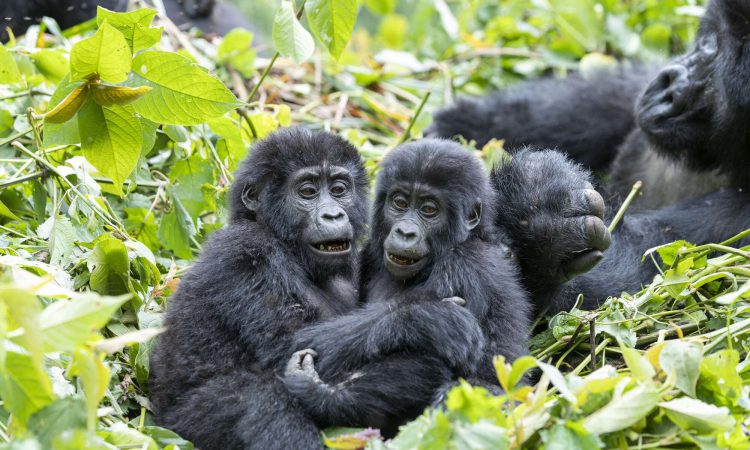
The posho gorilla family is found in the southern sector of the luxurious Bwindi Impenetrable National Park, the Nkuringo sector. The posho gorilla family is comprised of at least 14 members, now led by a silverback known as Magara. The posho gorilla family is still in the process of habituation and will soon be available for gorilla trekking tours. Posho is a recently founded gorilla family that got its name from its founder a silverback called Posh. Posh established this family after separating from the Nkuringo gorilla family which was headed by the silverback Rafiki. Mountain gorillas are large and powerful apes that are distinguished from other primates with their dense black fur and gentle social behavior.
Adult male mountain gorillas are called silverbacks because of the silver-like fur on their lower backs. They have a striking distinction, characterized by a muscular physique and a silver band extending from the shoulders to the hips. These usually weigh from 120–191 kilograms with broad chests and relatively powerful arms to protect their family from any potential threat. In contrast, female mountain gorillas are relatively smaller and less heavy with an approximate weight of around 70–98 kilograms. These do not have a prominent silver or grey band on their back. They are however relatively strong, with a gentler yet muscular physique. The young mountain gorillas are smaller with their bodies covered in soft black fur. These are lively, often curious, and clinging to their mothers or interacting playfully with their fellow young.
Gorilla Permits
To participate in the exciting gorilla trekking adventures or gorilla habituation experiences in Bwindi Impenetrable National Park, each visitor is required to have a valid permit. These are issued by the Uganda Wildlife Authority and can be accessed throughout the year, depending on their availability. You can acquire a gorilla permit only by booking through a registered tour operating company in the country. We can book your gorilla permit, in addition to planning and managing your tour to include meals, accommodation, tour activities, and transportation among other things.
A gorilla trekking permit costs USD 800 for a foreign non-resident, USD 700 for a foreign resident, USD 500 for the rest of Africa, and UGX 300,000 for an East African Community citizen. This document allows you to hike through the dense forest in the company of an experienced park guide and 7 other fellow trekkers to locate and spend an hour with the mountain gorillas.
A gorilla habituation permits cost USD 1,500 for a foreign non-resident, USD 1,000 for a foreign resident and the rest of Africa, and UGX 750,000 for an East African Community citizen. This allows you to have up to 4 hours in the presence of a gorilla group undergoing habituation.
Reaching the Posho Gorilla Family
The distance of Bwindi Impenetrable National Park from Kampala city is about 501.7 kilometers. On the road, the scenic trip will take something between 9-10 hours. An alternative, yet quicker journey is on air transportation. This is on a chartered flight from Entebbe International Airport or Kajjansi Airfield to Kihihi or Kisoro Airstrip. This journey takes between 1-2 hours. This offers aerial views of Uganda’s natural wonders including forests, wetlands, grasslands, lakes, and rivers among others.
Best Time to Travel
Visiting Bwindi Impenetrable National Park to see the Posho gorilla group can be done throughout the year. We however recommend you to travel for this safari during the dry months of the year. There are two dry seasons in Uganda per year, the short dry season that runs from December to February and the long dry season that runs from June to August.
Requirements for Gorilla Safaris in Bwindi Impenetrable National Park
- Come with neutral-colored and lightweight clothing that includes long-sleeved shirts and pairs of trousers.
- Bring rain gear that includes either a lightweight rain jacket or poncho to prepare for the unpredictable rains in the forest.
- A pair of trekking gloves to protect your hands from injury due to thorns or rough terrain.
- A small backpack that accommodates several portable essential items you might need for the tour.
- Bug repellent to repel dangerous or disease-spreading insects like mosquitoes.
- Foot gear that includes strong and comfortable hiking shoes. Additionally, carry gaiters to offer protection against thorns, mud, and water.
- Carry a camera or use a smartphone to take photos for your memories. However, flash photography is often prohibited for obvious reasons.
- Bring binoculars to enhance your ability to see wildlife at a distance.
- Have a container of snacks and a refillable water bottle with drinking water to ensure that you sustain your energy levels while remaining hydrated at all times.
- Carry a basic first aid kit filled with bandages, scissors, hand sanitizer, wet wipes, personal medication, etc.
- Carry the requisite documentation, including passport or visa and gorilla habituation permit among others.
- Carry at least 2 face masks to minimize the spread of airborne diseases.


