
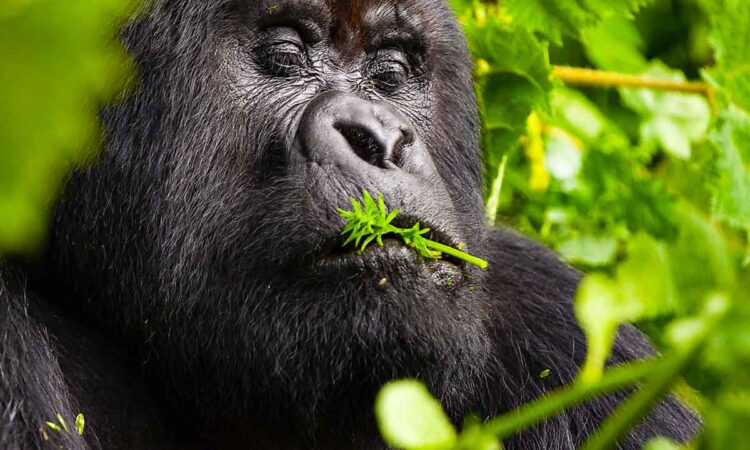
With Standard Safaris, you will have a joyous adventure in Rwanda for a gorilla trek from Belgium. A gorilla trek in Rwanda can only be experienced in the Volcanoes National Park which spans around 160 square kilometers northwest of the country. Volcanoes National Park is a rainforest first gazette in 1925 and part of the Virunga Conservation Area comprising Volcanoes National Park, Virunga National Park, Bwindi Impenetrable National Park, and Mgahinga Gorilla National Park. The park is comprised of 5 volcanoes including Bisoke and Karinsimbi. The ecosystem consists of montane forests and teems with diverse flora and fauna. There are about 300 endangered mountain gorillas and of these, at least 10 gorilla families have been habituated for gorilla trekking tours.
Besides the endangered mountain gorillas, Volcanoes National Park is endowed with golden monkeys, duikers, buffalos, hyenas, and numerous bird species including 13 species endemic to the Virungas and the Rwenzori mountain region. These fauna species can be found in habitats ranging from marshland, swamps, lakes, meadows, grasslands, and volcanoes. The key tourist activity is the gorilla trek where a maximum of 8 visitors are offered a unique opportunity to track a gorilla family and spend an hour in their presence. This activity is done in the morning by 8 am for an hour after the location of the mountain gorillas. The minimum age for trekking in Rwanda’s Volcanoes National Park is 15 and you will need a genuine gorilla permit to take on this adventure.
Cost of Rwanda Gorilla Trek from Belgium
If you are from Belgium, you should know that you need a gorilla permit to hike through Volcanoes National Park and spend an hour with these lovely gentle giants. The gorilla permit can be acquired from a registered tour company like Standard Safaris can help you with this acquisition process. The cost of a Rwanda gorilla permit varies as follows.
Foreign non-resident – USD 1,500 per person per trek
Foreign resident – USD 500 per person per trek
East African Community citizen – USD 200 per person per trek
Rest of Africa – USD 500 per person per trek
How to Secure a Rwanda Gorilla Permit through Standard Safaris
Contact Standard Safaris via numerous platforms, including our website, email address, Facebook, WhatsApp, and Telephone. After confirming your preferred trek day, Standard Safaris will check for the availability of a gorilla permit for that date. If the space is available, Standard Safaris will send you a soft copy of a quotation, for you to make the payment. After paying, Standard Safaris shall buy the gorilla permit on your behalf, and you will be sent a soft copy to confirm your payment. However, you should know that there is a limited number of gorilla permits for sale per day, it is quite competitive and thus should be secured a few months before the trekking day at least 3 months prior.
How to get to Volcanoes National Park from Belgium
Volcanoes National Park is about 104 kilometers by road northwest of Kigali, the capital city of Rwanda. After arriving at Kigali Airport from Belgium, you can travel to the park by air or road transport. A scenic journey by road will take 2-2.5 hours depending on the road or traffic conditions. Standard Safaris can transfer you to the site in the most comfortable safari vehicle.
There is also an option for air transportation if you prefer a shorter journey with an opportunity for aerial views of Rwanda’s natural wonders. This air transfer involves a domestic scheduled helicopter flight from Kigali Airport to Ruhengeri Airport. This takes around 30 minutes before you arrive at the Airport, and from there you will complete the rest of the journey by road.
The Best time to travel from Belgium for a Rwanda Gorilla Trek
The dry months of the year are the best time to travel for a Rwanda gorilla trek in Volcanoes National Park. The dry season is warm with dry weather conditions in Volcanoes National Park making the gorilla trails relatively drier and easier to navigate. The undergrowth is sparse facilitating visibility inside the dense forest. The dry months include December, January, February, June, July, and August.
What to Bring
- Warm sweater and Head sock
- Refillable water bottle
- Rain jacket or poncho
- Lightweight clothes like long-sleeved shirts and trousers
- Strong hiking shoes or boots and gaiters
- Broad-brimmed hat
- Sunglasses and suncream for protection against UV light rays
- Daypack for snacks, basic first aid kit, travel documents, binoculars, camera and extra batteries, charger, etc.
- Torch
- Insect repellent
- A Pair of garden gloves


