
Queen Elizabeth National Park is Uganda’s most visited, thanks to its impressive assortment of top 10 animals to see. These are part of over 95 mammal species that live in the various habitats within Queen Elizabeth National Park. These habitats are composed of lakes, forests, wetlands, savannah grassland, and woodland, etc. The following are the top 10 animals that you should put on your must-see animals list for Queen Elizabeth National Park,
Lions
These are the most sought-after animals by visitors to Queen Elizabeth National Park. These are apex predators and are part of the Big 5. Queen Elizabeth National Park houses over 70 individuals in its savannah wilderness.
Buffaloes
Buffaloes are also members of the Big 5 and live in herds within Queen Elizabeth National Park. They are quite common in the park, and the chances of seeing them are much higher compared to the lions.
Elephants
These African giants are also members of the big 5, are the largest land mammals, and witnessing their sheer size is remarkable. Like buffaloes, they live in herds, and each of these is guided by a matriarch. Chances of seeing it are high.
Leopards
Quite rare to see, but a chance to see it is actually special to most visitors. These big cats are also part of the big 5, and when sighted, are often up in a tree branch. They are either staring back at you or watching out for potential prey.
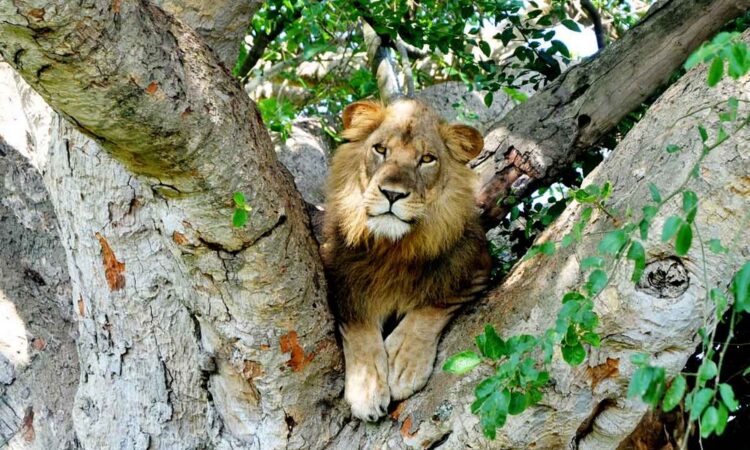
Tree-climbing lions in Ishasha
This is the only region in Queen Elizabeth National Park where you can see them. They have the rare behavior of climbing trees, which is only done by lions in only 2 countries, Uganda and Tanzania.
Spotted hyenas
These are also quite rare to encounter during the day. But there is a high chance of seeing them in Queen Elizabeth National Park at night. They are skilled hunters but are mostly known for being scavengers.
Chimpanzees in Kyambura
These primates can be seen during a trekking tour. In this case, visitors get to see a habituated chimpanzee troop in the forest. This increases the chances of seeing them physically.
Hippos
In this park, hippos are commonly seen in the Kazinga Channel. But they can also be seen along the savannah. Hippos are among the largest mammals on land, and their massive size is so nice to see with your own eyes. They live in groups, and watching them interact in the water makes your trip memorable.
These are antelopes that can be seen grazing on the savannah grasslands. Seeing them evading their predators like lions is among the most exciting things in Queen Elizabeth National Park.
Kobs
Commonly known as Uganda kobs, these are also antelopes and, like topis, are exciting to watch, especially while evading their predators.
How to see the animals?
As these top 10 animals inhabit Queen Elizabeth National Park, there are many ways to encounter or spot these animals. Below is how these animals can be seen.
Game drives
Game drives are guided tours in 4-wheel safari cars that have pop-up roofs. This is the best way of observing as many animals living in Queen Elizabeth National Park as possible. Kasenyi plains offer the finest views of lions, buffalo, elephants, topis, giraffes, Uganda kobs, and warthogs etc. Ishasha sector is another region in Queen where game drives offer exciting views of the animals mentioned, including tree-climbing lions.
Launch trips
Boat cruise or launch trips are guided, relaxing experiences on a motorboat moving on the Kazinga Channel. Besides the frequently encountered hippos and Nile crocodiles, visiting animals like elephants, buffaloes, topis, and Uganda kobs can be spotted. In addition, there are plenty of bird species to observe while on the trip. These include pied kingfishers, grey crowned cranes, saddle-billed storks, and African fish eagles etc.
Forest walks
Nature or forest walks are especially in the Kyambura Gorge, offer a chance to track and see chimpanzees in their natural habitat. Observation time is limited to only an hour, but visitors enjoy the opportunity to meet man’s closest relatives. This is also a huge opportunity to see the Angolan colobus monkey and many bird species. Maramagambo Forest is another place where visitors can have a forest walk and see some animals of Queen Elizabeth National Park.
How to travel?
Traveling to Queen Elizabeth National Park is possible by either road or air transport. The distance to cover to Queen is around 410 kilometers via Fort Portal. This scenic road trip takes 6-7 hours. Private means are available to ensure that you travel by road to Queen. At Standard Safaris, we have safari land cruisers to navigate through the rugged terrain from Kampala to the southwestern part of Uganda.
But we also have safari vans, buses, and SUVs, among others, to select from. For air transport, daily scheduled flights are available from Entebbe International Airport to Mweya Airstrip or Kasese Airstrip. These domestic flights take a much shorter duration than road transport while offering luxury travel experiences. The flight takes only 1 hour and 15 minutes, and you get to enjoy viewing Uganda’s landscapes from above. AeroLink Uganda is the operator.
When to visit?
With the gates of Queen Elizabeth National Park open throughout the year, you can visit the destination anytime. But, if you prefer to visit when clear views of animals are guaranteed, you should visit Queen in the dry season. Dry seasons in this destination often run from June to August. December to February is quite dry, thus another ideal period to visit Queen Elizabeth National Park.


