
Here are the top 10 animals with the worst sense of hearing, ordered from the best to the absolute worst.
10. Tortoise
On the outside, tortoises do not possess ears, while their ear drums are beneath their skin and scales. Therefore, the sounds from the air they pick up and process are muffled. However, tortoises have a good eyesight, that perceives in color to detect food and predators. Their sense of smell is also sufficient for them to Through their limbs, shell and bodies, tortoises can pick up low-frequency sound vibrations. You can meet the leopard tortoise in Uganda’s savannah.
Sea star
These echinoderms have no central nervous system like man, but a decentralized one. Additionally, sea stars have no auditory organs like ears and eyes. Sea stars have tube feet to feel the texture of an object as well as for physical contact. Their sense of smell and sight are descent enough to help them track food and distinguish between light and dark respectively. Travel to Tanzania and Kenya and find sea stars in coastal waters.
Sponge
These have no nervous system, thus cannot detect air sound waves. Also, lacking are specialized organs like ears, eyes and instead sponges use specialized cells in their body to feel physical movements and water currents. They can react to changes in water pressure and movement. In Kenya and Tanzania, the Indian Ocean contains some sponge species that can be seen.
Naked Mole Rat
Mole rats unlike terrestrial rats lack a cochlea amplifier, therefore find it difficult to pick sound waves. It is important to know that they do not need this because sounds from above the ground are not necessary for their survival. They must rely on their sense of smell, vibrations and body whiskers to detect enemies. In East Africa, you can visit Kenya’s savannah to find them in the wild.
Octopus
Though a highly intelligent cephalopod, an octopus has no ear, even inside it. Since they cannot pick up sound waves, they utilize statocysts and their skin. These contain sensory organs that help in detecting physical movements in water pressure and low-frequency vibrations. Travelers to East Africa can find octopuses in the Indian Ocean at Kenya, Tanzania, and Zanzibar.
Squid
Without external ears or even internal ones, squids cannot process sound waves from its environment. Like octopuses, they have an organ known as a statocyst, that facilitates in picking up low frequency sounds form the environment. In this way, they can detect predators and evade them. Travelers in East Africa should visit the coastal or marine waters to see squids. These are located in Tanzania, Zanzibar and Kenya.
Salamander
The salamanders lack ear drums on the outside of their bodies to process sound from the air. They however have inner ears and while some have tiny middle ear bones. Therefore, they can only detect low-frequency sounds in their environment. Also, they rely on vibrations through the ground, water and rocks to detect prey. In East Africa you cannot see salamanders in the wild. They live in North America, Europe and Asia etc.
Spiders
They lack external ears and ear drums to detect airborne sound waves. However, this is compensated with their legs. These have sensory cells in the fine hairs that can receive sound waves. Except in Antarctica, spiders live in every continent and can be seen in all Ugandan destinations.
Snake
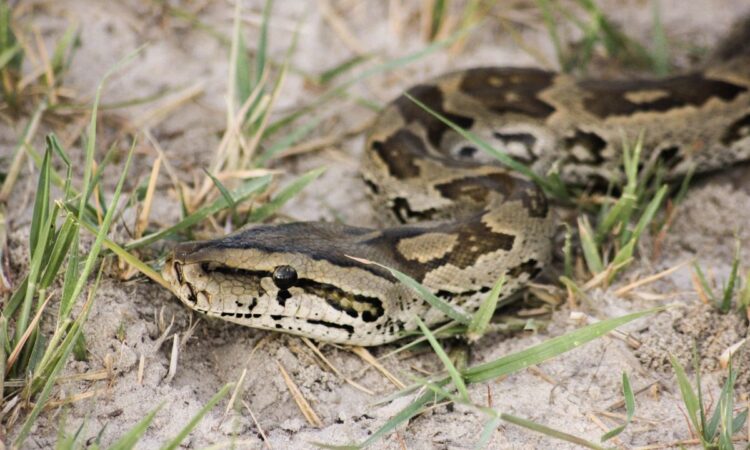
With no external ears, snakes have the inner ear to help them detect sound waves and vibrations. However, some snakes can detect airborne sounds that cause their bodies to somehow vibrate. Nevertheless, snakes can detect either prey or predator through sight, ground-vibrations and specialized sense of smell. Snakes appear in each continent a part from Antarctica. In Uganda, find the African rock python in Murchison Falls National Park.
Earthworm
With no ears earthworms cannot hear through the air like we humans do. Instead, they rely on vibration and touch, which are received through sensory cells in their skin. Besides Antarctica, earthworms are ubiquitous, in every continent on earth. But, you cannot find them in the desert or regions with permafrost. In Uganda, Democratic Republic of Congo, Kenya, Tanzania and Rwanda, you can see them in the garden on rainy days.
Contact us at Standard Safaris for an opportunity to see some of the animals on this list.


