
A perfect list of the top 10 tallest animals in the world is here. The list is unbiased as animals are got from all over the world. Some are found in East Africa and can be seen on your visit. They are not necessarily in order or in terms of height when the animals are standing on their hind legs. These animals are described as below,
10. Indian Elephant
Though quite shorter than their African counterparts, Indian elephants stand at 2-3 meters tall. Nevertheless, they are quite heavy, weighing up to 5,500 kilograms. Indian elephants are herbivores that survive for 60 years if left in their natural homes. Their diet has grasses, roots, tree barks and leaves etc. Meanwhile, Indian elephant population are currently on a decline. Therefore, they are under the category of endangered species.
9. Alaskan Moose
The Alaskan moose is quite tall, with a maximum height at their shoulder recorded at 2.3 meters. These are herbivores that can live in their natural setting for 15-20 years. They are also quite heavy, weighing 816 kilograms. Their population is however on the increase, which might be the reason why they are least concerned species. Find the Alaskan moose in North America, Asia and Europe.
8. Ostrich
This is a flightless bird that stands at a maximum height of 2.7 meters. On record ostriches are still the biggest birds worldwide, with an immense weight of 159 kilograms. They have powerful long legs, which is part of the reason they can run up to 45 meters per hour. Only a cheetah can beat that speed in Africa. Ostriches are omnivores, capable of surviving in the wild for 30-40 years. Though their overall population is on a decline, they are least concerned species.
7. African Elephant
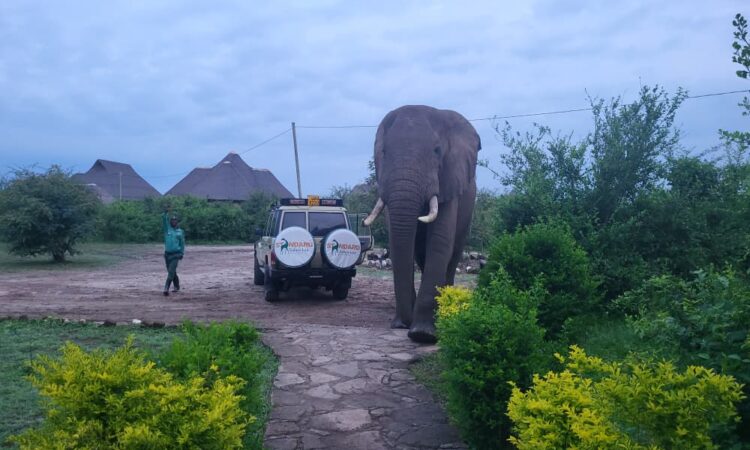
Their height is somewhere between 3 to 4 meters. No other land mammal competes with an African elephant in terms of weight because they weigh up to 6,350 kilograms. In East Africa, both the forest and savannah elephants can be seen in the wild. The latter are critically endangered while the savannah elephants are just endangered. In the wild they could survive until 70 years. Queen Elizabeth National Park, Masai Mara National Reserve and Serengeti National Park offer views of African elephants.
6. Whale Shark
This is the largest shark/fish species on earth. Whale sharks can measure at least 10 meters in length, which is the size of a bus. Whale sharks are known to survive in their natural habitat, the sea, for up to 70 years. They are carnivores that feed on plankton and a variety of fish species to achieve a weight of 20,600 kilograms. Their populations have been decreasing, and are now endangered species.
5. Brown Bear
Some brown bears can reach up to 3 meters if they stand on their hind legs. Their average weight is 317 kilograms. Brown bears seem to have a stable population, thus are species of least concern. Their homes are in the forests and mountains of North America, Asia and Europe. These are omnivorous mammals that can live in the wild for almost 25 years. In their diet, they mostly include leaves, roots, fruits, nuts and berries.
4. Lion’s Mane Jellyfish
Although not in the technical sense, they are in the top 10 tallest animals in the world. The tentacle of this jellyfish species can reach 37 meters long, and on average they are 30 meters. This makes them one of the longest animals on earth, in fact longer than the blue whale. Lion’s mane jellyfish are seen in the English Channel, some oceans and seas. One of its survival strategies is the ability to use its stinging tentacles to catch, pull and eat its prey.
3. Saltwater Crocodile
In terms of length, saltwater crocodiles are one of the top 10 tallest animals in the world. On average, their length can reach 5.2 meters. This is a carnivorous reptile that spends time both in water and on land. Saltwater crocodiles can live in the wild for up to 70 years. Saltwater crocodiles are also quite heavy, with some weighing up to 454 kilograms. These species are categorized under least concerned because their population trend is unknown.
2. Giraffe
A reticulated or Rothschild’s giraffe can stand at 5.8 meters in height. Giraffes are arguably considered the tallest mammals on earth. The giraffes are vulnerable species and can survive in their natural homes especially savannah grassland, for 25 years. Their height makes them lookout for their predators in the open savannah from a very long distance. On average these herbivores can weigh up to 1,270 kilograms. You can see them in Murchison Falls National Park and Masai Mara National Reserve.
1. Blue Whale
The blue whale is both the tallest and largest animal to ever been recorded. This mammal species has an average length of 32 meters. They are so heavy to the point where their weight can reach even up to 181,437 kilograms. Though blue whales are known to survive for 80-90 years in the ocean they are currently listed as endangered species. Blue whales are generally carnivores, and mostly consume krill.


