
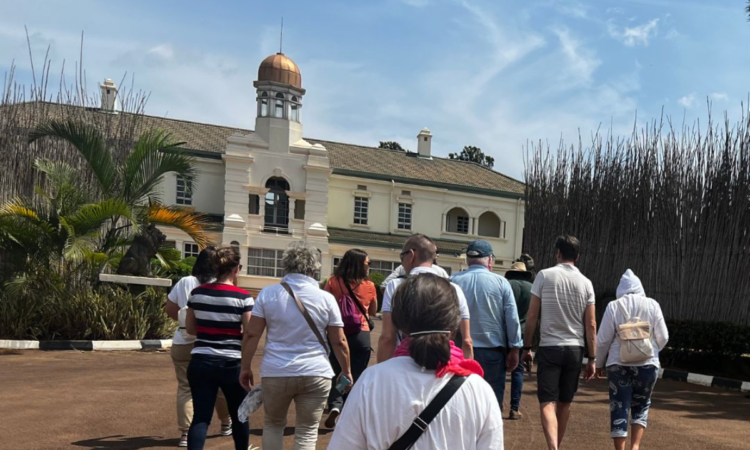
Visit Buganda Kabaka’s Palace to feel the weight of this legendary kingdom. A tour at the Kabaka’s (King of Buganda) Palace on Mengo Hill, Kampala city promises an immersive experience like no other. The iconic site is also widely known in Uganda as Lubiri, or the Mengo Palace, or among the Baganda, as Twekobe. The Kabaka’s Palace is the official residence of the Kabaka. The Bulange (Buganda Parliament) is the administrative headquarters of Buganda Kingdom containing offices of the Kabaka and the Katikiro (Prime Minister). This building is situated on Namirembe Hill.
The Kabaka’s Palace is linked to the Bulange by a straight road known as Kabaka anjagala (Kabaka loves me). This is known as the Royal Mile because it is 1 mile long and only supposed to be used by the Kabaka. According to the kingdom, the Kabaka must not turn a corner while on this road. On either side of this road, there are many carvings of animals that represent each original clan of Buganda. Walking on this road offers a chance of encountering the Kabaka who might wave at you.
Brief history
The Lubiri was constructed in 1884 by Kabaka Mwanga II. Also, the Buganda Parliament used to be convened in one of the palaces of the Kabaka. These meetings were done under tree shades. Later, each of the parliamentary buildings were constructed with thatching grass. But in the early 1900s, plans to construct a modern building for the parliament began. This was by the Prime Minister Apollo Kaggwa. It involved building the parliament outside the Kabaka’s palace for the first time ever.
In 1953, these plans were showed to the exiled Kabaka Edward Muteesa II in Scotland, who liked the idea. Soon after Muteesa II’s return from exile, he directed that a new Parliament building should be constructed according to the drawings. Construction started in 1955 with funding from the Buganda government. The Parliament building was completed in 1958. However, in 1966 the Kabaka’s Palace suffered significant damage. This was during the Buganda crisis when the Uganda army under President Milton Obote attacked the Palace.
This led to the exile of Kabaka Muteesa II and abolition of all Uganda kingdoms. Later, when Idi Amin Dada was president, some parts of this place became military barracks containing the infamous underground torture chambers. In 1993, President Yoweri Kaguta Museveni restored all Uganda kingdoms including the return of the Palace to Buganda Kingdom. This time, all kingdoms were cultural institutions. The Kabaka’s Palace was renovated and until today, the Buganda Parliament hosts numerous Buganda discussions.
What to see at the Kabaka’s Palace?
Visitors can explore a variety of things here. These include the perpetual fire that is lit twice each day, royal throne, photos, regalia, Muteesa II’s vehicle and Wankaki etc. Take your time to explore the Idi Amin Dada’s torture chambers and take photos. Relish the opportunity of gaining insight about the various clans that make up Buganda. Learn about the beliefs of the Baganda people including their hobbies, socio-economic activities and family structures among others. Pay close attention to details regarding the lineage of the Kabaka including their history.
How to reach there?
While in Kampala or Entebbe, reaching the Kabaka’s Palace requires only the use of road transportation. From the Kampala city center, you will drive for only less than 5.3 kilometers to arrive at the entrance. We as Standard Safaris urge you to use private travel, to avoid as much as possible uneasiness, disappointments and delays etc. A number of reputable companies offer cars for hire at budget-friendly prices. For example, we offer a wide range of vehicles including sedans, SUVs, safari vans, minibuses and buses to suit your budget.
You will also need the experience of our knowledgeable driver guides to navigate the busy streets of Kampala city. While on your drive to and from the Kabaka’s Palace our driver will also offer deep insight into Kampala in particular and Uganda in general. Trusting us with your transport needs has other benefits as well. For example, we also help in designing your tour package to encompass plenty of other things. Our tour packages include other safaris, meals, accommodation and others.
Where to stay while exploring Kabaka’s Palace?
While exploring the Kabaka’s Palace in Kampala you will have plenty of accommodation options where to stay. By the way the accommodations come in a wide range of types, including budget, midrange and luxury. Below are the selected accommodations for each type to suit your budget and interest,
Kampala Serena Hotel
This is a 5-star luxury hotel situated in Kampala just 5.9 kilometers from the Kabaka’s Palace. You are presented 186 spacious Deluxe rooms and Suites to select in Kampala Serena Hotel. All of these rooms are fitted with modern air conditioning to make your stay memorable. After exploring the Kabaka’s Palace, you will jump into the wide swimming pool to cool off and relax. There is enjoyment in dining and sipping a beverage in the magnificent restaurants or bars. It is acceptable here to take your beverage in any of the lounges or minibar in your room.
Dolphin Suites
Dolphin Suites is a midrange accommodation only 9.7 kilometers away from the Kabaka’s Palace. Nevertheless, there are 27 elegant suites that you can choose from in Dolphin Suites. These come in Singles, Doubles and Twin Deluxe suites. Moreover, you will also enjoy air conditioning in any of the rooms you have selected to stay in. Your dining experience is elevated by the combination of local and international cuisines prepared by professional chefs. Enjoy dining in the beautiful large and fully furnished restaurant or your room.
Forest Cottages Kampala
Forest Cottages is a budget accommodation slightly over 8.4 kilometers away from the Kabaka’s Palace. Enjoy your quiet and comfortable stay in one of the Standard rooms and cottages on the Naguru hill slopes. Also, you will enjoy dining in elegance with your food carefully prepared to include either local dishes or international cuisines. There is also a variety of beverages offered in the modern bar to make your relaxation even much better. Rooms have ensuite bathrooms and air conditioning etc.


