
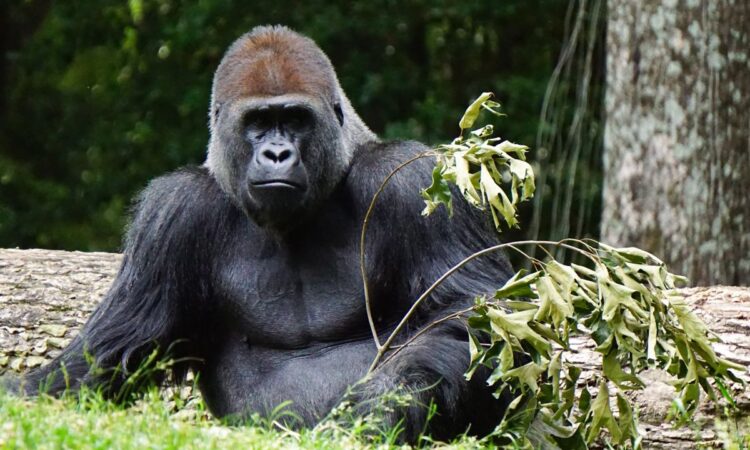
What is a gorilla’s worst enemy? It is the human being. This seems obvious, but why would it seem that way? For decades, we have been among the primary drivers of the low gorilla numbers on earth. This is thanks to our activities that have destroyed large chunks of gorilla habitats. We destroy some parts of their habitats for agriculture and settlement. Also, land fragmentation is done in the gorilla habitats.
Humans also threaten gorilla survival with diseases especially Ebola. However, pollution or reduction in the habitats can lead to rapid spread of anthrax, Covid-19 and other deadly diseases. Poaching for bush meat is also an issue that cements the hatred of humans to these apes. Even traps set up to capture the apes might lead to their deaths and severe injuries. Retaliations by humans when gorillas enter their gardens to eat crops also lead to this conflict.
What are the sub-species of Gorillas?
Gorillas have 4 subspecies, that in the wild, only live in Africa. These are Western lowland gorillas, Eastern lowland gorillas, Mountain gorillas and Cross-River gorillas. The Eastern lowland gorillas are the biggest, while the western lowland gorillas are the smallest. All prefer living in troops that are known as gorilla families. A family is often headed by a silverback – a mature male gorilla with a silver-grey saddle developed across his back.
Where do Gorillas Live?
In the wild these apes are found in subtropical forests of the equatorial part of Africa. Their habitats stretch across a dozen countries, from West-central Africa through East-central Africa. Gorillas are split into 2 distinct regions, with the western gorillas roaming in lowlands, swamps and coastal forests. Meanwhile, the eastern gorillas live in both lowland forested habitats and mountainous regions. Mountain gorillas live in Rwanda, Uganda and Democratic Republic of Congo. Eastern lowland gorillas are only found in Democratic Republic of Congo.
Western gorillas thrive in places with sea level marshes, and montane forests that reach up to 1,600 meters above sea level. On the other hand, eastern gorillas occupy high-altitude montane forests (650-4,000 meters above sea-level). Among the eastern gorillas, the Eastern lowland gorillas live in sub montane forests. It is the mountain gorillas that occupy higher elevations than the former gorillas. These gorillas live in D.R. Congo, Republic of Congo, Gabon, Cameroon, Equatorial Guinea, Angola and Central African Republic. Cross River gorillas live in the Cameroon-Nigerian border.
What do Gorillas Eat?
All gorillas are known to generally be herbivores because they love eating fruits, roots, vines, herbs, shoots, and shrubs etc. It is also common to find gorillas eating ferns, fibrous barks, gorilla dung, fungi, and pith. But they also love to supplement vegetables with some protein, though not so much. Also, gorillas eat some insects they find on the vegetation. Some of these include termites, ants and larvae among others.
What is the population of gorillas in the wild?
Population of western lowland gorillas in the wild is 360,000 and that of the Cross River gorillas is 300 or less. Mountain gorillas are currently 1,063 and their population is still increasing. The eastern lowland gorillas are currently 5,000 individuals. Uniquely, these are found only in the Democratic Republic of Congo. To date their habitats are still threatened with armed conflict etc. that has significantly reduced their number from 17,000 in the 1990s.
What is the Conservation Status of Gorillas?
Reports on the IUCN red list of endangered species indicate that mountain gorillas are now listed as endangered. Meanwhile, the eastern lowland gorillas are critically endangered, thus has the higher risk of extinction in the wild. Both results show that these gorillas are still generally conservation dependent. A variety of factors have led to this. War in the Congo eastern region, habitat destruction, hunting for bush meat and communicable diseases from humans.
The western lowland gorillas are critically endangered according to IUCN Red list despite the fact that they are relatively more. Cross River gorilla is also critically endangered, and you can tell by their lowest population among the 4 subspecies. Despite of the conservation statuses, there is still ongoing effort to increase each of their numbers in the wild. Many of their families are being habituated as part of the efforts.
What is the best time to see Gorillas?
Gorillas can be seen in the wild on any day, but dry seasons make the treks easier to do. Each dry season causes drier atmospheric conditions in the gorilla destinations. When this happens, the gorilla trails are dry and passable on foot. Even the foliage is not so dense which creates perfect conditions for walking and observing the gorillas. Also, when it does not rain heavily and frequently, you will surely trek without pausing until it stops.
To see gorillas during the dry season you can travel to Uganda, Rwanda and Congo in June-September and December-February. However, never hesitate to do gorilla tours in the wet seasons because of some advantages. First of all, gorilla trails are muddy and slippery, which is an exciting time for the physically fit and thrill-lovers. Then, discounts are usually offered on gorilla permits, accommodation and others. You also enjoy intimate gorilla encounters due to small crowds.
What is the cost of Gorilla Trekking in Uganda, Rwanda and Congo?
Uganda offers gorilla trekking at $800 for a foreign nonresident, and $700 for a foreign resident in the country. Only 300,000 shillings for Ugandans/every citizen from the East African community and $500 for those from Rest of Africa. Rwanda does this for $1,500 for foreign nonresidents, $500 for foreign residents/Rest of Africa, and $200 for citizens/East African Community. Democratic Republic of Congo has more pocket-friendly rates: $400 for foreigners, $200 for East African Community and $20 for citizens.
Why do Gorilla Tours with Us?
We at Standard Safaris set ourselves apart from all tour operators by delivering deeply authentic gorilla tours across Uganda, Rwanda and Congo. We achieve this through a combination of strategies, including the utilization of highly knowledgeable and locally based guides. They hold intimate connections to the region for authentic experiences. As a trusted community-grounded tour operator, each of our travels offer profound cultural insights and reliable firsthand expertise.
The praise from our clients and the TripAdvisor reputation we have built over the years indicates an ongoing commitment to safety, luxury and consistently memorable gorilla encounters. Also, our comprehensive packages cover every detail so well to provide excellent planning in permit handling, transportation and cozy accommodations. All these are included without hidden or extra fees. Contact us to start planning your bucket-list gorilla tour and more today.


