
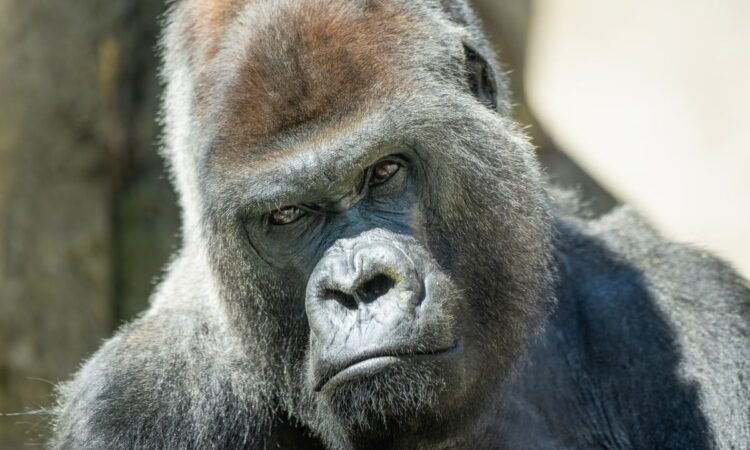
Which animal eats gorillas? In the wild, leopards prey on mountain gorillas. There are several reasons why leopards are the primary predators of gorillas. Both leopards and gorillas share the same habitat. These are the only known large African apex predators that are hosted in the dense jungles with the gorillas. Leopards are also exceptional climbers which allows them navigate the canopy easily. With this smart tactic they can ambush the gorillas and bypass their ground defenses. The leopards also use night ambush tactics to prey on the gorillas. Through this, they can leverage stealth, with their excellent night vision to lunch surprise attacks on the sleeping gorillas. It is also much easier to prey on the vulnerable infant gorillas because they may not be aware of their surroundings.
How Gorillas avoid Predators?
Gorillas use several mechanisms or tactics to ensure that predators do not prey on them. One if living in groups/families, often led by powerful silverback. This is quite efficient as predators find difficulties in isolating individual gorillas in a close-knit troop. Secondly, gorillas, especially the silverback displays intimidation tactics when threatened. When a leopard shows up, a gorilla will scream, while beating their chest and displaying his large canine teeth. Such a move can scare away a threat.
Thirdly, when desperate, the dominant silverback can stand his ground and courageously charge at a predator. They take advantage of their immense strength and powerful hands to fight their predator. Fourthly, gorillas tend to move quietly or stealthily in the forest to avoid drawing attention of leopards and other predators. Mountain gorillas tend to reside in mountainous forests for various reasons. One is for spotting approaching threats including predators. Even lowland gorillas occupy mountain slopes, sometimes open areas where they can easily scan and spot threats from a far.
Where to do gorilla tours?
Gorillas tours can be done in East, west and Central Africa. In east and central Africa, there are 2 populations of mountain gorillas, one in the Virunga Conservation Area. This is where they roam in 3 national parks, Rwanda’s Volcanoes, D.R. Congo’s Virunga and Uganda’s Mgahinga Gorilla NP. Another population is in Bwindi Impenetrable National Park. All these national parks have habituated gorilla groups that can be tracked during every morning. But, there is also a population of lowland gorillas found in D.R. Congo. Gorilla tours can also be done in Kahuzi-Biega National Park where the critically endangered eastern lowland gorillas live.
How Gorilla Tours are done?
In any of the 5 national parks mentioned, gorilla tours are done in a similar way. The tours normally start at 8:00 a.m., with briefing at the trailhead/park headquarters. Park rangers are there to offer tips on how to track gorillas in the dense forest in a safe way. For example, you should not make noise, or wander off the gorilla trails, or even get too close to the gorillas. Try to maintain 7 meters away from the gorillas when you meet them. These and more will be told to you before you enter the forest with very capable ranger guides.
During the tracking part, you look for a gorilla family, that you have been given some information about. There will be 1 hour set for the watching experience, when you find the gorillas. Pay attention to their unique behavior in the wild because they will express many of these. Notice how they prefer eating vegetation more than any other food. They also play, climb some lianas, communicate to each other and take some time to groom each other. When this is done, you will be guided back to where the tour started. End it and realize that it went for 2 to 6 hours.
Cost of Gorilla Tours
Different countries offer different prices for gorilla tours in their respective destinations. Congo offers the cheapest prices for gorilla trekking tours. It will cost a foreign nonresident 400 US dollars to trek gorillas in either Virunga or Kahuzi-Biega National Park. In Virunga National Park gorilla trekking is offered at a discount during the low season—October to December. You will have to pay 200 US dollars per person.
Uganda offers gorilla trekking at $800 per person for foreign nonresidents. Meanwhile in the low season, a discount is offered for these tours. Each visitor will have to pay 600 US dollars per person in the moths of April, May and November. Gorilla habituation experiences cost much higher than that. Each experience in Rushaga sector of Bwindi National Park is offered at 1,500 US dollars for each foreign non-resident. Rwanda’s are offered at 1,500 US dollars for each foreign non-resident.
What is the best time to see Gorillas?
Choose the dry season to see mountain gorillas for the easiest moments of tracking the gorillas in the forest. Dry seasons are also preferred for gorilla tours because the skies above are usually clear to offer crystal clear views in the forest. Rainfall patterns during the dry season reduce so much, thus low precipitation during the day. This has 2 advantages, and one of them is relatively low humidity to ensure you are comfortable in the forest. The second is a continuous experience in the forest because disruption due to rainfalls has reduced. Gorilla trails become drier when rains reduce, which is during the dry season. Now you can track the gorillas without minding about slipping or sliding. June to August and December to February are dry seasons every year.


