
Rwanda is a small landlocked country in East Africa that passed through tragic times that shaped its future and heritage. Uganda borders Rwanda in the north, Tanzania in the east, the Democratic Republic of Congo in the west, and Burundi in the south. This great land of a thousand hills has amazing features that interest most visitors. A notable factor is the endangered mountain gorillas that are found in the Volcanoes National Park, the Big 5 in Akagera National Park, and chimpanzees in Nyungwe Forest National Park to mention but a few. Rwanda has three main ethnic groups or tribes Tutsi who are the minority, Hutus the majority, and Twa who are relatively minimal. History has it that the Twa people were the first inhabitants of the country between 8000 and 3000 BC. These were followed by the Hutus and Tutsi during the Bantu migration. Traditionally the Twa pygmies are hunters and fruit gathers, Hutus are cultivators, and Tutsis are cattle keepers. When kingdoms came into play during the 18th century as clans divided and eight were formed, the Tutsi became the leaders of the clans and the Nyiginya clan became the ruling clan. It ruled the Kingdom of Rwanda for many centuries however this leadership caused Hutus to hate the kingdom since they were seen as servants to the kingdom.
What is the 1994 genocide in Rwanda?
To understand the Kwibuka ceremony of the 1994 genocide in Rwanda, we need to understand what the 1994 genocide was. The 1994 genocide in Rwanda was a 100-day all-out massacre of the Tutsi ethnic group and moderate Hutus and Twa people who sympathized with the Tutsis. The 7th of April 1994 is a date that will forever be tragically remembered in Rwanda for generations. This is because on this date the Hutu militias carried out an all-out genocide against the Tutsi minority where it is believed that over a million people were killed across the country.
Why did the 1994 genocide in Rwanda happen?
The ethnic tensions between the Hutus and Tutsis were a timing bomb and it was a matter of time before it would blow out. This tension began when a Tutsi rebel group called the Rwandan Patriotic Front consisting of the Tutsis in exile in Uganda began a war against the Hutu government in Rwanda. In 1993 the war came to a cease-fire as there were peace negotiations taking place in Arusha Tanzania. However, as the then Rwandan President Juvenal Habyarimana was coming from the peace meeting in Tanzania in 1994, his plane was shot down as it landed. He died together with the Burundian president who was traveling with him in the plane. This incident sparked the 1994 genocide across the country seeing there was a power vacuum to stop this tragedy. The Hutu militias took this opportunity to massacre their Tutsi brothers. This was a way of tribe cleansing that eliminated all the Tutsi people across the entire country.
The genocide was fueled by the anti-Tutsi propaganda that was spread by the Hutu journalists who encouraged the killing of the Tutsis. The militias used various tools and methods for killing including machetes, using aggravated rape tactics like using HIV-positive people to rape women and girls. Guns and hand grenades were used to eliminate the Tutsis in a larger group such as the Nyamata church where over 20,000 people were killed as they sought refuge in the Nyamata Catholic Church thinking the Hutu militants would not enter. To their shock, the militias bombed the church entrances and opened fire on the hiding Tutsi killing most of them. This genocide stretched across the country for over 100 days and on 19th July 1994 the Rwandan Patriotic Front overthrew the government forces and ended the genocide.
Kwibuka Ceremony
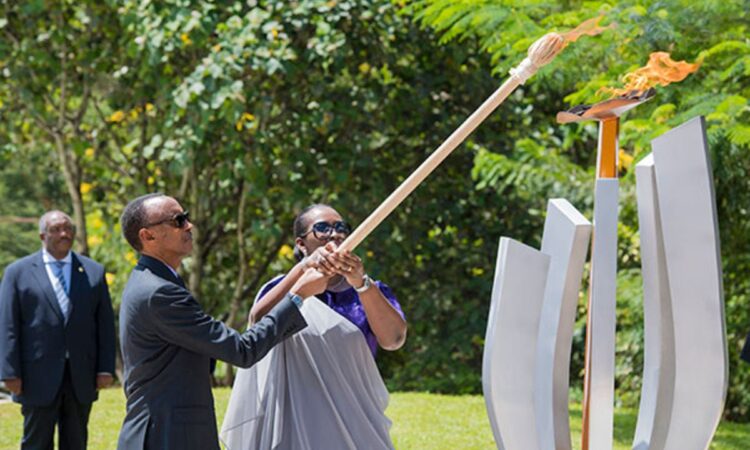
Kwibuka is a Kinyarwanda word that means “to remember”. The Kwibuka ceremony was set up to remember the victims of the 1994 Rwanda genocide against the Tutsi. The ceremony is symbolized by a touch or flame that represents the hope and resilience of the Rwandans. It is also met to remind the international community to speak out against hate and tribal tension. The Kwibuka ceremony begins on 7th April every year lasting for 100 days commemorating the 100 days of the Rwandan genocide against the Tutsis. This ceremony is meant to remember the victims and for people to reflect on the genocide and teach future generations the dangers of genocides and why they should never happen again.
What are some of the genocide sites in Rwanda?
These genocide sites in Rwanda are places where massacres took place during the 1994 genocide in Rwanda against the Tutsi. These include the following.
Kigali Genocide Memorial
The Kigali Genocide Memorial is located on the Gisozi hill in Kigali. This genocide memorial is a place that hosts the remains of over 250,000 people who were killed on this hill. The memorial has three sections, one showcases the actual names of the children victims of the genocide. The second section shows the adults who died and the third shows the different genocides that have taken place in the world.
The Presidential Palace Museum
This museum is located in Kigali at the former president’s palace. The Presidential Palace Museum showcases Rwandan history and artifacts. This palace was once home to President Juvenal Habyarimana before his assassination in 1994. His plane was shot as it was landing and the plane debris is still invisible at the palace compound.
Nyamata Catholic Church
This Catholic Church came to the history books during the 1994 Rwanda genocide. As massacres of the Tutsis were patriated by the Hutu militias, a large group of Tutsis hid in a catholic church in Nyamata town. They thought they would be safe in the church however to their shock, the militias found their way to the church and broke open the church doors with hand gerunds and opened fire upon entry killing 20,000 people. The remains of the people and their clothes are still visible today and the church is now a genocide site.


