
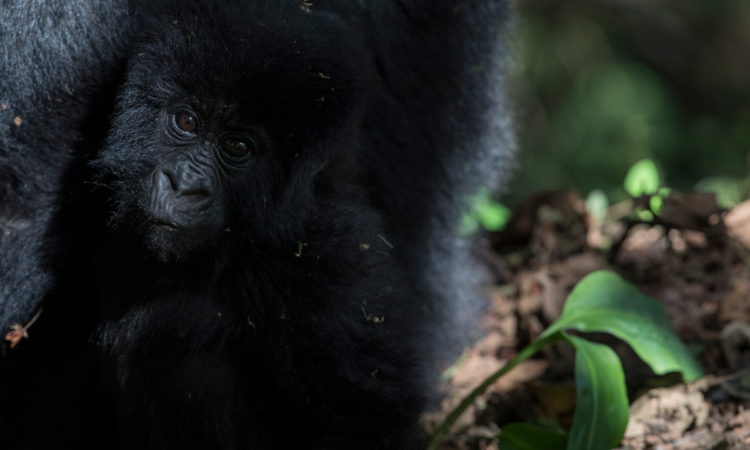
Located in Rwanda’s far northwestern region, Volcanoes National Park is the country’s most popular national park. Volcanoes National Park derives its name from the dormant volcanoes that call this park their haven. The park harbors five of the eight volcanoes of the Virunga mountain ranges. These include Mount Karisimbi which is the highest, Mount Sabyinyo, Mount Mahavura, Mount Bisoke, and Mount Gahinga. All the above mountains are dormant volcanoes hence forming the name Volcanoes National Park. However, Volcanoes National Park is not popular for housing these dormant volcanoes though they are also a significant feature to explore, the park is home to the endangered mountain gorillas. These mountain gorillas harbor the steep slopes of various mountains in the park hence their name “mountain gorillas”. These gentle primates are referred to as endangered because there are very few left in the wild since they are only located in the Virunga conservation area. This conservation area stretches from the Virunga National Park of the Democratic Republic of Congo through Uganda’s Bwindi Impenetrable National Park and Mgahinga Gorilla National Park to the Volcanoes National Park of Rwanda.
Volcanoes National Park is one of the oldest protected areas in Africa and the world. It was established in 1925 to protect the endangered mountain gorillas are they were first sighted. This made it Africa’s oldest park and Rwanda’s first national park. It stretches for about 160 square kilometers encircling the five volcanoes of the Virunga mountain ranges. The park also gained international recognition when it hosted a renowned primatologist and conservationist Dian Fossey. Dr. Dian Fossey dedicated her life to raising awareness of these endangered mountain gorillas and the dangers they face like poaching. She set up a base inside the Volcanoes National Park and named Karisoke Research Center where carried out her works like habituating these primates and studying their behaviors. Her works grew internationally as she attracted funding to better her awareness campaigns and protect endangered mountain gorillas. Her story and works of hope took an unfortunate turn when on the 26th of December 1985 she was murdered inside the park. Though her life was unfortunately cut short, her legacy and work still go on.
Mountain gorillas share about 98% of their DNA with humans thus their similarity in living. Just like humans, mountain gorillas are social beings who live in a group called a gorilla family. This family is headed by a dominant male gorilla called a silverback because of the silver-like fur on their low backs. However, there can also be more than one silverback in a particular family but the dominant one is always the head of the entire family.
Kigoma gorilla family
Volcanoes National Park has over 15 gorilla families and notably Kigoma gorilla family is part of them. The Kigoma gorilla family or group is the newest in the park having been formed on the 31st of December 2023. This gorilla family derives its name from the dominant and leader of the group the silver Kigoma. This family was once part of the Kwisanga group which often had two sub groups in it. Kigoma the silverback then decided it was time to move and start his own family thus splitting from the Kwisanga group. Splitting of some gorilla individuals from one group to form another can in most cases be after a brutal fight for dominancy between two silverbacks that sees the defeated silverback moving away with some females to start another group. However, that was not the case with the Kigoma gorilla family since it was a peaceful move that saw Kigoma the silverback leaving with 4 members to start his family. This group has a silverback, a blackback, a juvenile, an adult female, and an infant.
As mentioned earlier Volcanoes National Park has 14 more gorilla families that include some of the following.
Amahoro gorilla family
This is another gorilla family in the Volcanoes National Park. It was named after the silverback Amahoro one of the former leaders of this group. The name Amahoro is a Kinyarwanda word meaning peace and the then silverback Amahoro the name suited him since he was peaceful and friendly. This group was first habituated in 1997 and by 1998 the process stopped because of the civil war in the country and later in 2000 it was open for trekking. At the age of 31, Amahoro died on the 4th of May 2002. His succession was not a smooth process as the two subordinate silverbacks Ubumwe and Charles fought for dominancy leading to the splitting of the group. Charles marched on to form his group which was later named Umubano and Ubumwe remained in the Amahoro family. However, Ubumwe in June 2015 disappeared without a trace leaving the group to the silverback Gahinga who is now the dominant silverback. The group has over 22 members.
Kwisanga gorilla family
The Kwisanga gorilla group is also a new group in the park after being formed in 2021 on the 4th of May. The dominant silverback Lisanga is the leader of this family. Kigoma the former dominant silverback still had a desire to lead and hence decided to peacefully leave the group with four other members to start his own family. The Kwisanag gorilla family now has about 10 members.
Susa gorilla family
The Susa gorilla family is one of the oldest families in the Volcanoes National Park. It was formed in 1974 and is part of the group that was used in research by Dr. Dian Fossey. It is famous for hosting two sets of twins ever to be recorded in the history of mountain gorillas. The group also holds the record of once being the largest group with over 41 individual members. The group went under many splits that formed many other families like Karisimbi and Igisha groups thus significantly reducing its numbers. The Susa group now has about 15 members under the leadership of the dominant silverback Impuzamahanga who replaced Kurira after he disappeared.


