
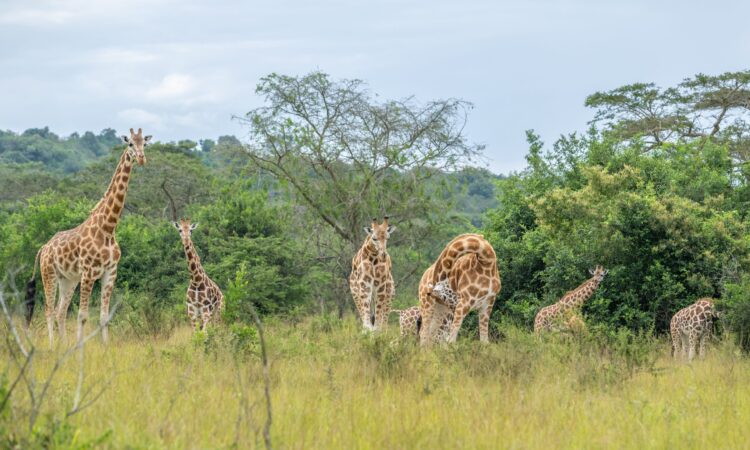
Uganda’s giraffe population increases to 100 in Lake Mburo National Park. The population of Rothchild’s giraffes have grown from the previous less than 50 in the park. This tremendous increase in giraffe numbers follows their successful translocation from Murchison Falls National Park in 2015. This was after careful ecological studies were done to determine the feasibility of Lake Mburo National Park as their new home. Only 4 male and 11 female giraffes were introduced to boost the low numbers in the park.
In the first 8 years, the introduced Rothchild’s giraffes fruitfully bred and caused an immense growth of up to 65 individuals. This success is a testament that Lake Mburo National Park is among the best giraffe conservation sites in Uganda. Lake Mburo National Park is a savannah park, just like the vast Murchison Falls National Park hence offers similarly suitable habitat requirements to ensure the survival of the Rothchild’s giraffes in the wild.
For decades Lake Mburo National Park was used by the local people for hunting, fishing and grazing of cattle. Even the Ankole King (Omugabe) used Lake Mburo National Park as a hunting ground. Most of the activities led to the local extinction of numerous wild animals. Illegal hunting of game has remained a significant issue. But, Uganda Wildlife Authority along with the locals are implementing modern strategies to curb the activities and conserve wildlife.
What are some of the facts about Lake Mburo National Park?
Lake Mburo National Park is around 260 square kilometers in surface area and found in the western region of Uganda. The park was first designated as a controlled hunting area in 1933. In 1963, the site became a game reserve. In 1983, it was officially established as a national park. With an altitudinal range of 1220-1828 meters above sea level, the park has numerous habitats. These include savannah grassland and woodland, swamp, open water and forest etc.
Recorded mammal species in Lake Mburo National Park number up to around 69. These include the Rothchild’s giraffes, Burchell’s zebras, topis, elands, hyenas, African buffaloes, hippos, Uganda kobs and sitatungas etc. The recorded bird species are around 350 and include shoebill stock, white-winged warbler, black crake, African darter, papyrus warbler, papyrus gonolek, African jacana, African finfoot, papyrus yellow warbler and pied kingfisher etc.
Around Lake Mburo National Park, you will find the indigenous Banyankole who make up majority of the people. The Banyankole include Bahima who mostly practice cattle-keeping as their main source of livelihood. The Bairu are also part of this tribe and are mostly crop farmers. These people make Lake Mburo National Park an important place where interesting cultures can be encountered besides doing wildlife safaris to see giraffes.
How to see giraffes in Lake Mburo National Park?
Rothchild’s giraffes, like most wild animals in Lake Mburo National Park can be viewed during a day game drive. Enjoy yourself in an open-roof safari car driven by a passionate and knowledgeable driver guide from Standard Safaris. You will drive on a number of game tracks to places they frequent the most. You can also see them while on a nature walk, in the company of a park guide. During a delightful horseback safari, giraffes can be spotted as well.
Seeing giraffes in Lake Mburo National Park costs 25$ on a guided walking safari with an armed ranger guide. However, this does not include park entrance fees. The entrance fee at Lake Mburo National Park is only 40$ per day. This can be booked through a reputable tour operator like Standard Safaris. We have a well-organized team of staff to ensure that you enjoy your safari experience in Lake Mburo National Park without any inconveniences.
With Standard Safaris, you will be informed about how and when to make your payments. Our excellent team of professional tour consultants will also tailor your tour package to ensure that it is all inclusive. This implies that transport, meals, accommodation and more tour activities are included. This subsequently makes your experience in Lake Mburo National Park and the entire Uganda stress-free.
Best time to see giraffes in Lake Mburo National Park?
The gates of Lake Mburo National Park are open year-around. Therefore, plan your visit to see the giraffes on any day you find convenient. Though out-door activities like game drives can be done on any day, they are more enjoyable during the dry season. At Lake Mburo National Park, the dry season occurs from June to August and December to February. These periods offer relatively drier and warmer weather conditions in Lake Mburo National Park.
Your game drive or nature walk will be done on dry game tracks or trails respectively to make movement very comfortable. During the dry season, Lake Mburo National Park has less dense foliage. This provides clear views of wild animals in the park including the giraffes. The dry season also offers fewer water sources for wild animals in the park. Therefore, they have to gather around the few remaining sources to ensure that you see them.
How to travel to Lake Mburo National Park?
You can travel to Lake Mburo National Park by either road or air transport. With a scenic journey, the distance covered is around 240 kilometers from Kampala via Masaka and Mbarara roads. The time you are likely to take your trip to the western part of Uganda is 4-5 hours. Private means is the best way to travel to Lake Mburo National Park to see these lovely giraffes. With a passionate driver from Standard Safaris, your transfer will be as seamless as never before.
By air, your flight will start from Entebbe International Airport to Mbarara Airstrip. This is a short 45-minute flight with offers of excellent aerial views of western Uganda. The comfortable scheduled flights are offered by the experienced and reliable AeroLink Uganda. As soon as you step out of the aircraft, a passionate representative from Standard Safaris will greet you, and will ensure that you reach your final destination by road, a journey that takes an hour.


