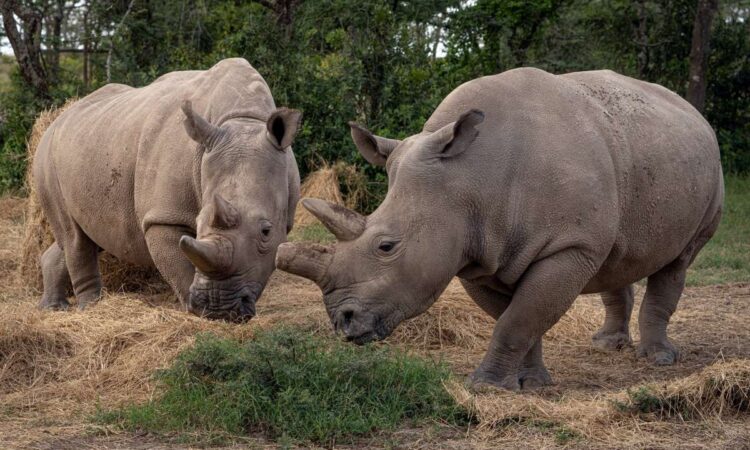
In early June 2025, precisely 70 southern white rhinos were successfully relocated to Rwanda’s Akagera National Park from South Africa. This was a concerted effort involving key actors, including the Rwanda Development Board, African Parks, and other partners. The journey from Munywana Conservancy in South Africa to Akagera National Park in eastern Rwanda spanned around 3,400 km.
Both road and air transportation modes were used for this extremely long journey. Ground transportation was by truck, and air transportation was by Boeing 747. Currently, this is the largest translocation of rhinos by air ever. From Munywana, each of them was put in a steel crate. Then, they were driven to King Shaka International Airport in Durban. At the airport, cranes were used to load the crates on a Boeing 747, bound for Kigali International Airport.
Upon arrival at Kigali International Airport, the rhinos were then driven by truck to Akagera National Park. Here, they were released into the Savannah Park. The rhinos were relocated in 2 separate phases, spanning only 3 days. In each phase, 35 rhinos were translocated. Since their arrival, a team of veterinary officers has been monitoring their progress regarding adaptation and stress levels.
Why relocate the southern white rhinos from South Africa to Rwanda?
In 2021, Akagera National Park received 30 southern white rhinos from South Africa. After their introduction, these rhinos increased to 41 through breeding. This implies that Akagera National Park is a suitable habitat for southern white rhinos. Therefore, meta-populations of southern white rhinos can be established in Akagera National Park. This will help in expanding the number of southern white rhinos that are already threatened with poaching worldwide.
Because this translocation is the first of its scale, the success could be replicated in some other well-managed ecosystems. This will enhance their wildlife conservation status from near threatened. The key partners and collaborators here include the Rwanda Development Board, African Parks, Munywana Conservancy, conservation experts, and relocation experts, among others. This strategy will also be used for other relocations throughout Africa.
The relocation is part of the Rhino Rewild Initiative, funded by Howard G. Buffett Foundation. This makes it imperative to study the survival of the southern white rhinos from South Africa to Rwanda. For instance, the rhinos were moved from the Rhino Rewild site to Munywana Conservancy—a collaboration of both the local community and private land owners. The conservancy is a place with similar ecological conditions to Akagera National Park.
Interesting facts about white rhinos?
White rhinos are generally large and heavy, with a large head, short neck, and broad chest. Southern white rhinos are only slightly different from the northern white rhinos. The southern white rhinos are slightly larger and have slightly more hair on their exterior. However, the shape of their teeth and heads is also slightly different. Contrary to their name, their skin is greyish. Their lips are squarely which differs from the pointed shape of the black rhinos.’
White rhinos are territorial but semi-social at the same time. Their territories are defended by males with their horns and great size. They prefer staying and feeding together in herds, while males are quite solitary. In their herds, you will notice that they love mud so much. They do roll in the mud to cover their bodies. This is very important to them as it cools down their body temperature during hot weather. This is also used to protect their bodies from insects.
Southern white rhinos can live up to 35 years in their natural homes and at least 40 years in captivity. Southern white rhinos feed generally feed on short grasses. The females produce once every 2/3 years to a single calf. Their gestation period is around 16 months, almost twice that of humans.
Best time to see Southern White Rhinos in Akagera National Park?
Generally, the majority of activities in Akagera National Park are best done during the dry season. This is a time when the rainfall total received in Akagera National Park is relatively much lower than in the rainy season. The result of this is low vegetation cover throughout most of the savannah ecosystem. Subsequently, the southern white rhinos get less cover while roaming around their home ranges. This offers clear views for you while on a game drive or nature walk.
The low rainfall total is also good for game drives and nature walks. When the game tracks are dry, the game drive is smooth as you cruise in a safari car. You do not need to worry about being stuck in mud like during rainy seasons. The dry season is mostly experienced from June to August. Another dry season with light rains occurs from December to February. Nevertheless, Akagera National Park is open for you to see southern white rhinos all year round.