
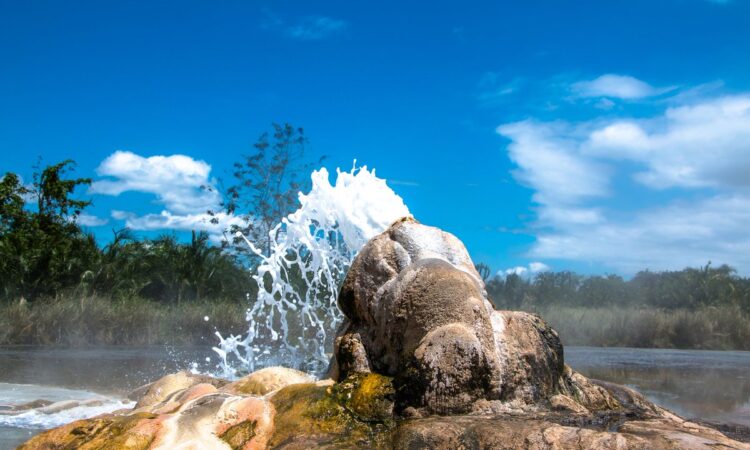
The magical Sempaya hot springs are the face of Semuliki National Park and the major attraction. They get their name, Sempaya, from a Kiswahili phrase Sehemu Mbaya, meaning difficult. Situated in the heart of Semuliki National Park on the border with the Democratic Republic of Congo, the Sempaya hot springs face the Ituri Forest of Congo, where the Semuliki River flows. These hot springs are formed when groundwater beneath the earth is pushed rapidly out of the ground or the earth’s surface through vents or fissures after it is boiled upon coming in contact with very hot rocks underground in the earth’s core. Geographically, the hot springs are called geothermal springs. The Sempaya hot springs are not just an important part of Semuliki National Park as a top attraction, but are also beneficial to the local communities around the park. Formed many years ago, the Sempaya hot springs gained much popularity within the local communities after they believed the hot springs harbor their traditional gods. These hot springs are categorized into two, with one known as the male hot springs and the other the female hot springs. These two hot springs are a 30-minute walk from each other with a joining wooden path.
The male hot spring is locally known as Biteete and is classified as a holy temple where the male god resides. Many local people, especially the men, visit this site more often for spiritual blessings from the male god, such as wealth. They offer sacrifices at the hot spring to their male god and, in turn, wait for blessings. This narrative of the male hot spring being a holy sight, as referred to by the locals, came into play years ago. The local tribe in the area of the hot springs, called Bamaga, tells a story of how their women were out collecting firewood and saw a man wielding a spear with a dog. Frightened as they were, they rushed to their men, who followed up and captured the mysterious man and took him back to the village. As time moved on, this man, who was to be known as Biteete, married a woman called Nyasimbi from the village. Later, Biteete went for hunting with his dog in the present-day park area, where he was first met and was never seen again. After searching for a while for him by the locals, they later discovered his spear in the area of the present-day hot spring. The Bamaga people then concluded that he was a god, and he disappeared into the hot spring. This is how the male hot spring traditionally came to be known.
Comparably, Nyasimbi, the wife of Biteete, the believed god who disappeared in the male hot spring, went out alone to find her husband. Hours passed, and she had not returned home. Worry filled the locals back home, and a search was conducted in the area. The local searched the entire area, but there was no sign of her. As they were about to return home, they came across the clothes that she had left at home as she went to find her man. These clothes were at the now female hot springs. When the locals saw this, they were astonished and named it the female hot spring after the Nyasimbi, the disappeared wife. This female hot spring has attracted many local women who flock there in prayer for the blessings of fertility and health.
The locals believe that the Sempaya hot springs are not just of spiritual benefit, but also offer healing to those with skin diseases. On a visit to these hot springs, visitors can spot the locals resting by the springs as some relax in the warm water flowing from the springs.
What else is there to see at Semuliki National Park?
Although the Sempaya hot springs form the face of the park, ranking as the top attraction, Semuliki National Park also possesses other incredible sights and sounds that are interesting to encounter. These include some of the following.
Wildlife
Semuliki National Park has a wide range of wildlife species that visitors can spot upon visiting this park. The wildlife species to look out for include the forest elephants, forest buffaloes, hippos, crocodiles, the water chevrotain, bay duiker, bush babies, civets, and flying squirrels, among others.
Birdlife
Semuliki National Park is not called ‘the true birders’ haven’ for nothing, it harbors over 441 bird species. These birds are categorized into the migratory birds, which come to the park during specific seasons, and the endemic bird species, which are the usual residents. The park harbors the 23 Albertine Rift endemic birds, which are rare to spot in most birding destinations. Semuliki is a top birding destination and a must-visit for bird and nature lovers. The notable bird species to spot include the piping hornbill, yellow-throated cuckoo, black dwarf hornbill, Nkulengu rail, lyre-tailed honeyguide, Congo serpent eagle, white-chested hornbill, shoebill stork, crested malimbe, the great blue turaco, long-tailed hawk, and yellow-throated nicator, among others.
Primates
The natural biodiversity of Semuliki National Park is limitless, as on top of the other animals and birds, it adds primates. The park hosts a variety of primates that run the forest and the trees, and are very easy to spot. Semuliki harbors both the diurnal primates that are active during the day, and is the only time to spot them, and the nocturnal primate species commonly seen during night nature walks and game drives. The diurnal primates in the park include chimpanzees, black and white colobus monkeys, vervet monkeys, red-tailed monkeys, grey-cheeked mangabeys, and olive baboons, among others, while the nocturnal primates include pottos and galagos.
The magical Sempaya hot springs form a strong foundation for an undisputed and untamed adventure experience in Semuliki National Park. These hot springs combine a series of experiences where visitors can learn the cultural myths that surround these hot springs, and also the geographical aspects. Further into Semuliki National Park, the visitors have a variety of interesting attractions to keep them entertained after their magical experience of the Sempaya hot springs.


