
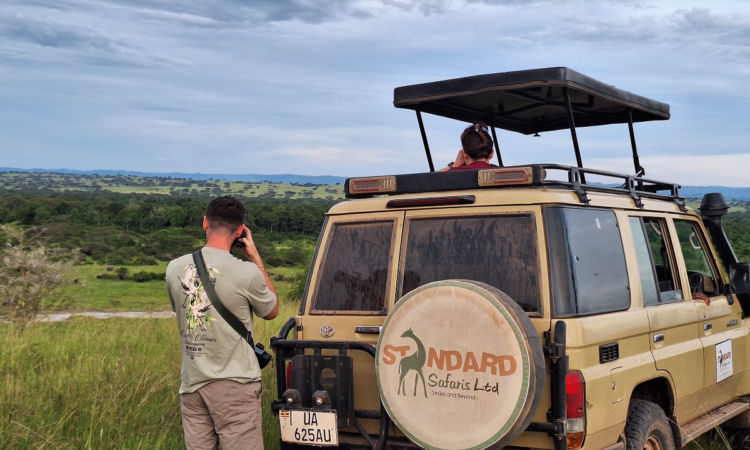
Lush sceneries, vibrant urban life, rich cultures, and unique biodiversity are extraordinary for filming tours in Uganda. The country is home to the iconic mountain gorillas and the Big 5, which offer interesting visuals. Meanwhile Kampala, Jinja, and Entebbe etc. present lively streets where documentaries can explore contemporary urban culture, urban settings and vibrant markets. But, safari filming in Uganda necessitates careful preparations and planning through adherence of the local regulations and guidelines. The following are key,
Filming permits and permissions
Filming tours in Uganda requires that you secure a valid permit, which depends on the filming location, crew size and theme.
Media accreditation; This is obtained from the Media Council of Uganda and highly required for foreign documentary filmmakers in the country. Each member of your crew must complete a form from the Council or Uganda Media Center. These are submitted to the Council along with a scanned copy of the passport biodata page and passport photo. An official letter from your production company is also required to show the project synopsis, filming locations, dates and crew roles. You will be charged a fee that depends on the period of filming. Your permit is processed after a period of between 2 to 5 working days.
General Filming Permits; these depend on whether your filming is in urban, rural or public spaces. In cities and municipalities, permission to film is from the respective City Authorities or Municipal Councils. Meanwhile municipal authorities offer permits for other towns. Permission to film in rural areas, involves the Resident District Commissioner and the Uganda Police Force. Obtaining this is after submission of a passport photo and a formal letter. The latter should have details about your filming project, filming date, filming location, and crew details. Duration of processing is around 1 week.
Uganda Wildlife Authority Filming Permits; offered for filming documentaries inside national parks and game reserves. Also they are necessary for filming wildlife species like gorillas, chimpanzees, lions and leopards etc. The process to obtain this permit involves submission of an application comprising details of the project, park, wildlife, crew size and equipment. The Uganda Wildlife Authority responds by issuing a filming contract or a Memorandum of Understanding. Permits for filming gorillas and chimpanzees are quite special and must be got in advance.
Kit Customs Clearance
Since Uganda is not a Carnet country, it does not accept ATA Carnets or any International Customs documents. Therefore, temporary importation of your equipment requires a Temporary Import Permit also known as (TIP). To do this you will have to use your licensed clearing agent or your film fixer. Provide a detailed list of all your equipment including cameras, lenses, drones, tripods etc. all having serial numbers and declared values. Uganda Revenue Authority then clears. Processing this takes between 3 to 4 working days. Get help from us.
Rules and Permits of filming with drones
It is important to know that filming documentaries using drones in Uganda is allowed though highly regulated. The approval process involves a letter of no objection from the relevant ministry. Another requirement is clearance from the Chief of Defence Forces via Uganda People’s Defence Forces. Also, get declaration from Uganda Revenue Authority for temporary importation and operating permit from Uganda Civil Aviation Authority. Submit technical specs, pilot license, medical certificate, insurance and the maps of filming locations to them.
Approval with the Uganda Civil Aviation Authority takes a month while the entire process takes 3-6 months. Hire drones from the local licenced companies instead if this is time consuming. These companies also offer experienced pilots to operate the drones.
Top filming locations in Uganda?
Shoot documentaries of wildlife and landscapes in Queen Elizabeth, Murchison Falls, Bwindi Impenetrable and Kidepo Valley National Parks etc. Documentaries with excellent sceneries can be shot at Rwenzori Mountains, Lake Mburo National Park and Semuliki National Park etc. Capture aquatic birds and water sports on Lake Victoria, Mabamba Bay, Lake Mutanda, Lake Bunyonyi and River Nile etc.
Best time to do filming tours in Uganda
Essentially, filming tours in Uganda happen all year-round without any seasonal shutdowns. However, seasonal variations affect continuity while filming. The country experiences 2 peak seasons annually, you must consider which one is best for you. There is the dry season and the wet season, both offering unique filming tour experiences. During the dry seasons, Uganda often receives less rainfall compared to the wet season. This reduces vegetation density in the nature destination to allow clear views of wild animals.
With low chances of rainfall, there is no interruptions yet under clear skies while safari filming. Wildlife in nature sites mostly concentrate around the few water sources left due to the dry period. Also, the relatively passable access roads present dry and less slippery surfaces compared to the wet season. Therefore, to film in Uganda during the dry season, you must visit from June to September. Another relatively dry period is from December to February.
Filming tours in Uganda during the wet season occur between March to May and also from October to November. Expect heavier and more frequent rains while filming during the wet season. Plus, access roads to nature sites are muddy therefore caution while driving is important. With heavy nimbus clouds in skies almost each day, visibility during filming is lowered. Nevertheless, the dense vegetation cover caused by heavy rains is perfect for creation of marvelous backdrops. Also the destinations host smaller crowds and lots of migratory birds this time.


