
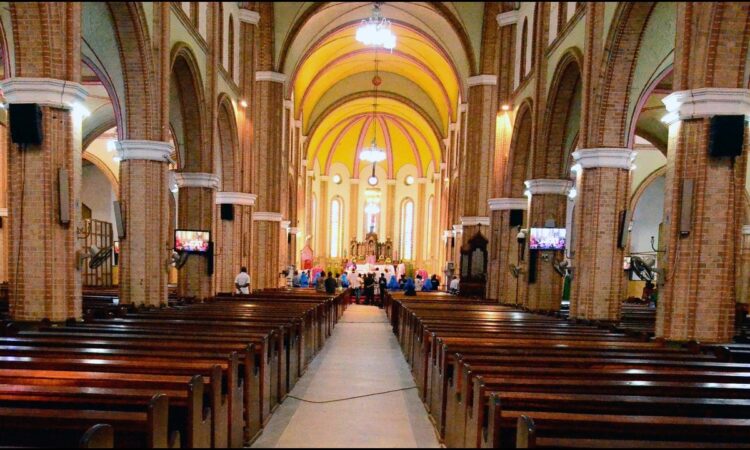
All religious churches to visit in Kampala offer their believers opportunities to gather in harmony to worship their respective creators. Whether you wish to enrich your own spiritual life or simply explore these sites divinely captivate you supernaturally. Their construction demonstrates distinct architectural designs, also a reflection of their origin and rich history. Visitors from all religions, tribes, race and creed among others come to explore these churches all year-round. These are some of the key religious sites to visit in Kampala,
Rubaga Cathedral
Rubaga Cathedral on Rubaga Hill by road takes just around 6 kilometers from the Kampala city center. Also known as St. Mary’s and Sacred Heart Cathedral Rubaga, constructed between 1914 to 1924. The 10-year period resulted from interruptions faced during World War 1. Especially reduced finances. Its architectural design was adopted from Normandy, France by Architect, Brother Gilbert. This building measures 260 feet in length, 63 feet wide and 50 feet high, from the floor to the ceiling.
Rubaga Cathedral was once a home to the first Catholic missionaries in Uganda. Now the cathedral accommodates around 5,000 people. As you explore, get some knowledge about the church’s long history. Explore the remains of Joseph Kiwanuka, the first African Catholic Bishop, as well as the first African Archbishop of Kampala Archdiocese. On record, Rubaga Cathedral hosted 3 popes, who include Pope Paul VI in 1969, and Pope John Paul II in 1993. This makes the cathedral among the best religious churches to visit in Kampala.
Records and some photos of the archbishop and his predecessors can be seen in a guided tour. These include Dr. Cyprian Kizito Lwanga, Emmanuel Wamala and Emmanuel Nsubuga etc. Get information about their lives and how they shaped the future of the Roman Catholic faith among Ugandans. Also, in the compound get views of Kampala city, with its many towering buildings and the busy streets. There is a giant statue of the Virgin Mary that overlooks the city. You can make your prayers and take photos from here.
Namirembe Cathedral
It is such an iconic site with its rich religious and historical significance to the Anglican Church of Uganda. Namirembe Cathedral sits on Namirembe hill and just less than 3.4 kilometers from the Kampala city center. Also known as St. Paul’s Cathedral this is the oldest of its kind in Uganda, with a long history since 1890. Moreover, its construction happened between 1915 and 1919 with materials composed of earthen bricks and its roofs made of earthen tiles. The beautiful architectural design is not the only unique aspect at Namirembe Cathedral.
Visitors love to explore a range of things with historical and religious significance. For example, the tombstone that contains containing Bishop James Hannington’s remains. Bishop Hannington, the first Anglican Bishop in Uganda became a martyr after his murder in 1885 at the age of 38. This happened in Bunya, Busoga under the orders of Kabaka Mwanga II. Each year on Martyrs Day, Bishop James Hannington is remembered as one of the first martyrs in Uganda.
In the graveyard remains of the cooks who built Mengo Hospital exist. In a guided tour get firsthand information about how Namirembe Cathedral serves as the provincial cathedral of the Church of Uganda. Another highlight at the destination includes the clear views of Kampala city from the cathedral’s compound. Enjoy reading records of the past and present leadership. Join other Anglicans for prayers this Sunday because this is among the best religious churches to visit in Kampala.
Baha’i temple
Find this ubiquitous temple on Kikaya Hill in the outskirts of Kampala and just 7.4 kilometers from the city center. The Bahai’ temple sits on 8.5 acres of land near Kisaasi. It is a continental temple in the whole of Africa thus among the most unique religious churches to visit in Kampala. Visitors gain insight in the founder, Baha’u’llah and other notable historical aspects of the Baha’i faith. For example, learn more about the origin of the Baha’i faith in Persia (present day Iran) since the mid-nineteenth century.
The Baha’i community in Uganda started in 1951 with the arrival of a group of friends from Iran and United Kingdom. They introduced the teachings of the Baha’i faith to the locals, and captured the attention of 4 local friends. These grew to around 200 people by the end of 1952. Come 1952, establishment of the first local administrative body, the Local Spiritual Assembly of the Bahai’s of Kampala became successful. In 1956 the first Regional Spiritual Assembly that comprised Uganda, Kenya, Ruanda-Urundi, Belgian Congo, Comoros Islands and Seychelles formed.
At the temple, learn about how the Baha’i community played an immense role to enhance the livelihoods of Ugandans. Exploration of the House of Worship offers a glimpse into one of Uganda’s unique architectural designs. This circular building looks really beautiful to capture on a photograph. In the very wide compound, enjoy the cool fresh air. Numerous birds visit the site for plenty of species to identify. Monkeys still thrive here for people to watch them high up in the trees.


