
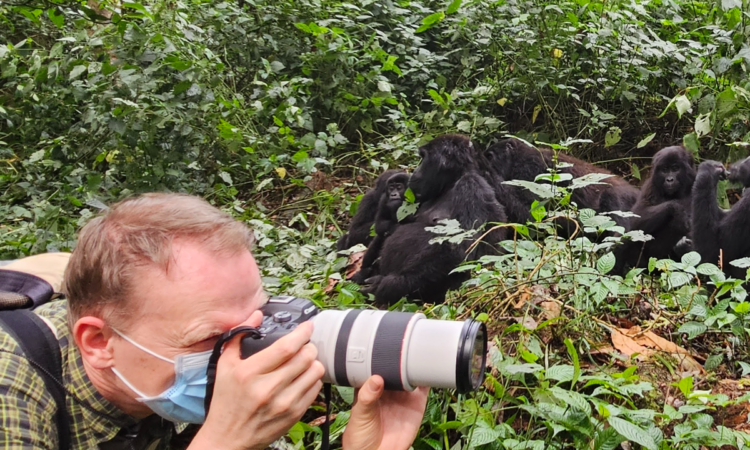
This is a complete guide to Rwanda gorilla photography safari. It describes the tips for a successful safari, specifics, ethical considerations while on the safari, camera equipment and technical considerations. In the end we shall highlight the post-processing for photography safaris and the best time to do this activity.
Tips for a Rwanda Gorilla Photography Safari
Before you even travel to Volcanoes National Park you must have a clear understanding of the gorilla trekking codes of behavior. Secondly, you and your crew should clearly understand the various techniques used to capture photos in a dense forest. This implies that your photography equipment should be capable of working effectively under low light and humid places. While you capture photos, you need to respect wildlife protection guidelines. These are provided to you by the park rangers.
Photography Specifics for Gorillas
Maintain at least 7 meters from the mountain gorillas to avoid stress. You will need telephoto lenses if you want to achieve intimate portraits while respecting the safety guidelines. This is important in protecting both you as the photographer and the mountain gorillas from either stress or disease spread.
It is prohibited to utilize flash photography because the gorillas might get frightened by it. This also disrupts their natural behavior, thus you must be capable of using a variety of suitable light techniques and high-ISO performance. With this you can achieve exposed images in a dense forest properly.
Shoot your photos in silent mode to minimize camera noise that could otherwise disturb gorillas. Do behavioral photography to capture behaviors like feeding, grooming, family dynamics and interactions. These narrate issues regarding gorilla society as you create images that engage people emotionally to foster conservation messaging.
Gorilla photography composition techniques use natural frames that are created by the vegetation in the forest. This captures environmental portraits to help reveal gorillas in their habitat, and focus on their eyes and expressions. These surely create emotional connections with many viewers.
Ethics and Conservation during Photography
As you enjoy any of the Rwanda gorilla photography safaris, emphasize ethical standards throughout. Shoot images while you aim to conserve the wildlife and its environment, Volcanoes National Park in this case. Meanwhile, your practices should be done in such a way that respects communities adjacent to Volcanoes National Park. To promote gorilla conservation, understand their behavior and avoid disturbing them with actions that cause stress. Do not get too close to them or talk loudly, or use flash photography etc.
Efforts to preserve the forest include walking on designated gorilla trails to avoid damages to the vegetation. Also, while capturing your photos and videos, do not leave any material that you came with to the forest. This preserves the natural homes of the mountain gorillas for both the present and future generations. By the way, this happens without compromising access to photography. Such a practice is also good to ensure that future visitors find the forest in perfect conditions, without pollution.
Ethical Rwanda gorilla photography safaris also brings tangible benefits to the communities around Volcanoes National Park. Other than exploiting the ignorant ones, compensate them appropriately for their involvement in photography. While interacting with the people, respect them, regarding their beliefs, cultures, and others. This also applies to image the time of sharing their images. Do it in such a way that does not harm their interests but rather beneficial.
All your images should be compelling enough, yet with wonderful conservation messaging attached. This encourages viewers to help in the protection of gorillas while conserving Volcanoes National Park and the environment in general. The result of this is many people joining in to show care for Rwanda’s natural heritage. In the meantime, conservation initiatives and organizations gain more support through these efforts.
While sharing the images, you have the solely responsible to include accurate captions and appropriate attributions. Do not misrepresent the behavior of gorillas or any other wildlife by presenting them in a sensationalized way. Always maintain their educational value and support for conservation.
What are the Camera Equipment?
As you plan your Rwanda gorilla photography safaris, ensure that you have a clear understanding of essential equipment. For instance, your camera body should be waterproof. Since this safari is in the forest, the camera should have good high-ISO performance necessary for low-light shooting. The autofocus systems of the camera should be fast enough for wildlife photography. It should possess full-frame sensors to perform better in low-light.
The camera should also have crop sensors to provide effective focal length multiplication for wildlife photography. In addition, you should select lenses that balance versatility with the quality of the wildlife image. Use telephoto lenses for this type of photography because it provides wide-angle lenses that also include landscapes or environmental portraits. Basically use a 70-200mm f/2.8 lens for the gorilla photography safari because these allow you to get excellent versatility.
Travel with macro lenses to get close-up photos of the gorillas and small details such as the nose and eyes. This adds diversity to the photographic portfolio and also showcases Rwanda’s natural wonders. You might as well travel with support equipment such as tripods, monopods and bean bags etc. It is possible to get the sharpest images in a dense jungle with these. Meanwhile, the stability for the long telephoto lenses and low-light photography is achieved.
What are the Technical Considerations?
Have a professional understanding of the camera settings, lighting conditions, and environmental factors to maintain the best quality of the image. This is very essential because Volcanoes National Park offers diverse habitats and vegetation that can cause several technical challenges. To use your camera in low light, you must have mastered high-ISO performance. Know all the noise reduction techniques and use of appropriate shutter speeds to balance image sharpness and appropriate noise levels.
Every modern camera mostly works well at ISO 3200-6400, which is something good for efficient handheld photography in the forest. There is a chance that you might find the gorillas at the edge of the forest. Alternatively, the weather might be variable thus offering inconsistency in lighting. For these cases, you must understand how exposure compensation works. In addition, you need to be knowledgeable about spot metering and histogram interpretation if you want to achieve properly exposed images.
Instead of using automatic settings you must know how to use custom white balance settings for a more accurate color reproduction. This is because forest canopies can create color casts that need to be adjustments.
Another consideration is using the focus techniques for gorilla photography. Possess knowledge on autofocus modes, focus tracking systems and manual focus techniques. This is for low-contrast environments, when attempting to photograph through vegetation. Autofocus often struggle in such circumstances. Finally, know the depth of field because it affects both the gorilla and landscape photography. A deeper depth of field offers a sharp focus throughout the landscape composition, meanwhile a shallow depth of field isolates the subject from its background.
Post-Processing for Photography Safaris
To optimize the images got from your Rwanda gorilla photography safaris use digital post-processing techniques. This assumes that photography occurred in a forest that offered challenging shooting conditions while maintaining its natural appearance. Use RAW processing advantages to overcome technical problems in the forest such as mixed lighting. It is achieved through more flexibility for exposure correction, white balance adjustment and noise reduction.
High-ISO photos captured in low-light need the latest noise reduction software, that will also maintain the best image quality. Forest canopy or hazy atmosphere in Volcanoes tend to cast color to affect color accuracy upon original shooting. You can use color correction techniques to address these issues and ensure the final images still maintain a natural look. Also, employ the use of sharpening techniques to optimize the clarity of the gorillas and its surroundings. This results in output formats that range from web display to large print production.
Best time for Rwanda Gorilla Photography Safaris
Firstly, Rwanda gorilla photography safaris are offered throughout the year. But, there is an optimal time of the year where excellent photography is achieved. The dry season is the best since quality gorilla photography depends on clearer skies to enhance light. Meanwhile, when vegetation cover is not so dense, gorillas can be fully visible and captured properly. Also, you need to feel comfortable while you walk in the forest, hence need for the gorilla trails to remain drier.
In the dry season, humidity is quite low compared to the wet season to ensure comfort while shooting. June to September is a dry season where you get clear views, low chances of rainfall and less dense vegetation. Rain does not fall as heavily or frequently than in the wet season.
Building a Rwanda Photography Portfolio?
To create a comprehensive photography portfolio from Rwanda, you must plan diverse subjects. Also, you must get a clear understanding of the principles of storytelling. Lastly, develop the technical skills to highlight Rwanda’s beautiful natural and cultural diversity. You as the photographer should include the gorilla, landscape, cultures and local people’s stories in the subject diversity. This offers a comprehensive representation of the country’s attractions while demonstrating its versatility and storytelling capabilities in terms of photography.
Master a wide range of photographic techniques for several subjects and conditions. Meanwhile strive to maintain quality standard in a consistent basis to support professional presentation and conservation messaging. A portfolio presentation must have some considerations. These include sequencing images effectively, appropriate context and captions, and selection of presentation formats that maximize visual impact. Meanwhile, ensure to support the promotion of conservation.


