

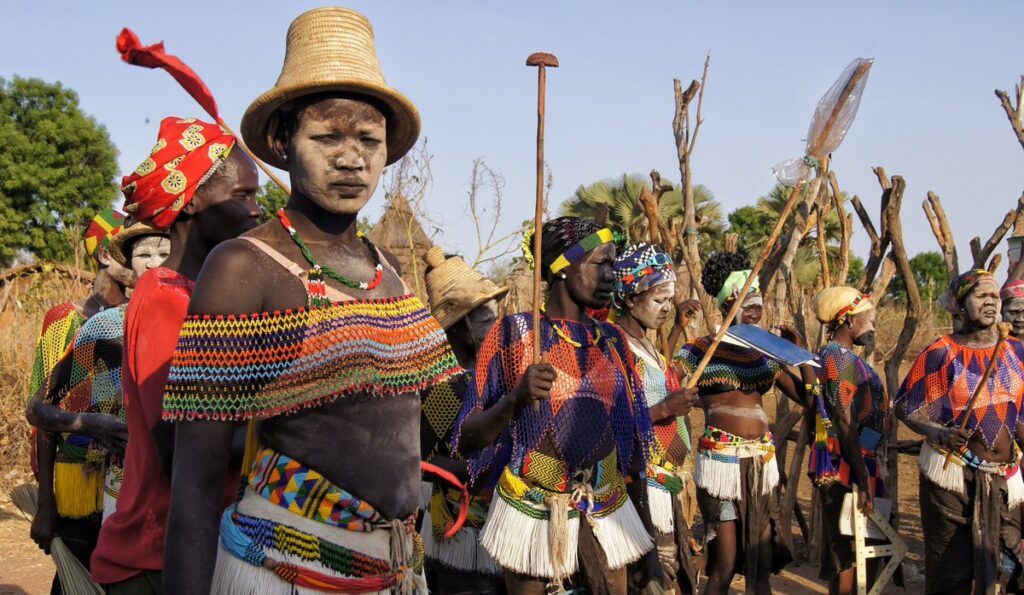
When you ask the most culturally rich and persistent ethnic group in South Sudan what comes to the minds of passionate travelers, especially those into the region’s deep culture, it is the ethnic community of the Anuak, also known as Anyuak. The deeply rooted community consists of about 350,000 to 400,000 that find home in different parts of the fertile riverine in the Upper Nile state. They are especially in areas of Akobo and the Sobat River basin, with some communities stretching to the border of Ethiopia.
Their identity is deeply anchored in rivers that sustain their way of life. A big number of them are farmers, hunters, and fishermen, who are intimately tied to their environment. Despite the fact that their neighbors are pastoralists who entirely rely on cattle, the Anuak people are different and traditionally regard themselves as agriculturalists, farming crops along the riverbank. This way of life has led to strong social organizations and deep spiritual beliefs, making them one of the most river-oriented communities on the land of South Sudan.
The historical background of the Anuak People.
The Anyuak or Anuak community originates from the migrations of the Nilotic people. Many believe that the ancestors moved from the Upper Nile regions before they could finally settle in the fertile floodplains where they could farm comfortably. Historically, they are renowned for their interactions with neighboring ethnic groups like the Dinka, Nuer, and Ethiopian communities.
The 20th century brought many conflicts that trapped many Anuak people and later led to the split of Sudan into 2 including South Sudan. The persistent political instabilities, continuous civil wars, and fights over who should own resources left many without their homes, livestock, and families.
Such disputes have left a heavy toll in many parts of South Sudan but at least led to the detailed Peace Agreement of 2005 and the independence of South Sudan in 2011. This later brought hope, even though the civil wars in 2013 again led to the destruction of many Anuak villages, leading to widespread loss of life.
Despite these struggles, the Anuak have maintained a strong sense of cultural identity, making them one of the most resilient local groups in the country. Their language remains vibrant, and their traditions have continued to guide community life even in hardship situations.
Cultural practices and the traditional life of the Anuak people.
What has made the Anuak people so popular is how they are deeply connected to the rivers. To them, fishing is a means of culture and a promising economy. They are renowned for their extraordinary traditional fishing practices, such as using traps and fish nets while they work hand in hand to maximize the outcomes. Agriculture here is similarly vital; many Anuak communities continue to cultivate sorghum, beans, millet, maize, and vegetables in the rich fertile soils that have been caused by annual floods. In an environment where the well-being of the locals and good food are not guaranteed, a combined economy like this allows them to survive.
When it comes to the social organization of the Anuak people, age and clan play a significant role. Respected elders guide and sometimes determine community decisions, while they are also looked up to in mediating conflicts and are exemplary. Marriage here is highly valued, and it involves negotiations and dowries, ensuring there is a strong bond between clans and families.
The spiritual side of the Anuak community is deeply rooted, and the ancestral spirits and natural forces are considered real and respected. Rivers are seen as living natural endowments with spiritual power. Many rituals continue to be carried out so as to ensure offerings of favorable rains, successful fishing, and protection from harm and enemies. Specific hairstyles, beard work, and body art carry deep symbolic meanings like age and achievements.
Challenges currently faced by the Anuak people.
Over the past decade, the resilient community of Anuak people has encountered numerous hardships. From the 2013 civil conflict in many parts of the Upper Nile characterized by intense violence, displacement of local people, and destruction of homes, to other multiple struggles. The Anuak have since been forced to return to the refugee camps in some parts of Uganda and Ethiopia, where large refugee camps continue to reside. Those that have chosen to stay have faced various difficulties like inadequate food, loss of their cattle, and endless violence.
To date, continuous fights over land, water sources, and fishing fields still escalate, and the discovery of oil and other resources in the region has also contributed to the persistent internal conflicts. Unbearable weather conditions have also affected the Anuak people, especially through floods and drought that later make survival activities like traditional farming and fishing entirely challenging. Despite all the struggles, the Anuak people continue to show remarkable resilience. They have established a strong identity where they’ve preserved their language intimately while they continue to advocate for peace at home.


