
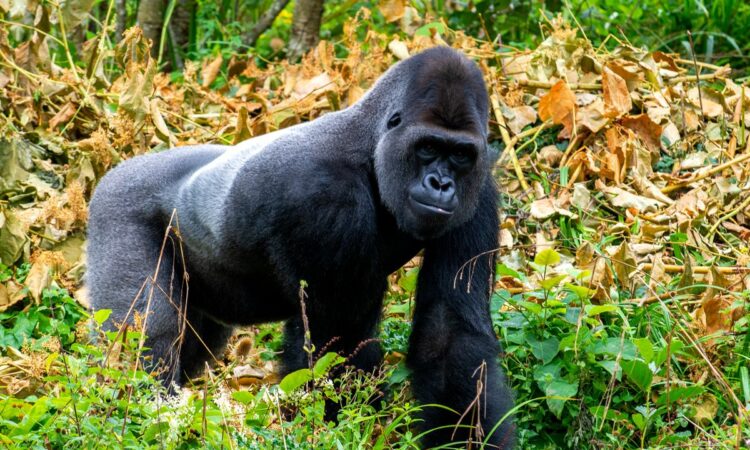
A question is often asked about why do you need to see African silverback gorillas in Uganda? There are several answers to that and one of them is that you can only see these, particularly mountain gorillas in the wild. These are authentic experiences. Other reasons are that Uganda offers both gorilla trekking and gorilla habituation experiences to see the silverbacks. Gorilla permits are also obtained at reasonable costs compared to Rwanda, yet the experience is also great. Uganda has a half of the total mountain gorilla population throughout the world thus a great chance of seeing them.
Silverbacks can be seen in 2 destinations, Bwindi and Mgahinga national parks. With these destinations you have options to choose where you can see the silverback from. Regarding the African silverbacks, these are mature adult male gorillas with a characteristic distinct saddle of silver-grey hair across their backs. They typically develop this at age 12. Some of the silverbacks in Uganda include Mucunguzi, Magara, Christmas, Binyindo, Kaharata, Rurehuka, Mahaane, Mutatina, Mugisha, Bahati and Muyambi etc.
Where can I see African Silver Back Gorillas?
African silverback gorillas in Uganda live in the jungles of Bwindi Impenetrable National Park and Mgahinga Gorilla National Park. Both of these national parks are found in Uganda’s southwest. Bwindi, the lushest of the 2 national parks is at the edge of the Albertine Rift Valley, occupying 321sq.km. This is a World Heritage Site that was gazetted as a national park in 1991. With 459 mountain gorillas living inside the park, it is no wonder among the best places to see these apes. There are 22 habituated gorilla families, each headed by a silverback that you can see during a visit.
Mgahinga is smaller than Bwindi, in fact it is the smallest national park in Uganda with a size 33.7sq.km. The destination became a national park in 1991. It is situated in the Virunga area and has 3 of the 8 volcanoes found there. These are Sabyinyo, Muhabura and Gahinga. A lot of gorillas are found on the volcanoes, but the park has only 1 habituated gorilla family. Regardless of the quantity, you can track this gorilla family every day to see the African silverback gorilla. Here, a more intimate gorilla trek is had because they are the least trekked among the Ugandan gorillas.
How can I see African Silverback Gorillas?
The African silverback gorillas can be seen either during a gorilla trekking tour or gorilla habituation experience. In a gorilla trek, you start at 8:00 a.m. with a briefing at the park headquarters or the trailhead. Here you actively engage with the park authorities who clarify on how to track and see a gorilla family peacefully. You are allowed to even ask questions about the habituated gorilla family you are going to trek. When you enter the forest, they ensure that you are not more than 8 visitors to track the gorilla family.
They guide you in the forest, as you search for clues about the gorilla family’s whereabouts. These include seeing the gorillas’ footprints, leftover food, broken twigs, nests and others. After you find the gorillas, get to as close as 7 meters near them to avoid being too close. For 1 hour, you can see how gorillas behave. Watch the mannerisms of the silverbacks and how they lead the family. Return to the trailhead when the 1 hour is done. For a gorilla habituation experience, you will follow quite a similar approach, but start at 6:30 a.m.
Habituators, scientists and ranger guides are there for you to move with while you search for a semi-habituated gorilla family. Spend 4 hours with the gorillas, including the silverbacks, whose mannerisms and behavior here will prove different from the others. Watch and capture photos of the silverback along with his family members. When the hours are up, return to the start to complete the experience. In Uganda, only Bwindi Impenetrable National Park offers gorilla habituated experiences, that start in the Rushaga Gorilla Sector.
How much does it cost to see a silverback?
A silverback can be seen along with the family members it belongs in and the cost is $800 per person. That is for foreign nonresidents, while only $700 per person is required from the foreign residents. Other visitor categories are East African Community and Rest of Africa, required to pay $500 and 300,000 shillings respectively. To see a silverback during a gorilla habituation experience, the cost of the permit is quite higher. You will need to fully pay $1,500, $1,000 and 750,000 shillings for foreign nonresidents, foreign residents/Rest of Africa and EAC respectively.
New rates of gorilla habituation permits have been introduced and will start next year on January 1st. While foreign residents will start paying $1,800 per person, the foreign residents will pay on $1,600 per person. Everyone from the Rest of Africa and the East African Community will continue paying $1,000 and 750,000 shillings respectively. Each and every amount paid is includes park entrance and the services of the ranger guides at either Bwindi or Mgahinga. Part of the money is used for community development contributions.
Are there Discounted Gorilla Trekking Permits in Uganda?
Yes, discounted gorilla tracking rates exist in Uganda. They are however offered for low season gorilla trekking tours. Also, they apply to foreign nonresidents and foreign residents’ categories. Respectively, they are required to make payments of $600 and $500 per person. Only the months of April, May and November are these rates offered. Contact us for more information about this and how you can acquire your gorilla trekking permit. With us, seeing the African silverback gorillas is memorable, and you can read the testimonies of our previous clients on our TripAdvisor page.


